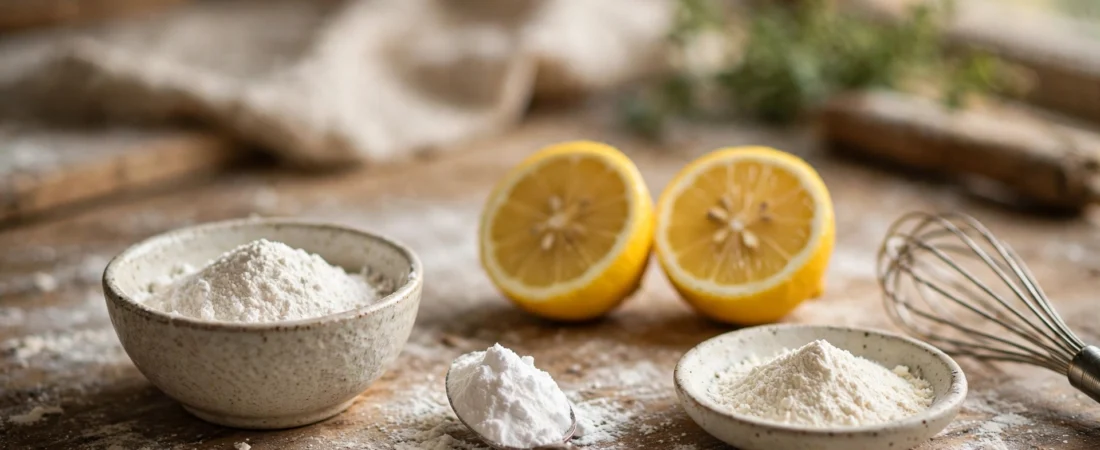
You’ve got the butter creamed, the sugar in, the eggs cracked — and then you reach for the baking powder and find an empty tin. Don’t bin the batter. A baking powder substitute is one of the easiest swaps in the kitchen, because baking powder is just baking soda with its own acid built in. Give the soda an acid from your cupboard and you’ve rebuilt it in seconds.
The one thing you can’t do is use baking soda on its own, one for one. Baking soda is roughly three to four times stronger than baking powder, and without an acid to react with it just sits there making your cake taste soapy and flat. Every swap below pairs a small amount of soda with an acid — and if you want the same quick ratios for other ingredients, our ingredient substitute finder covers them all.
The short answer: three swaps that work
If you’re in a hurry, here’s the whole article in one table — every ratio replaces 1 teaspoon of baking powder.
| Swap | What to use per 1 tsp baking powder | Best for |
|---|---|---|
| Baking soda + cream of tartar | ¼ tsp baking soda + ½ tsp cream of tartar | Cakes, cookies, biscuits — the closest match |
| Baking soda + lemon juice or vinegar | ¼ tsp baking soda + ½ tsp lemon juice or white vinegar | Pancakes, waffles, quick breads |
| Baking soda + buttermilk or yoghurt | ¼ tsp baking soda + ½ cup buttermilk or plain yoghurt, swapped for ½ cup of the recipe’s liquid | Pancakes, muffins, scones, chocolate cake |
Scale up by multiplying: 2 teaspoons of powder needs ½ teaspoon of soda plus 1 teaspoon of cream of tartar. One warning applies to all three — homemade substitutes are single-acting, while shop-bought baking powder is double-acting. Your swap starts fizzing the moment it gets wet and won’t give a second lift in the oven, so get the tin in straight away.
Why baking soda on its own won’t do it
Baking powder is three things in one tin: baking soda (the base), a dry acid (usually cream of tartar), and cornflour to keep it dry. Add liquid and the acid and base react, releasing carbon dioxide bubbles that lift the batter; add heat and a second reaction kicks in — the “double-acting” part — so a cake keeps rising in the oven.
Baking soda is just the base on its own. It needs an acid to wake it up. Drop it into a plain batter with nothing acidic and you get almost no bubbles, plus a yellowish tinge and a bitter, soapy aftertaste that no amount of icing will hide. The recipes where soda works solo — gingerbread, chocolate cake, anything with buttermilk or honey — already contain an acid.
1. Baking soda + cream of tartar — the closest thing to the real stuff
This is the one to use when it matters. Cream of tartar is potassium bitartrate, the same dry acid that’s already inside commercial baking powder, so mixing it with soda is literally rebuilding baking powder from its own parts. King Arthur Baking and several university extension services give the same ratio.
Per 1 teaspoon of baking powder, mix ¼ teaspoon of baking soda with ½ teaspoon of cream of tartar.
Whisk them together before they go near the flour — a clump of either will leave a sour or bitter pocket in the finished bake.
It works in pretty much everything: sponge cakes, fairy cakes, cookies, scones. The flavour is neutral, which is why it beats lemon juice in a delicate vanilla cake.
Making a big batch? Mix a jar of your own: 1 tablespoon of baking soda to 2 tablespoons of cream of tartar, plus a tablespoon of cornflour, stored airtight. It’ll keep for months and costs a fraction of the shop-bought tin.
2. Baking soda + lemon juice or vinegar
No cream of tartar? Look in the fridge. Lemon juice and white vinegar are both strong enough, and most kitchens have one within arm’s reach.
Per 1 teaspoon of baking powder, use ¼ teaspoon of baking soda plus ½ teaspoon of lemon juice or white vinegar.
Stir the soda into the dry ingredients and the acid into the wet ones, then combine and bake immediately. If your recipe already has a fair amount of liquid, you can reduce it by that half-teaspoon — in practice, half a teaspoon is so little that most batters won’t notice, but it’s good practice in a delicate sponge.
This swap shines in pancakes, waffles, and quick breads, where a faint tang is either welcome or invisible. It’s less ideal in a plain vanilla cake, where you might catch a whisper of lemon or vinegar in the crumb. White vinegar is the safer choice there — it has no flavour of its own once baked, while lemon juice will leave a citrus note whether you want one or not.
One thing to watch: don’t be tempted to add extra acid “to be safe.” Too much acid makes the batter over-acidic, which can collapse the crumb and leave a sharp taste. The ratio is the ratio — a quarter-teaspoon of soda needs half a teaspoon of acid, no more.
3. Baking soda + buttermilk or plain yoghurt
This is the swap for batters that already contain milk. Buttermilk is naturally acidic, and so is plain yoghurt, which means they can supply the acid while also replacing some of the liquid in the recipe.
Per 1 teaspoon of baking powder, use ¼ teaspoon of baking soda plus ½ cup of buttermilk or plain yoghurt — and take ½ cup of liquid out of the recipe somewhere else.
That last part matters. If you just add half a cup of buttermilk on top of the milk the recipe already calls for, you’ll end up with a runny batter and a dense, soggy bake.
It works beautifully in pancakes, muffins, scones, and chocolate cake, where a bit of tang helps. Buttermilk gives chocolate cakes a deeper flavour and softer crumb, which is why so many of those recipes already pair it with soda. If you’re out of buttermilk too, our guide to buttermilk substitutes covers how to make a quick stand-in from milk and lemon juice in about ten minutes.
If your recipe already contains buttermilk: every half-cup of it can carry a quarter-teaspoon of soda. So a pancake batter with a full cup of buttermilk can handle half a teaspoon of soda in place of two teaspoons of powder, and you don’t need to add any extra acid at all.
Two more options when the cupboard’s really bare
Self-raising flour. If you’ve got a bag of self-raising flour, you’ve already got baking powder — it’s just hiding in the flour. Self-raising flour is plain flour with baking powder and salt mixed in, roughly 1½ teaspoons of powder per cup. Swap it cup for cup for the plain flour in your recipe, and leave out both the baking powder and the salt. This works best when the recipe calls for somewhere between half a teaspoon and a teaspoon of baking powder per cup of flour; much more than that and the flour won’t have enough lift on its own.
Whipped egg whites. This one is the last resort, and it’s really only for light, airy bakes like sponge cakes and soufflés. Separate the eggs, whip the whites to stiff peaks with a pinch of cream of tartar if you have it, and fold them gently into the batter at the very end. You’re replacing chemical lift with mechanical lift — trapped air instead of gas bubbles. It won’t work for a dense fruit cake or a batch of cookies, but for a Victoria sponge it can genuinely save the day. Our guide to egg substitutes in baking explains what eggs do in a bake, which helps when you’re improvising.
Four mistakes that sink the swap
Using baking soda one-for-one. This is the big one, and it’s the mistake most people make first. A teaspoon of soda in place of a teaspoon of powder is three to four times the alkali your recipe needs. The cake will rise fast, then collapse, and taste like soap. Always divide by four.
Leaving the batter sitting around. Commercial baking powder waits for the oven’s heat before its second burst of lift. Your homemade version doesn’t have a second burst — it starts reacting the second liquid touches it and the bubbles escape within minutes. Pre-heat the oven before you start mixing, grease the tin first, and get the batter in as soon as it’s combined.
Adding too much acid. More acid doesn’t mean more lift. Once the soda is neutralised, extra acid just sits in the batter making it sour and weakening the crumb. Stick to the ratios above, even if it feels like a tiny amount.
Forgetting the liquid swap with buttermilk or yoghurt. Half a cup of extra liquid is a lot in a cake batter. If you don’t take the same volume out elsewhere, you’ll get a heavy, under-risen bake and wonder why the swap “didn’t work.”
Is your baking powder even still alive?
Before you blame the substitute, check the original. Baking powder goes stale — an opened tin loses strength after about six months. Here’s the test: drop half a teaspoon into a mug of hot water. If it fizzes hard straight away, it’s fine. If it barely bubbles, it’s dead, and no amount of careful measuring will save it.
There’s a matching test for baking soda, too: half a teaspoon into a splash of vinegar. Fizzing means it’s still good; silence means it’s time for a new box. Both tests take ten seconds, and a stale tin is the most common reason a good recipe comes out flat.
Frequently asked questions
Can I use baking soda instead of baking powder?
Yes, but never on its own and never one-for-one. For each teaspoon of baking powder, use ¼ teaspoon of baking soda plus an acid — ½ teaspoon of cream of tartar, lemon juice, or vinegar, or ½ cup of buttermilk or yoghurt with the liquid reduced. Soda alone gives almost no lift and a soapy taste.
What is the best substitute for baking powder?
Baking soda plus cream of tartar, at ¼ teaspoon of soda to ½ teaspoon of cream of tartar per teaspoon of powder. It’s the closest match because it rebuilds baking powder from the same ingredients, and it has a neutral flavour that suits cakes and cookies.
Can I use self-raising flour instead of baking powder?
Yes — swap it cup for cup for plain flour and leave out both the baking powder and the salt. It works best when the recipe needs about half to one teaspoon of baking powder per cup of flour. Recipes needing much more lift will come up short.
Does a baking powder substitute work in cakes?
It does, with one caveat: homemade substitutes are single-acting, so they only lift while the batter is wet. Get the cake into a preheated oven immediately after mixing, and avoid recipes that need a long rest before baking.
How much baking powder substitute do I need for 1 tablespoon?
A tablespoon is 3 teaspoons, so multiply by three: ¾ teaspoon of soda plus 1½ teaspoons of cream of tartar, or the same amount of lemon juice or vinegar.
What happens if I use too much baking soda?
The bake rises too fast, then collapses, and ends up with a bitter, soapy taste and a yellowish crumb. If it’s already mixed in, scale the rest of the recipe up to match — or start again.
The bottom line
Running out of baking powder mid-bake is annoying, but it’s one of the most fixable problems in the kitchen. The ratios are the whole game — get them right, work fast, and your cake will never know the difference.
If you hit another empty tin while you’re cooking, our ingredient substitute finder covers dozens of common swaps with the same exact ratios — from buttermilk and eggs to cream and sugar. And if you’re scaling a recipe up or down at the same time, the free recipe serving calculator will do the maths for you so the ratios stay right at any size.