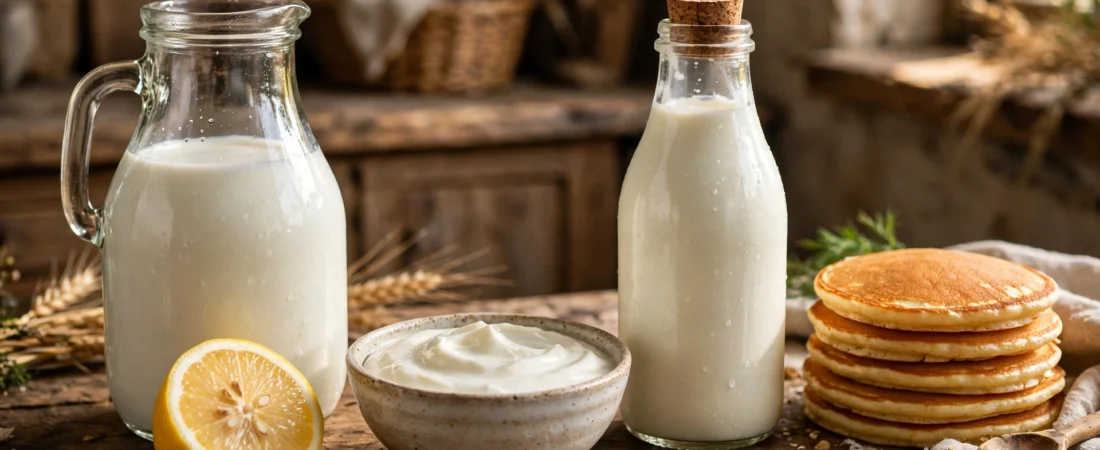
You’re halfway through a pancake batter when you spot it: the recipe calls for a cup of buttermilk, and your fridge has none. Don’t scrap the bake, and don’t just pour in plain milk and hope. A good buttermilk substitute needs to do the same job as the real thing, and most kitchens already hold at least one option that will. This guide covers five swaps that actually work, with exact ratios, so you can pick the right one for whatever you’re making.
Why buttermilk does more than add liquid
Real buttermilk is cultured, which means it’s acidic and a little thick, with a gentle tang. That acidity matters most in recipes that use bicarbonate of soda. The acid reacts with the soda, releasing carbon dioxide, and that’s what lifts a batter that has no baking powder to help it.
Acid also tenderises. It softens gluten and breaks down proteins in a marinade, which is why fried chicken soaked in buttermilk turns out so juicy, and why buttermilk biscuits pull apart in soft layers instead of baking up tough. The tang is the third job, and it’s the one people notice first in dressings and cakes: a plain milk swap tastes flat where buttermilk would have given a faint sour edge. A decent substitute has to cover at least the first two jobs, acidity and tenderness, and ideally the third as well. If you’re stuck for other swaps in the same recipe, try our free substitute finder — it covers far more than dairy.
1. Milk plus lemon juice or vinegar: the five-minute fix
This is the swap most bakers reach for first, because it needs nothing you don’t already own. Pour 1 tablespoon of lemon juice or white vinegar into a measuring jug, then add milk until you reach the 1-cup line. Stir once and leave it for five to ten minutes. You’ll see it thicken slightly and curdle in small flecks. That’s the sign it’s ready, not a sign it’s gone off.
Use whole milk if you can. Skim milk will still acidify, but the result is thinner and the finished bake loses a bit of richness. Lemon juice gives a faint citrus note that suits pancakes, muffins and lemon drizzle cakes; white vinegar is more neutral, so it’s the better pick for savoury batters, biscuits and cornbread.
Scale the ratio the same way every time: 1 tablespoon of acid per cup of milk. So for half a cup you need 1½ teaspoons, and for two cups you need 2 tablespoons. Don’t be tempted to add extra acid for a stronger effect. Too much will overpower the batter and can leave a sharp, almost metallic taste in a delicate sponge.
One honest caveat: this swap copies buttermilk’s acidity, not its full flavour. In a recipe where buttermilk is a background player, like a chocolate cake or a batch of muffins, nobody will notice. In a recipe where it’s the star, like a buttermilk dressing, you’ll taste the difference, and one of the cultured swaps below will serve you better.
2. Yoghurt thinned with milk
If there’s a tub of plain yoghurt in your fridge, you’ve got a stronger substitute than soured milk. Yoghurt is already cultured, so it brings real tang as well as acidity, and it gives batters more body. The catch is thickness: straight yoghurt is far thicker than buttermilk, and using it neat will make a batter too stiff and a dough too dry.
For 1 cup of buttermilk, whisk together ¾ cup plain yoghurt and ¼ cup milk until smooth. That thinned mixture pours much like buttermilk and behaves similarly in the oven. Plain yoghurt works at that ratio; Greek yoghurt is thicker still, so loosen it a bit more, roughly ⅔ cup Greek yoghurt to ⅓ cup milk, and whisk out every lump before it goes near your flour.
Use plain, unsweetened yoghurt only. A flavoured or sweetened tub will throw off both the sugar and the flavour of the recipe, and low-fat yoghurt is fine here — the milk you add back keeps the texture right. This is my pick for biscuits and scones, where the extra body helps the dough hold its shape, and for coffee cakes, where the tang sits nicely against a sweet crumb.
3. Sour cream thinned with milk
Sour cream follows the same idea as yoghurt, just richer. It’s cultured, it’s tangy, and it’s thicker than buttermilk, so it needs the same thinning treatment: ¾ cup sour cream whisked with ¼ cup milk gives you 1 cup of substitute. The extra fat is a bonus in rich cakes and coffee cakes, where it adds moisture and a deeper golden crust, but it’s a drawback in lighter recipes. A sponge made with sour cream instead of buttermilk can turn out heavier than you planned, so save this swap for bakes that can carry the richness.
Whisk it properly. Sour cream straight from the fridge holds lumps that won’t break down once flour is in the bowl, and those lumps bake into pale pockets.
4. Kefir, the closest shop-bought swap
Kefir is the one substitute that needs no measuring, no whisking and no waiting. It’s a cultured, drinkable milk, already about the thickness of buttermilk and already tangy, so you use it one-for-one: 1 cup of kefir replaces 1 cup of buttermilk, straight from the bottle. Shake the bottle first, since kefir can separate on standing.
If you keep kefir in the house, this is the swap to reach for first, especially in recipes where buttermilk’s flavour matters. Pancakes made with kefir rise well and taste close to the real thing, and a kefir marinade does the same tenderising work on chicken. If you buy it for this, buy plain, unflavoured kefir; the fruity versions will flavour your batter whether you want them to or not.
5. Dairy-free: plant milk plus acid
A dairy-free buttermilk substitute follows the same five-minute method as the first swap, just with a different milk. Pour 1 tablespoon of lemon juice or vinegar into a jug, add soy milk or oat milk to the 1-cup line, stir and rest for five to ten minutes. Soy milk gives the most reliable results because its protein content is closest to dairy milk, so it curdles and thickens in a similar way. Oat milk is a solid second choice, especially in muffins and quick breads.
Almond milk and rice milk will acidify too, but they’re thinner and lower in protein, so the mixture stays watery and the lift in a soda-raised bake is weaker. If almond milk is all you have, it will still beat plain milk in a pancake batter — just don’t expect the same rise you’d get from soy. As with the dairy version, keep the ratio at 1 tablespoon of acid per cup, and use unsweetened plant milk so you aren’t adding sugar the recipe didn’t ask for.
Which swap should you use for your recipe?
Pancakes, waffles and muffins are forgiving. Any of the five swaps will work, and the milk-and-acid fix is fastest when you’re already mid-recipe. Biscuits and scones reward the thicker cultured swaps — thinned yoghurt or sour cream — because the extra body helps the dough rise in layers instead of spreading. Cakes split by richness: a light sponge or a lemon cake does best with soured milk or kefir, while a coffee cake or a chocolate cake can carry sour cream’s extra fat without turning heavy.
Marinades are a different case. You want real acidity and time, so kefir or thinned yoghurt both work well for chicken, and soured milk will do in a pinch, though it won’t tenderise quite as deeply. Dressings and dips are the hardest test, because there’s no baking to hide behind. There, kefir or thinned yoghurt taste closest to buttermilk, and soured milk tastes noticeably thinner and sharper. If a recipe calls for buttermilk purely as a dressing base, it’s worth using a cultured swap rather than the quick fix.
Mistakes that spoil an otherwise good swap
The most common error is skipping the rest. Soured milk needs those five to ten minutes for the acid to work on the milk proteins; pour it straight into the batter and you get acid without the thickening, and a flatter result. The second error is reaching for the wrong tub: sweetened, flavoured or fruit yoghurt, or a sour cream with herbs, will flavour the whole bake. Check the label before you measure.
A third mistake is doubling the acid to “make it stronger”. Buttermilk is only mildly acidic, and an over-acid batter can taste sharp and collapse after rising too fast. Stick to the ratios above. Finally, don’t swap buttermilk into a recipe that doesn’t call for it and expect magic — adding acid to a baking-powder-only cake can throw off the leavening balance. The swaps here replace buttermilk, they don’t improve recipes that never needed it. If a recipe needs scaling up or down at the same time, our guide to scaling a recipe up or down keeps the ratios straight, and halving a recipe has its own traps, including what to do with half an egg.
Frequently asked questions
Can I use plain milk instead of buttermilk?
You can, but the bake will suffer. Plain milk lacks the acidity that reacts with bicarbonate of soda, so soda-raised batters rise less and can taste slightly soapy. If you have lemon juice or vinegar, spend the five minutes souring the milk — it’s a far closer match.
How much lemon juice do I need for 1 cup of buttermilk?
Use 1 tablespoon of lemon juice or white vinegar per cup of milk, stirred and rested for five to ten minutes. The same ratio scales up and down: 1½ teaspoons for half a cup, 2 tablespoons for two cups.
Is soured milk the same as buttermilk?
No, though it’s a useful stand-in. Soured milk copies buttermilk’s acidity and some of its thickness, but real buttermilk is cultured, so it has a deeper, more rounded tang. In most baked goods the difference is hard to spot; in dressings, it isn’t.
Can I use Greek yoghurt as a buttermilk substitute?
Yes, thinned with milk. Whisk roughly ⅔ cup Greek yoghurt with ⅓ cup milk for each cup of buttermilk needed, until smooth. Plain yoghurt is easier, at ¾ cup yoghurt to ¼ cup milk, because it’s already thinner.
What’s the best dairy-free buttermilk substitute?
Soy milk plus 1 tablespoon of lemon juice or vinegar per cup, rested for five to ten minutes. Soy curdles most like dairy milk; oat milk is the next best choice. Use unsweetened milk either way.
Does a buttermilk substitute keep, or must I use it straight away?
Use it straight away. Soured milk and thinned yoghurt are mixed to order, and they lose their fresh curdle and texture if left standing. Kefir keeps in the bottle as normal, so just measure out what you need.
A swap for every fridge
You don’t need a special trip to the shop to save a buttermilk recipe. A jug of milk and a lemon will cover most bakes in five minutes, a tub of plain yoghurt or a bottle of kefir will get you closer to the real thing, and a carton of soy milk keeps the same trick open for dairy-free baking. Keep the ratios in this guide to hand, match the swap to the recipe, and the missing buttermilk stops being a problem at all. And next time a recipe calls for something you don’t have, try our free substitute finder before you rewrite the menu.