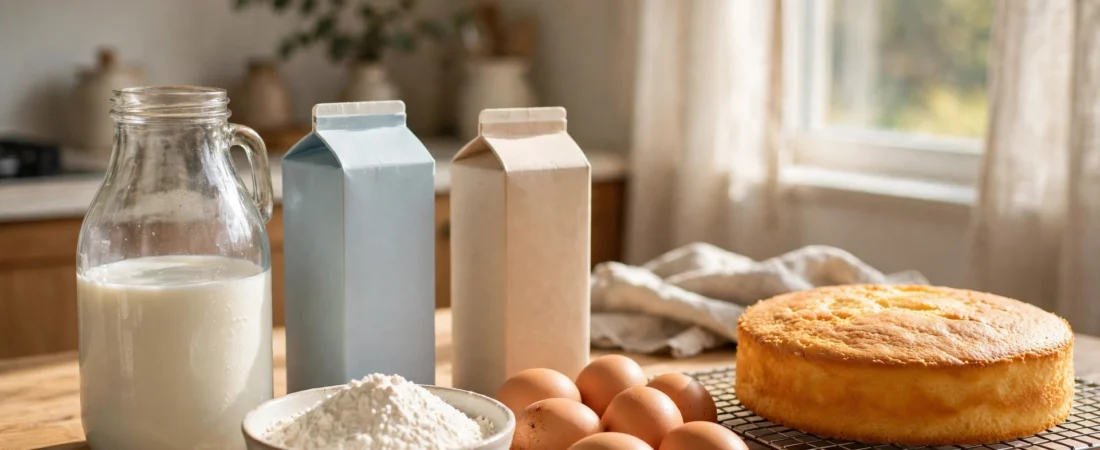
You’re halfway through a cake batter. The eggs are in, the sugar’s creamed with the butter, and then you tip the milk carton upside down and get nothing but a sad little dribble. Or maybe dairy’s off the menu for good, and every recipe you own still calls for a cup of milk. Either way, you need a milk substitute for baking that actually works, not one that turns your sponge into a brick.
What milk actually does in a bake
Before you swap anything, it helps to know what you’re replacing. A cup of whole milk is roughly 244 grams, and it’s mostly water — but the small stuff does the heavy lifting. About 3.5% fat keeps the crumb tender and carries flavour, around 3% protein gives the batter structure and helps it brown, and lactose — the milk sugar — adds gentle sweetness and a deeper golden colour.
That’s why a straight water swap rarely gives you the same cake. Water replaces the liquid, but it brings no fat, no protein and no sugar. The bake still works — it just comes out paler, a touch drier, and a little less rich.
The short answer: what to grab first
If you’re standing in the kitchen right now and the oven’s already hot, here’s the quick version. For a dairy-free swap, reach for unsweetened soy milk. Its protein content — about 7 to 8 grams per cup, nearly the same as dairy milk — is what makes it behave most like the real thing. Cakes rise properly, the crumb sets, and the browning looks right.
If soy’s not in the house, unsweetened oat milk is your next best bet. It’s creamier than most plant milks, with a mild sweetness that suits muffins, pancakes and quick breads — though it browns a little faster, so watch the oven in the last few minutes. Our substitute finder has the full list if you want to compare them side by side.
Dairy-free milk substitutes, ranked for baking
Not all plant milks bake the same way — here’s how the main ones stack up.
Soy milk. The workhorse. Highest protein of any plant milk, neutral flavour, and it curdles nicely with a splash of lemon juice if you need a buttermilk stand-in. Best for cakes, muffins, enriched breads and custards — anywhere structure matters. Use it 1:1, unsweetened. The one caveat is a faint beany note in very delicate recipes, though it usually bakes off.
Oat milk. The crowd-pleaser. Creamy, mild, and barely noticeable in the finished bake. It’s my pick for muffins, pancakes, scones and cookies, where moisture matters more than structure. It contains more natural sugar than other plant milks, so bakes brown faster. Use it 1:1, unsweetened.
Almond milk. The light option. It’s thin — about 1 gram of protein per cup against dairy’s 8 — and very low in fat, so on its own it can leave cakes a little dry and crumbly. It still works well in thin batters, crepes, glazes and recipes where milk is a background player. Using it in a proper cake? Add a teaspoon of oil or melted vegan butter per cup to make up for the missing fat. Use unsweetened, 1:1.
Coconut milk. Two very different products share this name, and mixing them up is the classic mistake. The carton stuff — coconut milk drink — is light, with a gentle coconut flavour that suits tropical cakes and muffins. Use it 1:1. The canned stuff is far richer: full-fat canned coconut milk runs 20 to 24% fat. To stand in for a cup of whole milk, use half a cup of canned coconut milk and half a cup of water.
Rice milk. The thinnest of the lot, and the lowest in protein. It works where you want lightness — a delicate sponge, say — but it won’t support a rich cake on its own. Use it 1:1, unsweetened.
| Substitute | Swap ratio | Best for | Watch out for |
|---|---|---|---|
| Soy milk (unsweetened) | 1:1 | Cakes, breads, custards | Faint beany note in delicate bakes |
| Oat milk (unsweetened) | 1:1 | Muffins, pancakes, quick breads | Browns faster; slightly sweet |
| Almond milk (unsweetened) | 1:1 + 1 tsp oil per cup | Thin batters, crepes, glazes | Low protein and fat; dries cakes out |
| Canned coconut milk | ½ cup + ½ cup water | Rich cakes | Very high fat if used undiluted |
One rule covers all of them: buy unsweetened and unflavoured. Sweetened or vanilla plant milk throws off the sugar balance of a recipe and browns far too fast. You can always add sugar yourself; you can’t take it back out.
Dairy substitutes hiding in your fridge
If dairy isn’t the problem and you’re just out of milk, the fridge probably has something that works. These all keep the flavour profile of the original recipe, which the plant milks can’t quite do.
Evaporated milk is the easiest of the lot. It’s just milk with about 60% of the water removed, so mix it 50/50 with water and you’ve got milk again. A tin in the cupboard lasts for months, which is why it’s worth keeping one around for exactly this situation.
Heavy cream works the other way round: it’s far richer than milk, so dilute it. A quarter cup of cream plus three-quarters of a cup of water gives you a cup of something very close to whole milk.
Half-and-half sits between the two. Mix equal parts half-and-half and water and the fat content lands almost exactly where whole milk sits.
Plain yogurt and sour cream are thicker, tangier options that shine in dense bakes. Use them 1:1 in place of milk in cakes, muffins and banana bread — they add moisture and a lovely tender crumb. Greek yogurt needs thinning first: two-thirds of a cup of Greek yogurt plus a third of a cup of water. Their tang also pairs well with baking soda, which brings us to buttermilk. If a recipe calls for buttermilk, stir a tablespoon of lemon juice or white vinegar into a cup of milk and leave it for five to ten minutes — it’ll thicken slightly and curdle, which is exactly what you want. Our full buttermilk substitute guide covers five ways to do this, including a dairy-free version with soy milk.
The emergency options when there’s nothing milky at all
Sometimes the fridge is bare and the shops are shut. A bake can still be saved.
Plain water is the honest fallback. Swap it 1:1 and the recipe will work — your cake will just be paler and a little less tender. Stir in a tablespoon or two of melted butter or neutral oil per cup of water and you get back some of the richness milk would have brought.
Sweetened condensed milk is the last resort, and it comes with a catch: it’s 40 to 45% sugar. Mix it 50/50 with water, then cut back the sugar in your recipe by roughly a third. It only really makes sense in desserts — don’t try it in a savoury scone.
Matching the swap to the bake
The best milk substitute depends on what you’re making, because different bakes lean on milk in different ways.
Cakes need structure and browning, so soy milk is the safest dairy-free choice. Oat milk is a close second for moist, dense cakes like carrot or chocolate, where its extra sweetness is an asset rather than a problem. Almond milk is the one to avoid in a light sponge; the crumb can turn dry and crumbly without enough protein to hold it together.
Muffins and quick breads are forgiving. Oat milk is my first pick here — it keeps them moist and the faster browning gives banana bread and bran muffins a lovely top. Soy works just as well, and yogurt or sour cream make them richer still. Cookies barely notice the swap either: the milk in a cookie recipe is usually just a few tablespoons to bring the dough together, so any unsweetened plant milk at 1:1 will do.
Enriched breads — brioche, challah, soft dinner rolls — want protein and fat, so soy milk is the pick again. Water works for a lean white loaf, where milk is a bonus rather than a load-bearing ingredient.
Custards and puddings are the trickiest. They rely on milk’s protein to set, so soy milk is really the only plant milk that behaves properly. Oat milk can work in a baked custard if the recipe also has eggs doing the setting, but rice and almond milk will leave you with something that never quite firms up.
Three mistakes that spoil an otherwise fine swap
Most failed milk swaps come down to one of three errors, and they’re all easy to avoid.
The first is reaching for the sweetened carton. Vanilla almond milk in a savoury cheese scone is a flavour disaster, and sweetened oat milk in a cake that’s already got a cup of sugar in it will brown before the middle is cooked. Unsweetened, unflavoured, every time.
The second is forgetting about fat. Whole milk’s 3.5% fat is doing real work in a rich cake, and a swap like almond milk — under 1% fat — leaves a gap. Fix it with a teaspoon of oil per cup, or pick a richer substitute like oat or soy.
The third is the acid balance. Buttermilk isn’t just tangy milk; its acidity reacts with baking soda to make the bubbles that lift a cake. If a recipe was written for buttermilk and you swap in plain milk, you lose that lift. Either use a soured milk instead, or swap the baking soda for baking powder. The reverse is true too: if a recipe calls for plain milk and you use buttermilk, add a pinch of baking soda to neutralise the extra acid. Our baking powder substitute guide explains how the two leaveners relate.
FAQs
Can I use water instead of milk in baking?
Yes, at a 1:1 ratio — expect a paler colour and a slightly drier crumb. A tablespoon of melted butter per cup of water gets you closer to milk’s richness.
What’s the best milk substitute for cakes?
Unsweetened soy milk. Its protein content is closest to dairy milk, so cakes rise, set and brown much like the original. Oat milk is a strong second choice for moist, dense cakes.
Can I use almond milk in baking?
Yes, for light bakes like muffins, crepes and thin batters. For richer cakes, add a teaspoon of oil per cup to replace the missing fat, and always use the unsweetened kind.
How do I make buttermilk from milk?
Stir a tablespoon of lemon juice or white vinegar into a cup of milk and leave it for five to ten minutes. It’ll thicken and look slightly curdled — that’s normal.
Does oat milk make cakes brown faster?
Yes, slightly. Oat milk has more natural sugars than dairy milk, so keep an eye on the oven in the last few minutes and cover the top loosely with foil if it’s colouring too fast.
The bottom line
Running out of milk doesn’t have to mean running to the shops. For most bakes, unsweetened soy milk or oat milk at a straight 1:1 swap will get you a cake nobody can tell apart from the original. If dairy’s on the table, diluted half-and-half or cream is even closer. And if there’s genuinely nothing milky in the house, water with a spoonful of butter will still save the bake.
Next time you’re mid-recipe and short an ingredient, our free substitute finder covers more than milk — from egg substitutes in baking to butter and cream swaps. And if you’re scaling a recipe up or down at the same time, our guide to how to scale a recipe up and down will keep the ratios honest.