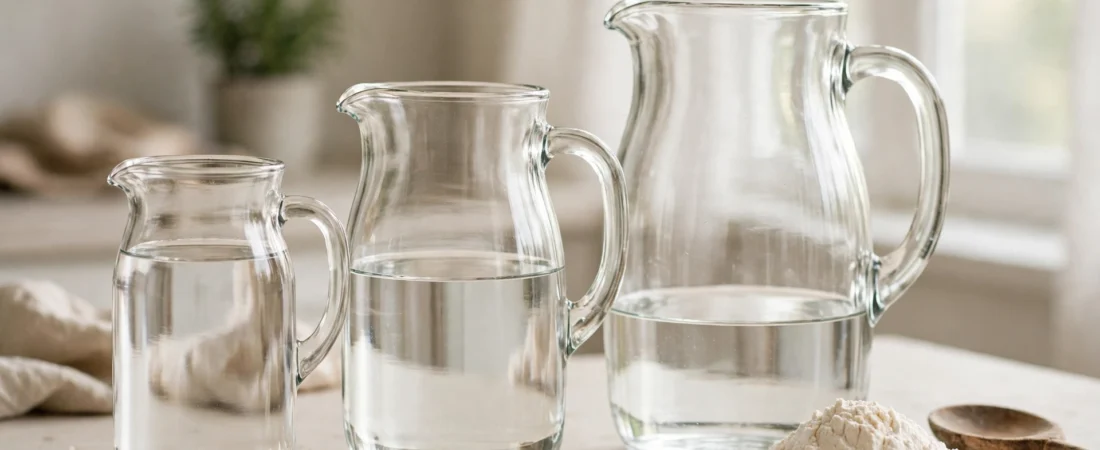
One cup of milk. It sounds like the simplest instruction in a recipe — until the recipe came from Sydney and your measuring cup came from Ohio. So how many ml in a cup? It depends on which cup you mean. A US cup holds 236.6 ml, a metric cup holds exactly 250 ml, and the old UK imperial cup holds 284 ml. That’s a spread of nearly 50 ml between the smallest and the largest, which is enough to turn a sponge cake dense or a pan sauce thin.
The annoying part is that none of these is wrong. They’re three different standards that all happen to share one name, and recipes almost never tell you which one they’re using. Once you know the three numbers and which countries use each, you’ll stop guessing.
The short answer: 237, 250 or 284 ml
If you’re standing in the kitchen right now and just need the number, here it is. A US customary cup is 236.588 ml, which everyone rounds to 237 ml. A metric cup — the one used in Australia, New Zealand and Canada — is exactly 250 ml. And the old UK imperial cup is 284.13 ml, usually rounded to 284 ml.
One more number: on US nutrition labels, a cup is defined as exactly 240 ml — the US legal cup, set by the Food and Drug Administration. That’s why some American sites say 240 ml and others say 237 ml; for cooking, the 3 ml gap is nothing. The gap that bites is the one between countries.
So the rule of thumb: American recipe, 237 ml. Australian or New Zealand recipe, 250 ml. Old British recipe, possibly 284 ml — though, as we’ll get to, modern British recipes barely use cups at all.
Why one word means three different volumes
Cups were in kitchens long before anyone agreed on a global standard, and each country standardised its own version. The American cup comes from fluid ounces: one cup equals eight US fluid ounces, and since a US fluid ounce is 29.5735 ml, the cup lands at 236.588 ml.
Australia, New Zealand and Canada took a different path when they went metric in the 1970s and 1980s: they redefined the cup as a clean 250 ml, exactly a quarter of a litre. Four metric cups make a litre, and the arithmetic is painless. The trade-off is that a metric cup holds about 5.7% more than a US cup — 13.4 ml per cup, roughly a tablespoon.
The British imperial cup is the oldest of the three and the biggest. It’s half an imperial pint, and an imperial pint is 568 ml, so the cup works out at 284.13 ml — ten imperial fluid ounces of 28.413 ml each. It’s about 20% larger than a US cup. That 47.5 ml gap is the one that genuinely wrecks recipes, which is fortunate, because it’s also the cup you’re least likely to meet.
Cups to ml conversion chart
Keep this table open on your phone while you cook. Figures are rounded to the nearest whole millilitre, which is more precision than any jug can deliver anyway — and for an odd amount not listed here, our free unit converter will give you the exact figure.
| Cups | US cup (237 ml) | Metric cup (250 ml) | Imperial cup (284 ml) |
|---|---|---|---|
| 1/4 cup | 59 ml | 63 ml | 71 ml |
| 1/3 cup | 79 ml | 83 ml | 95 ml |
| 1/2 cup | 118 ml | 125 ml | 142 ml |
| 2/3 cup | 158 ml | 167 ml | 189 ml |
| 3/4 cup | 177 ml | 188 ml | 213 ml |
| 1 cup | 237 ml | 250 ml | 284 ml |
| 1 1/2 cups | 355 ml | 375 ml | 426 ml |
| 2 cups | 473 ml | 500 ml | 568 ml |
| 3 cups | 710 ml | 750 ml | 852 ml |
| 4 cups | 946 ml | 1,000 ml | 1,137 ml |
Two rows in that table are worth memorising. Two metric cups are exactly half a litre, and four metric cups are exactly one litre — that’s the whole point of the 250 ml cup. Two US cups are 473 ml, just short of half a litre, and four US cups are 946 ml, just short of a litre. If a recipe says “1 litre of stock” and you’re measuring in US cups, you need about four and a quarter cups, not four.
When the 13 ml difference actually matters
For most cooking, it doesn’t. A soup that calls for three cups of stock will taste the same whether you add 710 ml or 750 ml — that’s a 5% difference in a dish with a litre of liquid in it, and nobody’s palate is that precise. Sauces, stews, marinades and dressings all forgive the gap. If the recipe is a weeknight dinner, use whichever cup you own and move on.
Baking is where it starts to matter, because baking is chemistry with a timer. A cake batter that calls for two cups of milk gets an extra 27 ml if you use a metric cup on a US recipe — a tablespoon and a half of extra liquid. The result is usually a slightly denser crumb and a longer bake, not a disaster, but it’s the kind of thing that makes a recipe feel unreliable. Custards, jam and candy are fussier still: jam needs a precise sugar-to-liquid ratio to set, and candy temperatures depend on the water content, so a 5% error there can be the difference between set and runny.
The rule I use: if the recipe has more than two cups of liquid and precision matters — baking, custards, jam, candy — match the cup to the recipe’s country. If it’s a soup or a sauce, don’t worry about it. Our free unit converter handles cups to millilitres in both directions if you’d rather not do the maths mid-recipe.
The UK cup: real, but mostly history
The 284 ml imperial cup is genuine — it’s in the old measurement tables, defined as ten imperial fluid ounces — but in practice, you can almost forget about it. Britain moved toward metric in the 1970s, and modern British recipes give dry ingredients in grams and liquids in millilitres. A British cookbook published in the last thirty years that says “1 cup” almost certainly means the 250 ml metric cup, if it means a cup at all.
The only place the imperial cup still lurks is old recipes: pre-1970s British cookbooks and handwritten family recipes. If you’re cooking from your grandmother’s sponge recipe and it says “one cup of milk,” there’s a real chance that cup was 284 ml. The giveaway is the rest of the recipe: ounces and pints mean imperial, grams and millilitres mean it’s already been converted and the cup is 250 ml.
The odd ones out: Canada, Japan and the Australian tablespoon
Canada is straightforward these days: the modern Canadian cup is the 250 ml metric cup. Older Canadian recipes sometimes use the old imperial cup of 227 ml — eight imperial fluid ounces, not ten — which is smaller than both the US and metric cups, and the one most likely to leave a cake dry.
Japan has its own cup entirely: the standard Japanese measuring cup is 200 ml. It shows up in Japanese recipes and in rice cookers, where the little plastic cup that comes in the box is often 180 ml — one traditional gō, the old rice measure. If a Japanese recipe says “1 cup of rice,” it’s usually the 200 ml cup. Either way, it’s well short of the 237 ml American cup, so don’t substitute one for the other without converting.
Then there’s the Australian tablespoon, which is the sneakiest trap in this whole subject. Australia standardised on a 20 ml tablespoon when it went metric, while the US, UK and New Zealand all use a 15 ml tablespoon. So an Australian recipe that says “1 tablespoon” means 20 ml, and a metric cup holds twelve and a half Australian tablespoons, not sixteen. If you’re converting an Australian recipe’s tablespoons using the American 15 ml figure, you’ll under-measure by a quarter on every spoonful. The cup numbers get all the attention, but the tablespoon is where most cross-border recipes quietly go wrong.
How to convert cups to ml in your head
You don’t need a calculator for this — one multiplication each way covers it. For a US recipe, multiply the cups by 237. Two cups is 474 ml, three is 711 ml, and you can round to 240 if you’re in a hurry, since the error is only about 1.4%. For a metric recipe, multiply by 250, which is just a quarter of a litre per cup: two cups is 500 ml, three is 750 ml, four is a litre. For an old imperial recipe, multiply by 284: two cups is 568 ml, which handily is exactly one imperial pint.
Going the other way, divide millilitres by 237 for a US cup or by 250 for a metric cup. A 500 ml bottle of cream is just over two US cups and exactly two metric cups. A litre of milk is about four and a quarter US cups and exactly four metric cups — see our guide to how many cups are in a litre for the full breakdown. And if you’re converting a recipe written in millilitres into cups on the fly, the metric numbers are forgiving: 125 ml is half a metric cup, 60 ml is about a quarter, and 15 ml is a tablespoon — or a 20 ml tablespoon if the recipe is Australian, as above.
Measuring millilitres properly
The numbers only help if the measuring is honest, and liquid measuring has a few habits worth getting right. Use a jug for liquids, not the cup measure you use for flour — dry measuring cups are meant to be levelled off with a knife, and a liquid measured in one will be short because you can’t fill it to the brim without spilling. Put the jug on a flat surface and read it at eye level rather than holding it up and guessing from above; the meniscus, the little curve at the surface, should sit with its bottom edge on the line you want. And measure over the worktop, not over the bowl — one over-pour into the batter is a mistake you can’t undo, while one over-pour onto the worktop is just a wipe.
Frequently asked questions
Is 250 ml the same as 1 cup?
Only if it’s a metric cup — the one used in Australia, New Zealand and Canada. A US cup is 236.6 ml, so 250 ml is about a tablespoon more than a US cup.
How many ml is a cup of water?
The same as any other liquid: 237 ml for a US cup, 250 ml for a metric cup, 284 ml for an old imperial cup. Water doesn’t get special treatment — a cup is a volume, and volume doesn’t care what’s in it.
How many ml is half a cup?
118 ml for a US cup, 125 ml for a metric cup, and 142 ml for an imperial cup. Half a metric cup is the easiest to remember, since it’s an eighth of a litre.
Why do US and Australian cups hold different amounts?
They were standardised separately. The US cup comes from fluid ounces — eight of them, 29.5735 ml each. Australia redefined its cup as a clean 250 ml when it went metric in the 1970s, and never looked back.
How many tablespoons are in a cup?
Sixteen, if you’re using the US 15 ml tablespoon in a US cup — see our guide to how many tablespoons are in a cup for the full tables. A metric cup holds twelve and a half Australian tablespoons, because Australia’s tablespoon is 20 ml — one of the easiest mistakes to make when following an Australian recipe.
Does a cup of flour hold the same ml as a cup of water?
Yes — a cup is a volume, so a cup of anything is the same number of millilitres. What changes is the weight: a cup of water weighs about 237 g, while a cup of flour weighs about 120 g. For the gram figures, see our guide to how many grams are in a cup.
The number to remember
If you take one thing from this, make it the three numbers: 237 ml for a US cup, 250 ml for a metric cup, and 284 ml for the old imperial cup. Check the recipe’s country, pick the right number, and the conversion takes care of itself. For everything else — cups to litres, tablespoons to millilitres, grams to ounces — try our free unit converter and let it do the awkward arithmetic while you get on with cooking.