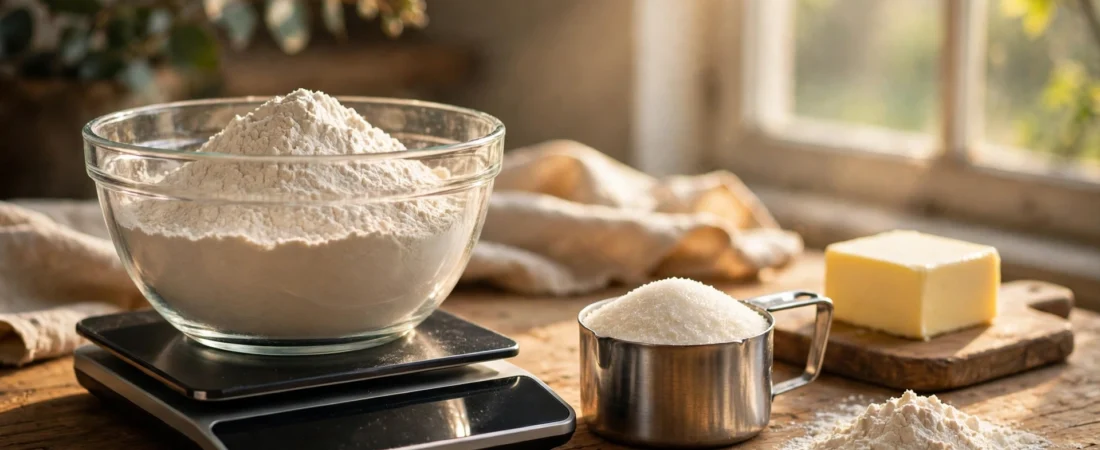
You’re halfway through a recipe when it hits you: “250 g flour.” Your measuring cups are right there, but the recipe talks in grams. How many grams in a cup? It depends on what’s in the cup. A cup of flour weighs 120 g. A cup of sugar weighs 200 g. A cup of butter weighs 227 g. Same cup, three different numbers. This guide gives you the full chart for 20+ ingredients, explains why the numbers differ, and shows you how to convert in either direction.
The short answer
If you only need one number, here it is for the three ingredients people look up most:
- All-purpose flour: 1 cup = 120 g
- Granulated sugar: 1 cup = 200 g
- Butter: 1 cup = 227 g
Those figures come from King Arthur Baking’s ingredient weight chart, the reference most American test kitchens use, and they assume the standard way of filling a cup: spooned in and levelled off, not scooped. The full chart below covers everything from cocoa powder (84 g a cup) to honey (336 g a cup). Before you grab a number, it’s worth understanding why there isn’t one universal answer.
Why one cup never weighs the same
A cup measures volume. A gram measures weight. They aren’t the same kind of thing, and nothing connects them until you know what’s filling the space.
Fill a cup with feathers and it weighs almost nothing. Fill the same cup with lead shot and you’d struggle to lift it. Flour, sugar and butter sit between those extremes, and each one packs into a cup differently. Flour is light and full of air. Sugar crystals are dense and settle tight. Butter is solid fat with almost no air at all. Honey is denser still — a cup of it weighs nearly three times as much as a cup of flour.
Density is the word for it. Every conversion in this article is a density figure in disguise: grams per cup for one specific ingredient, measured one specific way. Change the ingredient and the number changes. Change how you fill the cup and the number changes too.
The full chart: grams in a cup for 20 ingredients
All weights are for one level US cup (236.6 ml), spooned in and levelled unless stated otherwise. The source is King Arthur Baking’s ingredient weight chart, cross-checked against USDA FoodData Central figures.
| Ingredient | 1 cup (grams) | 1 cup (ounces) |
|---|---|---|
| All-purpose flour | 120 g | 4¼ oz |
| Bread flour | 120 g | 4¼ oz |
| Whole wheat flour | 113 g | 4 oz |
| Cake flour | 100 g | 3½ oz |
| Almond flour | 96 g | 3⅜ oz |
| Granulated sugar | 200 g | 7 oz |
| Brown sugar (packed) | 213 g | 7½ oz |
| Powdered sugar | 113 g | 4 oz |
| Butter | 227 g | 8 oz |
| Cocoa powder (unsweetened) | 84 g | 3 oz |
| Rolled oats | 89 g | 3⅛ oz |
| Chocolate chips | 170 g | 6 oz |
| Honey | 336 g | 12 oz |
| Whole milk | 245 g | 8.6 oz |
| Water | 237 g | 8.3 oz |
| Vegetable oil | 198 g | 7 oz |
| Cornstarch | 128 g | 4½ oz |
| Cream cheese | 227 g | 8 oz |
| Heavy cream | 227 g | 8 oz |
| White rice (uncooked) | 200 g | 7 oz |
Two rows deserve a footnote. Whole milk is listed at 245 g because milk is slightly denser than water, yet plenty of charts print 227 g for milk, water and cream alike — that’s eight ounces, the shorthand of treating a fluid ounce as an ounce. Brown sugar is the other one: 213 g is King Arthur’s packed figure, while other charts round it to 220 g.
Flour: 120 g — if you fill the cup right
Flour is where most conversions go wrong, and it’s not a small error. Spoon flour into a cup and level it with a knife, and you get about 120 g. Plunge the cup straight into the bag and scoop, and the same cup can hold 140 g or more. That’s a 17% swing on the ingredient your whole recipe is built around. Two extra spoonfuls of flour in a cake is the difference between tender and dry.
King Arthur Baking’s figure is 120 g per cup, spooned and levelled. You’ll also see 125 g quoted — that comes from USDA-based tables, and the gap is mostly about how the flour was handled. Pick one and stick with it, and spoon-and-level every time so your cup matches the chart.
Other flours differ slightly: bread flour 120 g a cup, whole wheat 113 g, cake flour 100 g. Almond flour is the outlier at 96 g — light, fluffy, and easy to over-measure if you pack it down.
Sugar: three sugars, three weights
Sugar looks simple until you line the three kinds up. A cup of granulated sugar weighs 200 g. A cup of packed brown sugar weighs 213 g. A cup of powdered sugar weighs just 113 g — barely more than half the granulated, because it’s mostly air.
That gap catches people out both ways. Swap powdered for granulated cup-for-cup in a frosting and you’ll end up short on sweetness and structure; swap the other way in a cake and you’ll add nearly double the sugar by weight. Brown sugar only works if you pack it — scooped loosely, a “cup” can weigh 180 g; pressed in firmly until it holds the cup’s shape, it’s 213 g. The packing instruction isn’t decoration. It’s the difference between a chewy cookie and a crisp one.
Butter and other fats
Butter is the easiest ingredient on this page to convert, because it’s sold in standard blocks. One US stick weighs 113 g, exactly half a cup. Two sticks make a cup: 227 g, or 8 oz. If your recipe calls for 100 g of butter, that’s just under half a cup — about 7 tablespoons. A 250 g block, the standard size in the UK and Australia, is a little over one cup (about 1.1 cups).
Cream cheese follows the same pattern: a standard 227 g block is one cup. Heavy cream is listed at 227 g a cup on most charts, though its true weight is closer to 240 g. Vegetable oil is lighter, 198 g a cup, because oil is less dense than water. For fats, the gram figure is almost always the safer one to trust — butter wrappers are marked in grams and tablespoons in the US, and in 50 g and 100 g increments elsewhere. Try our free unit converter if you’re bouncing between grams, ounces and cups mid-recipe.
Liquids: water, milk and honey
Liquids are the well-behaved end of the chart. Water weighs 1 g per ml, so a US cup of water (236.6 ml) weighs 237 g. That’s the one conversion you can do in your head: one cup of water is roughly 240 g.
Milk runs a touch heavier at 245 g a cup, and honey is the heavyweight of the kitchen at 336 g a cup — nearly three times the weight of the same volume of flour. A cup of honey is a third of a kilo, and pouring it by volume is messier than weighing it. Put the bowl on the scale, tare it, and pour until the display reads 336 g.
US, metric and UK cups aren’t the same size
Here’s the trap that gets people converting between American and British recipes. A US cup holds 236.6 ml. A metric cup — the standard in Australia, New Zealand and Canada — holds 250 ml. An old imperial cup holds 284 ml, though you’ll rarely meet one in a modern recipe.
The gram figures in this article assume the US cup. If your measuring cup is a metric 250 ml cup, multiply any figure here by 1.057: a metric cup of flour weighs about 127 g, sugar about 211 g, butter about 240 g. Follow an American recipe with a metric cup and don’t adjust, and every cup you measure is about 6% over — enough to throw off a delicate sponge.
Most of the time the fix is simple: weigh the ingredient instead. Grams are grams everywhere, which is why most recipes outside the US abandoned cups decades ago.
Going the other way: grams back to cups
Recipes usually give you grams and leave the cup maths to you, so the reverse conversion is the one you’ll actually use. The formula is just the chart backwards: cups = grams ÷ grams per cup. A few amounts come up often enough to memorise:
- 100 g flour = 0.8 cups, call it ¾ cup plus a tablespoon
- 100 g sugar = ½ cup exactly
- 100 g butter = 0.44 cups, call it just under ½ cup
- 250 g flour = 2 cups (240 g) plus a tablespoon
- 250 g sugar = 1¼ cups
Round to the nearest sensible fraction and don’t stress about the last few grams — baking is more forgiving than the charts make it look. And if your recipe uses ounces instead of grams, our kg-to-lbs conversion chart covers the weight side.
When to weigh, when to grab the cup
A kitchen scale costs less than a bag of good flour and settles every argument on this page. You don’t need it for everything — soups, stews, marinades and dressings are fine by the cup. Pastry, bread and cakes are where weighing earns its keep, and flour is the worst offender, with that 30 g swing between a spooned cup and a scooped one.
Get one that reads in 1 g increments and has a tare button. Put the bowl on, tare it to zero, and add each ingredient in turn. You can even scale a whole recipe up or down by weighing — our guide to scaling recipes explains the serving-size maths.
Frequently asked questions
How many grams is 1 cup of flour?
120 g, spooned in and levelled off with a knife — King Arthur Baking’s standard. Scooped straight from the bag, the same cup can weigh 140 g or more. Some charts list 125 g from USDA tables; either works if you fill the cup the same way every time.
How many grams is 1 cup of sugar?
200 g for granulated white sugar. Packed brown sugar is 213 g a cup, and powdered sugar just 113 g because it’s mostly air. Don’t swap them cup-for-cup without adjusting.
How many grams is 1 cup of butter?
227 g, which is two US sticks or 8 oz. One stick is 113 g, or half a cup.
How many grams is 1 cup of water?
237 g. Water weighs 1 g per ml and a US cup holds 236.6 ml, so 240 g is a safe round figure for cooking.
Is a cup the same size everywhere?
No. A US cup is 236.6 ml, a metric cup is 250 ml, and an old imperial cup is 284 ml. The weights in this article assume the US cup; multiply by 1.057 for a metric cup.
Why do different charts give different numbers for flour?
Because the filling method changes the weight. Spooned and levelled flour weighs 120 g a cup; scooped flour weighs 130–150 g.
The bottom line
There is no single answer to how many grams are in a cup, and that’s the point. The cup measures space, the gram measures weight, and the ingredient decides how the two relate. Flour is 120 g, sugar is 200 g, butter is 227 g — and now you know why.
For the recipes where it matters, weigh the ingredient and skip the conversion entirely. For everything else, the chart above will get you close enough. And when you need to convert between grams, ounces, cups and millilitres, try our free unit converter. It does the maths so your baking doesn’t have to.