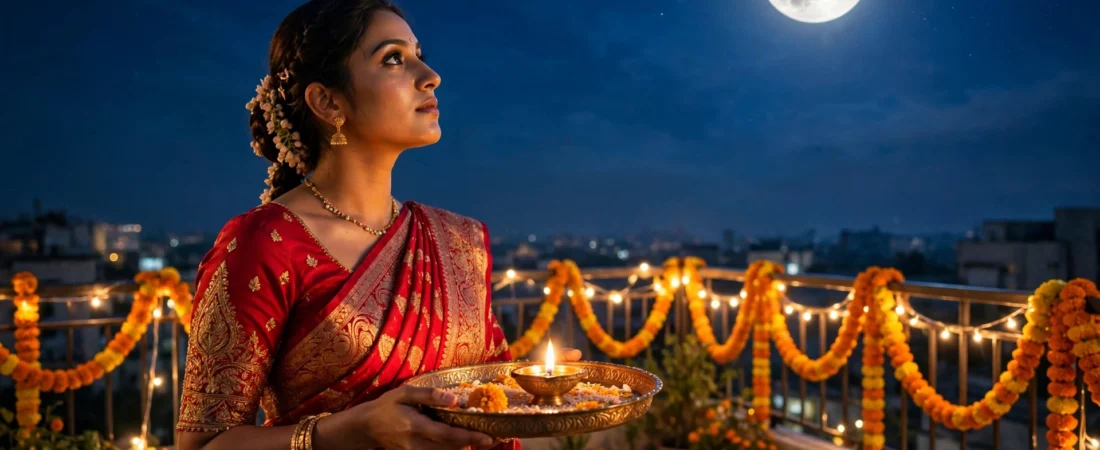
Wondering how many days until Karwa Chauth 2027? It’s Monday, 18 October 2027 — the fourth day of the waning moon in Kartik — and this time the date is about as unambiguous as lunar-calendar dates get. If you want the exact ticking figure, the live countdown below tracks it down to the second; this article covers how the date was confirmed, what the day actually involves, and how to get through a nirjala fast without wilting.
Open this page with the timer already set for Karwa Chauth 2027, or type “Karwa Chauth 2027” into the widget above, set 18 October 2027, and hit Start countdown.
How the 2027 date was confirmed
Karwa Chauth drifts on the Gregorian calendar because it follows the moon — Kartik Krishna Chaturthi, to be precise — so the only responsible way to state the date is to check the panchang math instead of trusting a forwarded WhatsApp graphic. This year’s math is unusually tidy:
- Drik Panchang’s 2027 festival tables mark Monday, 18 October as Karwa Chauth, and calculate moonrise in Chandigarh at 7:31 PM.
- Astrology Divine’s 2027 vrat calendar agrees on 18 October, listing the Delhi puja muhurat at roughly 5:48–6:57 PM and moonrise at 7:29 PM IST.
- The aggregators — calendarena.com, datetimeonline.com, calendartamil.co.in, giftstoindia24x7.com — and holidaylistindia.in all converge on the same Monday.
And the calendar agrees with itself: 18 October 2027 really is a Monday. There’s no regional drift this year either — no tithi-boundary split pushing some cities to the 17th. For once, everyone can circle the same square.
The festival sits in a busy stretch: Dussehra 2027 falls on Saturday, 9 October — nine days before — and Diwali’s Lakshmi Puja on Friday, 29 October, eleven days after. Our Dussehra 2027 countdown and Diwali 2027 countdown track both ends of the season, and last year’s Karwa Chauth 2026 article is still up if you’re comparing.
The day, from sargi to moonrise
The eating starts before the fasting, and both start earlier than you’d like. Sargi — the pre-dawn meal, traditionally sent by the mother-in-law — gets eaten in the dark, usually between 4 and 5 AM. The thali typically holds pheni or sevaiyan simmered in milk, dry fruits, fruit, sometimes parathas; the exact menu is a family recipe rather than a rule. Its job is straightforward: it’s the only meal until evening, so it has to last.
After sargi, the day goes dry. Nirjala — literally “without water” — means no food and no water from sunrise until the moon shows up. That’s what makes this one of the toughest fasts in the Hindu calendar. In 2027, Delhi sunrise sits around 6:30 AM and moonrise near 7:29 PM, so you’re looking at roughly thirteen hours. Plenty of women take the day quietly; in states where it’s not a public holiday, the half-day leave request is practically a tradition of its own.
By late afternoon the mood shifts from endurance to ceremony. Women gather — at home, in the building compound, at the temple — dressed for it. Red is the traditional pick; plenty wear their wedding finery or the closest thing to it. The Karwa Chauth katha gets recited, usually by an elder, with everyone listening around their decorated thalis: lit diyas, sweets, a sieve, and the karwa itself — the small earthen pot the festival is named after.
Then the moon. Around 7:29 PM in Delhi in 2027 (a minute or two later in Chandigarh, and it shifts by city everywhere else), women look at the moon through the sieve, swing the sieve toward their husband’s face, offer water to the moon, and the husband feeds them the first bite and the first sip. That’s the fast broken — and the evening meal that follows is nobody’s idea of a light snack.
The stories behind the fast
Nobody keeps Karwa Chauth because of astronomy; they keep it because of the stories. There are several, and families tend to inherit a favorite.
The most dramatic is Queen Veervati’s. A princess keeping her first Karwa Chauth, she was fading by evening when her seven brothers — unable to watch — rigged a fake moon: a mirror in a peepal tree, firelight behind it. She broke her fast, ate, and moments later learned her husband was dead. The gods, moved by her grief, gave her a second chance: keep the fast properly the next year and he’d return. She did, and he did. The moral, depending on your reading, is either about devotion or about not trusting your brothers.
Then there’s Draupadi’s version. When the Pandavas were in exile and Arjuna was away, Krishna told Draupadi to keep the Karwa Chauth fast for his safety — she did, and the story credits it with his protection. Savitri’s tale gets told too: she fasted and prayed until Yama, the god of death, relented and returned her husband Satyavan’s life. And the festival’s own namesake, Karwa — a devoted wife who, legend says, fought a crocodile that had seized her husband’s leg, binding it with cotton yarn until Yama himself intervened.
Whether you take them as history or parable, the katha recital is the emotional center of the evening — the part of the day that isn’t about hunger at all.
Where it’s kept — and where it isn’t
Karwa Chauth is overwhelmingly a North Indian festival: Punjab, Haryana, Delhi, Uttar Pradesh, Rajasthan, Madhya Pradesh. In Maharashtra, Karak Chaturthi covers similar ground with its own customs. The south largely doesn’t observe it — Karnataka, Tamil Nadu, Kerala and Andhra Pradesh have their own fasting traditions, and Karwa Chauth never migrated there in any serious way.
But the map is shifting. Bollywood did more for Karwa Chauth’s geography than any migration: the DDLJ scene turned the moon-sighting into a national image, and these days you’ll find Karwa Chauth gatherings in Bengaluru and Hyderabad among North Indian families, plus a growing number of husbands fasting alongside their wives — a quiet rewrite of a ritual that used to be strictly one-sided.
One more modern wrinkle: the moonrise apps. A decade ago you craned your neck at the eastern sky with everyone else; now half the terrace is refreshing a moonrise tracker. The old-timers consider this cheating-adjacent. The moon doesn’t care.
Getting through the day: practical notes
First-timers usually underestimate the no-water part. If 2027 is your first Karwa Chauth, front-load hydration the day before — and the night before, not just at sargi. Sargi itself should lean toward slow-release foods: milk-based dishes, nuts, fruit, complex carbs. A plate of pure sugar will abandon you by noon.
Mehendi goes on a day or two earlier, not the morning of — it needs hours to set, and you’ll want your hands free. If your mother-in-law sends sargi and baya (the gift package — clothes, jewellery, the karwa set), confirm the plan the night before rather than assuming 4 AM logistics will sort themselves out.
Moonrise times are city-specific, and worth checking against your local panchang rather than a national headline. For 2027, Delhi’s is about 7:29 PM and Chandigarh’s about 7:31 PM — but Jaipur, Lucknow, and Mumbai will each differ by several minutes. And if the sky is overcast? The common practice is to break the fast at the stated moonrise time anyway; the fast is kept in good faith, and the clouds are not your fault.
A word on the holiday question, since it comes up every year: Karwa Chauth is a full public holiday in a few states — Haryana and Punjab notably — and a restricted holiday in others. Most of the country works the day, which is exactly why sargi happens in the dark.
FAQs
Can unmarried girls keep Karwa Chauth?
Traditionally it’s a married woman’s fast, but unmarried women keeping it — for a future husband, or simply as devotion — is increasingly common and widely accepted now. Nobody at the katha is checking certificates.
What if the moon isn’t visible because of clouds?
Break the fast at the local moonrise time anyway. This is the standard practice: the fast is observed in good faith, and an overcast sky doesn’t invalidate it. Some families wait a little past the stated time just in case the clouds thin.
What exactly is sargi, and when is it eaten?
Sargi is the pre-dawn meal eaten before sunrise — usually between 4 and 5 AM — traditionally prepared or sent by the mother-in-law. Pheni or sevaiyan in milk, dry fruits, fruit, and parathas are typical. After sargi, the nirjala fast begins.
Is Karwa Chauth a public holiday?
Only in some states. Haryana and Punjab declare it a public holiday; several other states list it as a restricted holiday. Everywhere else it’s a working day, so plan sargi and the evening puja around office hours.
Can you drink water during the fast?
Strictly speaking, no — nirjala means no water at all, and that’s the traditional form. Some women, especially first-timers, the elderly, or those with health conditions, keep a sarjala (with water) version instead. The katha crowd won’t judge; the fast is between you and the moon.
When should the 2027 puja be done?
The evening puja muhurat in Delhi runs roughly 5:48–6:57 PM on 18 October 2027, ahead of the ~7:29 PM moonrise. Timings shift by city, so confirm against your local panchang — or just set the free countdown timer for 18 October and work backward from moonrise.
The countdown is on
Karwa Chauth only comes once a year, and in 2027 it lands on a Monday — which means the sargi alarm goes off on a workday for most of the country. Worth planning for. The timer at the top of this page counts down to 18 October 2027 to the second; if you’re tracking anything else in the festive season, the countdown tool handles custom dates too — Dussehra, Diwali, or your own events.