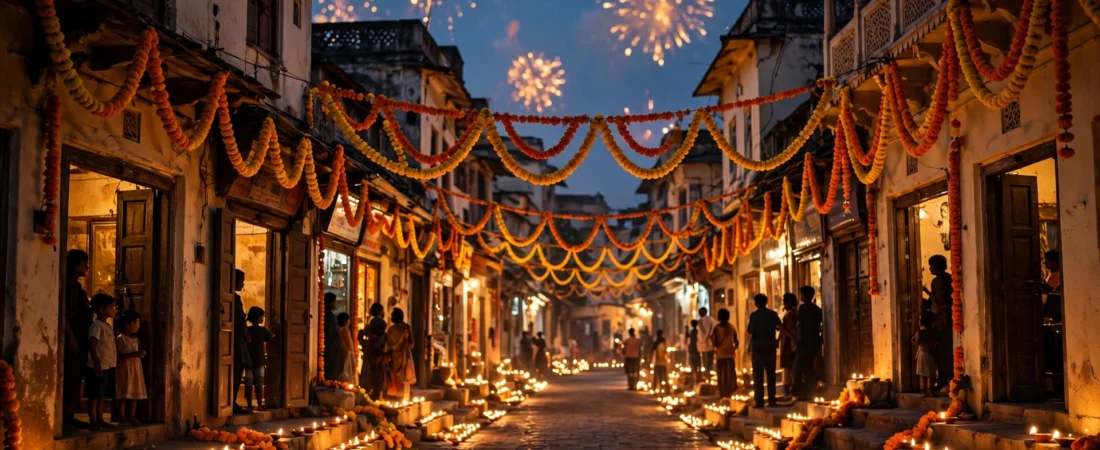
Diwali 2026 is still three weeks away — the diyas for this year’s festival haven’t been lit yet — and the planners have already moved on. Train-booking windows, factory shutdown rosters, corporate gifting budgets: in India, October 2027 is already on people’s minds. So, how many days until Diwali 2027? The main night, Lakshmi Puja, falls on Friday, 29 October 2027 — roughly twelve and a half months from mid-October 2026. The timer at the bottom of this page is counting down to the second.
Friday, 29 October 2027 — and how that date was pinned down
Diwali dates come from the Hindu lunar calendar, which means they’re computed, not guessed. The festival’s anchor is the Amavasya (new moon) of the month of Kartik, and Lakshmi Puja is observed on whichever Gregorian evening that tithi falls during Pradosh Kaal — the roughly two-and-a-half hours after sunset.
For 2027, the tithi data is unusually clean. Amavasya begins on Thursday, 28 October at about 8:48 PM IST and runs through Friday, 29 October until roughly 7:05 PM IST (per Lagna360’s tithi calculator). The Pradosh window on the 29th runs about 5:50–8:14 PM, squarely inside Amavasya — so the main night is unambiguously Friday, 29 October. Independent festival calendars (AstroSage’s panchang, Calendarena, timeanddate.com) converge on the same date, and Drik Panchang-based sources put the most auspicious Lakshmi Puja muhurat in the evening: Pradosh Kaal roughly 5:39–8:13 PM IST, with the Vrishabha (fixed) lagna window around 6:34–8:30 PM — diyas lit just after sunset, puja done before the night gets old.
One genuine caveat, and it’s a geographic one. In the UK and parts of western Europe, the same Amavasya straddles the local sunset differently, and some panchangs used there (including Dublin-based ones) observe Lakshmi Puja on Thursday, 28 October 2027 instead. If you’re coordinating a family video call across continents, don’t assume everyone’s lighting diyas the same night — ask which date their local temple is following.
Why it’s October this time, not November
If 29 October feels early, it is. Diwali 2026 lands on Sunday, 8 November; Diwali 2025 was on 20 October. The festival swings between mid-October and mid-November because the lunar year runs about 11 days shorter than the solar one, and every few years an extra lunar month (Adhik Maas) gets inserted to drag the calendar back into line. 2027’s Diwali landing in the last week of October is the calendar swinging back after the late-2026 placement — the 2024 edition was on 1 November, 2025 on 20 October, 2026 on 8 November, 2027 on 29 October. No two consecutive years share a date, and the drift is the whole reason the question “how many days until Diwali” gets asked every year instead of once.
The six days around it
Diwali isn’t one night; it’s a festival week, and the 2027 cluster is a clean Monday-to-Sunday-style run — Tuesday to Sunday, to be precise. Here’s the lineup from the panchang-based calendars:
- Tuesday, 26 October — Govatsa Dwadashi (Vasu Baras). The quiet opener. Cows are honoured in the morning in many regions; in Maharashtra this is the traditional start of the Diwali season.
- Wednesday, 27 October — Dhanteras (Dhan Trayodashi). The big shopping day: gold, silver and new utensils, worship of Lord Dhanvantari, the physician of the gods. Our Dhanteras 2026 countdown covers the day’s rituals in full, and the pattern repeats in 2027.
- Thursday, 28 October — Narak Chaturdashi (Choti Diwali). The eve of the main festival, commemorating Krishna’s victory over Narakasura. Kali Chaudas is observed in Gujarat and parts of western India on the same day.
- Friday, 29 October — Lakshmi Puja (Main Diwali). The main event: Lakshmi and Ganesha worshipped together, homes blazing with diyas. The night the countdown is aimed at.
- Saturday, 30 October — Govardhan Puja (Annakut). Krishna’s lifting of the Govardhan hill; in many North Indian homes, a mountain of food (annakut) is offered and then shared.
- Sunday, 31 October — Bhai Dooj (Bhaiya Dooj). Sisters apply tilak to their brothers’ foreheads, brothers give gifts, and the festival week closes on family.
Six days, no tithi overlaps bunching days together — 2027’s cluster is about as tidy as festival calendars get.
What Lakshmi Puja night actually looks like
Forget the stock-photo version for a moment. The real evening starts earlier than you’d think: homes get their final deep-clean in the days before (this is non-negotiable — Lakshmi visits only clean houses, per tradition), rangolis go down at the doorstep on the morning of the 29th, and marigold torans appear over doorways. By late afternoon the kitchen is producing its quota of sweets and savouries, because guests start arriving around dusk.
The diyas come out just after sunset, during the Pradosh window. Oil lamps — not just electric fairy lights, though those are everywhere too — get placed along windowsills, balconies and boundary walls. The puja itself centres on Lakshmi, goddess of prosperity, alongside Ganesha; in trading families, the new account books (bahi-khata) are worshipped too, a ritual that dates back centuries and still happens in Mumbai’s Zaveri Bazaar every year.
Then, in most of India: fireworks. Bursts of them, from about 8 PM well past midnight. The sound-and-smoke debate returns every year — several cities now restrict timing windows or push for green crackers — but on the ground, 29 October 2027 will still sound like celebration. The evening ends the way most Indian festivals do: sweets, exchanged with neighbours whether you know their names or not.
Not everyone marks it the same way
The Amavasya night means different things across communities, and 2027 is no exception. In West Bengal, Odisha and Assam, the same new-moon night is Kali Puja — goddess Kali worshipped with her own elaborate pandals, running parallel to Lakshmi Puja in the north. For Jains, it’s the anniversary of Mahavira’s attainment of nirvana; for Sikhs, Bandi Chhor Divas, marking Guru Hargobind Ji’s release from imprisonment — the Golden Temple in Amritsar is illuminated for days around it. In Gujarat, the day after Diwali doubles as Bestu Varas, the Gujarati New Year. And in Nepal, Diwali overlaps with Tihar, a five-day festival of lights with its own rhythm — crow day, dog day, Lakshmi day, ox day, and Bhai Tika.
If you’re sending greetings, “Happy Diwali” works everywhere. But knowing which festival your recipient is actually celebrating is the difference between a polite message and a real one.
Planning around it? The practical stuff
Twelve-plus months of lead time sounds generous until you try to book a sleeper berth on the 27th. A few specifics for 2027:
Indian Railways opens reservations roughly 120 days ahead, which puts the Dhanteras-week booking window around late June 2027 — and festival-week trains on popular routes (Delhi–Lucknow, Mumbai–Patna, Kolkata–Guwahati) sell out within hours, sometimes minutes. Set a reminder, not a hope.
Flights follow the same logic in reverse: the cheap seats for late October are the ones bought months early. If Diwali travel is on your 2027 calendar, start watching fares by spring.
For jewellery buyers: Dhanteras (27 October) is one of the two biggest gold-buying days of the Indian calendar. Showrooms run pre-booking schemes weeks ahead, and making charges get negotiated best when you’re not competing with the 26th-evening crowd.
And if you’re an employer or HR planner: the cluster runs Tuesday to Sunday. Most offices will see leave requests bunching around Wednesday–Friday, with Bhai Dooj on Sunday softening the return-to-work blow. Gazetted-holiday lists will confirm the 29th as the central holiday; states typically add their own regional days around it.
Want the exact ticking number? Set a free countdown timer for 29 October 2027 — it runs in your browser, no sign-up, and you can share the link so the whole family watches the same clock.
Frequently asked questions
When is Diwali in 2027?
The main night, Lakshmi Puja, is Friday, 29 October 2027. The full festival cluster runs Tuesday 26 October (Vasu Baras) through Sunday 31 October (Bhai Dooj).
Is Diwali 2027 on 28 or 29 October?
In India it’s the 29th — the Amavasya tithi covers the Friday evening Pradosh window cleanly. Some UK and western-European panchangs observe it on Thursday the 28th because the tithi straddles their local sunset differently.
Why does Diwali fall on a different date every year?
It’s fixed to the new moon (Amavasya) of the Hindu month of Kartik. The lunar year is about 11 days shorter than the solar year, so the Gregorian date drifts — anywhere from mid-October to mid-November — until periodic leap months reset it.
What are the five days of Diwali 2027?
Dhanteras (Wed 27 Oct), Choti Diwali (Thu 28 Oct), Lakshmi Puja (Fri 29 Oct), Govardhan Puja (Sat 30 Oct) and Bhai Dooj (Sun 31 Oct) — with Vasu Baras (Tue 26 Oct) opening the week for many families.
Is Diwali a public holiday in 2027?
In India, Lakshmi Puja on 29 October is a gazetted central-government holiday, and most states add surrounding days. Outside India it’s a public holiday in countries like Nepal, Fiji, Malaysia, Singapore, Mauritius and Trinidad and Tobago, with the exact observance dates set locally.
How is Diwali 2027 different from Diwali 2026?
Timing, mainly: Diwali 2026 falls on Sunday, 8 November — ten days later on the calendar and on a weekend. The 2027 edition lands on a Friday, which makes the whole six-day cluster (Tue–Sun) unusually neat for leave planning.
One festival, twelve months of runway
Diwali 2027 won’t sneak up on anyone who plans — and with the date this firmly settled, there’s no excuse for the last-minute scramble. Friday, 29 October: mark it, book around it, and let the countdown above do the waiting for you. Our free countdown tool handles the ticking; you handle the diyas.