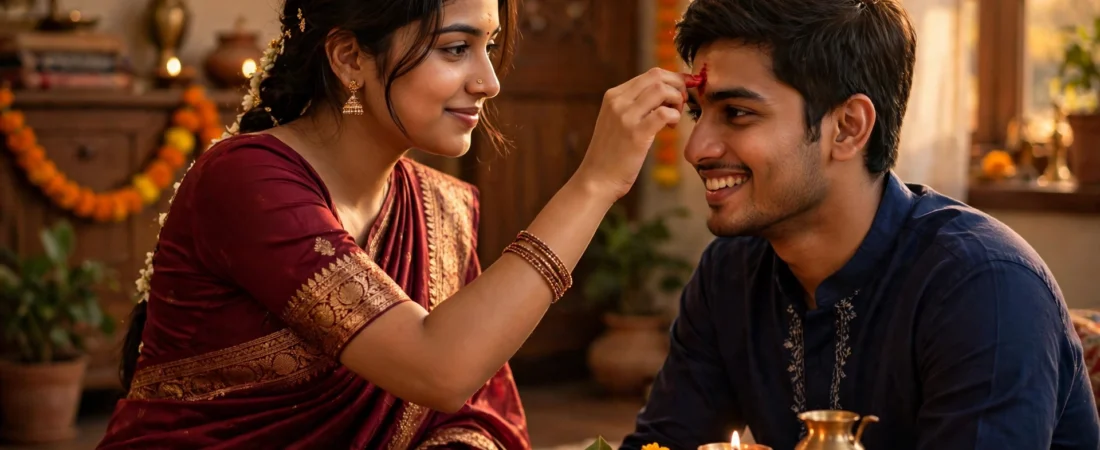
How many days until Bhai Dooj 2027? The date to circle is Sunday, October 31, 2027 — the fifth and final day of the six-day Diwali festival, when sisters apply a tilak on their brothers’ foreheads and brothers give gifts in return. For the exact days, hours, minutes and seconds left, the live counter above does the counting — set it to “Bhai Dooj 2027”, October 31, 2027, and let it run: Bhai Dooj 2027 pre-set countdown
Below is everything worth knowing for 2027: how the date was verified (and why a couple of calendar sites show the wrong one), the two legends behind the day, what the tilak ceremony actually involves, the many names the festival wears across India and Nepal, and where Bhai Dooj sits in the Diwali week.
When is Bhai Dooj 2027?
Bhai Dooj is observed on the Dwitiya tithi — the second day of the waxing moon — in the Hindu month of Kartik. In 2027, the tithi begins at 5:51 PM IST on Saturday, October 30 and ends at 5:12 PM IST on Sunday, October 31 (panchang figures published by lagna360, with sunrise on Sunday at 6:32 AM IST). Because the festival is counted by the tithi present at sunrise, the date is unambiguously Sunday, October 31, 2027.
That date is backed by every serious festival calendar: lagna360’s India page, calendarena’s India table, bhaidooj.com’s multi-year list, and ghdays.in all print October 31, 2027, a Sunday — and the calendar arithmetic agrees. Two pages floating around are worth ignoring: nationaltoday.com lists “November 16” for Bhai Dooj every year from a stale template (it gets 2026 wrong too), and one Indian site accidentally printed “31 November 2027” — a date that doesn’t exist. When the crowd of sources agrees and the tithi math is clean, the date is settled.
The traditional tilak window is the afternoon, when the tithi is well advanced. For 2026 the published muhurat was roughly 1:10–3:20 PM IST; the equivalent 2027 window will appear in the panchangs closer to the date, so check your local one in mid-October 2027 rather than trusting a number printed a year early. One genuinely useful accident of the calendar: Bhai Dooj 2027 falls on a Sunday, so the siblings travelling for the day won’t have to negotiate a leave day.
The two legends behind the day
The most told story belongs to Yama, the god of death, and his twin sister Yamuna, the goddess of the river. Yamuna had been asking her brother to visit for years, and Yama was always busy with the unglamorous business of collecting souls. At last, on the Dwitiya of Kartik’s bright fortnight, he walked through her door. She bathed him, applied a protective tilak to his forehead, performed his aarti, and served him a feast cooked by her own hands.
Touched, Yama offered her a boon, and Yamuna didn’t ask for gold or palaces. She asked that any brother who receives his sister’s tilak on this day be blessed with a long life — and that death itself pass over him. Yama agreed, which is why the festival also goes by Yama Dwitiya: the one day of the year when a sister’s love formally outranks death.
The second legend is the Krishna–Subhadra story. After Krishna slew the demon Narakasura, he visited his sister Subhadra, who welcomed him with aarti, tilak and sweets — the standard hero’s homecoming, elevated by Krishna declaring the day would forever honour the brother–sister bond. In Jain tradition there’s a third telling: after Mahavira’s nirvana, his grieving brother Nandivardhan was comforted by his sister Sudarshana, and the family set aside this day for brothers to honour sisters. Different theology, same gesture.
How the tilak ceremony actually works
There’s no priest involved and no elaborate puja vidhi — Bhai Dooj is a home festival, and the ceremony takes about fifteen minutes. The sister prepares a thali first: a lit diya, kumkum or roli, akshat (unbroken rice grains), sandalwood paste, sweets, flowers and a coconut. In some families the brother is seated on a small square of rice flour or cloth, facing east or north.
She applies the tilak to his forehead, presses rice grains onto it, and prays — silently or aloud — for his long life and well-being. Then comes the aarti, the diya circled before him, and the part that matters most: she feeds him a sweet with her own hand. The feeding gesture is the emotional centre of the ritual; everything else is framing. A kalava (red thread) is often tied on his wrist, he blesses her in turn, and then he hands over the gift — clothes, money, jewellery, something she’s been wanting. The unwritten rule is that the gift should cost him more thought than money, though in practice the envelopes of cash do a lot of heavy lifting.
The whole thing works best unhurried. Families that rush the tilak between Diwali-week chores tend to get the ritual without the warmth; the ones that sit down together, eat the meal the sister cooked, and actually talk end up with the festival they remember.
One festival, many names
Bhai Dooj is genuinely pan-Indian — and it shows in how many names it carries. In Maharashtra and Goa it’s Bhau Beej, with rangoli outside the door and sisters hosting the meal; in West Bengal it’s Bhai Phonta, where some sisters fast before applying a special sandalwood-rice-curd tilak; in Nepal it’s Bhai Tika, the emotional peak of the five-day Tihar festival, where sisters apply the famous Saptarangi Tika — a seven-coloured mark on the brother’s forehead — and the day outranks even the grander festivals for many families; in Gujarat it’s Bhai Beej, with sisters inviting brothers home for sweets and a full festive spread; in Haryana it’s Bhaiya Dooj, where a dry coconut tied with a thread is waved in the aarti; in Telangana and Andhra it appears as Bhatru Dwitiya or Bhagini Hastha Bhojanamu — “dining at the sister’s hand”, which is really the whole festival in four words; and in Manipur the equivalent is Ningol Chakuba, when married daughters return to their parents’ home for a feast.
If you’re searching “Bhai Tika 2027” or “Bhau Beej 2027” — same day, October 31, same tithi, same story.
Where Bhai Dooj sits in the Diwali 2027 week
Bhai Dooj is the closing note of a six-day arc, and it helps to see the week whole:
- Tuesday, October 26 — Vasu Baras: the gentle opening, honouring cattle, in Maharashtra
- Wednesday, October 27 — Dhanteras: the shopping day — gold, utensils, the Yamadeepa lamp. Counting down to that one too? See our How Many Days Until Dhanteras 2027? countdown
- Thursday, October 28 — Choti Diwali (Naraka Chaturdashi): Krishna’s victory over Narakasura; the pre-dawn oil bath
- Friday, October 29 — Diwali (Lakshmi Puja): the main night itself — Lakshmi puja, diyas, fireworks. See our How Many Days Until Diwali 2027? countdown
- Saturday, October 30 — Govardhan Puja / Annakut: Krishna lifts the hill; the mountain of food
- Sunday, October 31 — Bhai Dooj: siblings close the festival with blessings and gifts
Notice the rhythm: Bhai Dooj always lands two days after the main Diwali night, on the Dwitiya tithi. It’s the festival’s exhale.
Planning for Sunday, October 31, 2027
Because 2027’s Bhai Dooj is a Sunday, the logistics are friendlier than most years. Siblings in different cities can travel without burning a leave day, which makes it the kind of year extended families actually gather for. If that’s your plan, a few practical notes: train and flight bookings for the Diwali week open months ahead and the October 29–November 1 corridor is one of the busiest travel windows of the Indian year — book early. Gift shopping is better done in the Dhanteras week than on the day. And if your sibling is abroad and can’t make it, the video-call tilak has become a normal, accepted thing since 2020; the ritual bends, the intention doesn’t.
For the last stretch, our free countdown timer keeps the exact count — days, hours, minutes, seconds — on any device, no sign-up needed.
Bhai Dooj 2027 — FAQs
Is Bhai Dooj 2027 definitely on October 31?
Yes. The Kartik Shukla Dwitiya tithi runs from the evening of October 30 to the evening of October 31 IST, and since it is present at sunrise on the 31st, that is the festival date across India. Every major festival calendar agrees; ignore any page still showing a November date from an outdated template.
What time should the tilak ceremony be done in 2027?
The tradition favours the afternoon Aparahna window, roughly midday to mid-afternoon IST. The exact 2027 muhurat will be published in the panchangs closer to October 2027 — worth looking up locally rather than relying on this year’s numbers.
How is Bhai Dooj different from Raksha Bandhan?
They’re cousins, not twins. Raksha Bandhan falls in August (Shravana) and centres on a thread tied on the wrist; Bhai Dooj closes the Diwali week and centres on a tilak applied to the forehead, aarti, and a meal the sister cooks. One opens the festive season, the other closes it.
What do you need for the Bhai Dooj thali?
The essentials: a diya with oil or ghee, kumkum or roli, unbroken rice grains (akshat), sandalwood paste, sweets, flowers and a coconut. Betel leaves and a kalava thread are common additions. Everything is available at any neighbourhood puja shop.
Is Bhai Dooj a public holiday?
Not nationally. It’s a gazetted or restricted holiday in some states and a working Sunday in 2027 anyway — the Sunday placement is what makes this year easy. Nepal observes Bhai Tika as a public holiday during Tihar.
When is Bhai Dooj 2028?
The festival calendars place Bhai Dooj 2028 on Thursday, October 19, 2028. That one is worth double-checking closer to the date, since tithi boundaries shift each year.
The festival’s quiet superpower
Diwali gets the lights, the noise, the shopping, the photographs. Bhai Dooj gets something quieter: fifteen minutes at home, a mark on a forehead, a sweet fed by hand. It’s the smallest ceremony of the week and, for a lot of families, the one they actually remember a year later. Set your free countdown timer for October 31, 2027, and give this one its due.