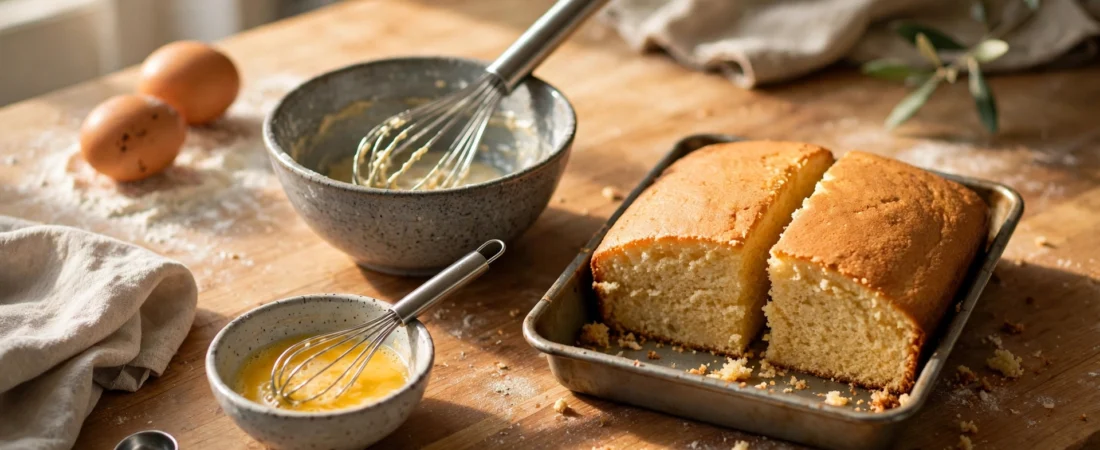
A recipe serves eight, there are three of you, and the thought of eating the same stew for four nights straight is already depressing. Learning how to halve a recipe properly is the fix — but “just divide everything by two” only gets you about 80% of the way there. The rest is eggs that won’t split, pans that are the wrong size, and a cake that comes out dry because nobody told you the baking time changes too.
Rewrite the recipe before you touch a bowl
This is the single habit that separates a clean half-batch from a panicked one. Before you measure anything, sit down with the original recipe and write out a halved version, ingredient by ingredient, on paper or in your phone notes. It takes three minutes and it saves you from the classic mistake: standing over a bowl of flour with a spoon in your hand, trying to remember whether you’ve already halved the baking powder or not.
Work through the list top to bottom. Flour, sugar, butter — those are easy. Then circle the awkward ones: anything measured in thirds, anything under a teaspoon, anything that comes in a fixed-size tin, and the eggs. Deal with those deliberately (the sections below cover each one) rather than improvising mid-recipe, when your hands are sticky and your judgement is at its worst.
If the recipe gives weights in grams, use them. Halving 240 g of flour gives you 120 g, no fractions, no guessing. A cheap kitchen scale turns halving from arithmetic into a non-event. If you’d rather not do the sums by hand at all, try our free recipe extractor — paste in a recipe link and it pulls out a clean ingredient list you can scale from, instead of squinting at a blog post full of life story.
The halving chart you’ll actually use
Most ingredients halve cleanly once you know the conversions. The ones that trip people up are the small spoon measures and the thirds, so here they are in one place:
| Original | Halved |
|---|---|
| 1 tablespoon (3 teaspoons) | 1½ teaspoons |
| 2 tablespoons | 1 tablespoon |
| 3 tablespoons | 1 tablespoon + 1½ teaspoons |
| ¼ cup (4 tablespoons) | 2 tablespoons |
| ⅓ cup | 2 tablespoons + 2 teaspoons |
| ½ cup | ¼ cup |
| ⅔ cup | ⅓ cup |
| ¾ cup | 6 tablespoons |
| 1 cup | ½ cup |
| 1 teaspoon | ½ teaspoon |
| ½ teaspoon | ¼ teaspoon |
| ¼ teaspoon | ⅛ teaspoon (a pinch, if you don’t own a ⅛-teaspoon spoon) |
Two things worth noting. First, ⅓ cup is the only genuinely annoying one — 2 tablespoons plus 2 teaspoons is exact, and it’s worth doing properly rather than rounding to “about a quarter cup” in baking, where a couple of tablespoons of liquid can change a batter. Second, if you halve a ¼ teaspoon of cayenne, don’t stress about an exact ⅛ teaspoon. A generous pinch is close enough for spices, and you can taste and adjust later — which you can’t do with baking powder.
Half an egg, without the drama
Eggs are where halving recipes gets its reputation for being fiddly, and honestly it’s the only part that deserves it. You can’t use half a shell, and using a whole egg instead of half in a small batch throws the liquid balance off by a noticeable amount — in a cake, that’s the difference between moist and soggy.
The fix is simple. Crack the egg into a small bowl, beat it lightly with a fork until the yolk and white are fully mixed, then measure out half. A large egg, beaten, is about 3 tablespoons (roughly 50 g without the shell), so half is 1½ tablespoons, or 25 g if you’re weighing. Use the rest in scrambled eggs or save it in a covered bowl in the fridge for the next day.
For whites and yolks, the same trick works: a yolk is about 1 tablespoon, a white about 2 tablespoons, so halve those figures. In forgiving recipes — most cookies, muffins, pancakes — you can round up to a whole egg and accept a slightly softer result. In anything precise — custards, soufflés, a tart filling that has to set — measure it properly.
The ingredients that don’t halve neatly
Most of a recipe scales in a straight line. A handful of ingredients don’t, and they’re the reason a halved cake can taste subtly wrong even when the maths was right.
Leavening comes first. Baking powder and baking soda should be halved exactly, and you should resist the urge to round up “just to be safe”. Too much baking soda leaves a metallic, soapy taste and a yellowish crumb; too much baking powder makes a cake rise fast and then sink in the middle. If the halved amount lands on something awkward like ⅜ teaspoon, use ¼ teaspoon plus a small pinch — close enough, and far safer than rounding up to ½.
Salt and strong spices are the opposite problem: they don’t need to be exact, but they do need tasting. Halve them, then taste the dish before serving and adjust. A halved curry with the full amount of chilli is still a halved curry in every way except the one that matters. The same goes for garlic and fresh herbs — halve first, then correct to taste, because a smaller pot concentrates flavour faster than you’d expect.
Yeast deserves a special mention. Halving it exactly usually works, but a very small dough can be slow to get going. If your halved dough feels sluggish, give it more time rather than more yeast — warmth and patience fix most slow rises, while extra yeast gives you a sour flavour you can’t undo.
Then there are the ingredients that come in fixed sizes and refuse to cooperate: a tin of tomatoes, a tin of beans, a packet of stock. You can’t buy half a tin. Either use the whole tin and scale the rest of the recipe around it, or freeze the remainder in a labelled tub for next week. Freezing half a tin of coconut milk is a perfectly good outcome; throwing it away because the recipe said so is not.
Pick the right pan, then fix the time
This is the step most people skip, and it’s the one that ruins the most halved bakes. A halved cake batter poured into the original tin spreads thin, bakes too fast, and dries out at the edges while the middle is still catching up. You need a pan with roughly half the surface area of the original, so the batter sits at the same depth it would have.
As a rough guide: a recipe written for a 9-inch round tin halves nicely into a 6-inch round tin. A 9×13-inch tray recipe halves into an 8×8-inch square tin. A 9×5-inch loaf halves into a smaller loaf tin, or into a couple of ramekins if that’s what you’ve got. If you don’t have the exact tin, anything with a similar base area works — measure the base, don’t guess by eye.
Baking time changes too, but not by half. A smaller cake in a smaller tin still needs most of its original time, because the depth is the same and heat still has to reach the middle. Start checking 10–15 minutes before the original time — if the original cake took 50 minutes, start peeking at 35 — and use the usual tests: a skewer that comes out clean, a top that springs back when pressed lightly, edges just pulling away from the tin. For stovetop cooking, a halved soup or sauce reaches a simmer faster and reduces faster, so keep the heat a touch lower and check earlier than the recipe says.
What you should not halve
A few things in a recipe aren’t ingredients, and halving them blindly causes trouble. Oven temperature stays the same — never halve it, or you’ll be baking at 90°C and wondering why nothing is happening. Garnishes, glazes and toppings are judgement calls: halve a glaze and you might not have enough to cover the cake, so make the full glaze and use what you need, or halve it and accept a thinner coat.
And don’t halve a recipe that was already small. A recipe serving two, halved to serve one, leaves you measuring ⅛ teaspoons of everything and baking a single muffin in a tin built for twelve. At that point, make the full small recipe and eat the leftovers for lunch tomorrow — some recipes just aren’t meant to go smaller.
A worked example: halving chocolate chip cookies
Say your cookie recipe makes 24 cookies and calls for 2¼ cups of flour, 1 teaspoon of baking soda, 1 teaspoon of salt, 1 cup of butter, ¾ cup of sugar, ¾ cup of brown sugar, 2 eggs, 2 teaspoons of vanilla, and 2 cups of chocolate chips.
Halved, that becomes: 1⅛ cups of flour (1 cup plus 2 tablespoons). Baking soda: ½ teaspoon, exactly. Salt: ½ teaspoon. Butter: ½ cup. Each sugar: 6 tablespoons. Eggs: one egg, beaten and measured — that’s 3 tablespoons of beaten egg, or just use one whole egg and accept a slightly softer cookie, which in this case is honestly fine. Vanilla: 1 teaspoon. Chocolate chips: 1 cup.
Bake them on the same trays at the same temperature, but start checking two or three minutes early, because a half tray of cookies in an oven with more empty space around them browns a touch faster. You get 12 cookies, the dough-to-chips ratio is unchanged, and nothing went in the bin.
Frequently asked questions
Can I halve a recipe that serves 4?
Yes, and it’s one of the easiest cases — you end up serving two, the pan maths is simple, and the egg question only matters if the recipe uses an odd number of eggs. Just rewrite the list first.
Do I halve the cooking time when I halve a recipe?
No, not by half. For baking, start checking 10–15 minutes before the original time and judge by doneness, not the clock. For stovetop dishes, expect things to cook a little faster and reduce a little more, so check earlier and keep the heat slightly lower.
What if a recipe calls for 3 eggs and I halve it?
Beat all three eggs together, measure out half by weight or volume — about 4½ tablespoons, or 75 g — and use that. Don’t use two eggs and hope, and don’t use one; both throw the batter off more than the measuring takes time.
Can I halve a recipe in a slow cooker?
You can, but a slow cooker needs a minimum fill level to cook evenly, usually about half full. If halving drops you below that, make the full recipe and freeze the extra portions — slow-cooker food freezes brilliantly.
Is it better to halve a recipe or just freeze the leftovers?
It depends on the dish. Soups, stews, curries and cookie dough freeze well, so cooking full and freezing half is often less work. Cakes, salads and anything with a delicate texture are better halved, because they don’t survive the freezer nearly as well.
Does halving work for bread recipes?
Mostly, yes, with the yeast caveat above: halve everything, give the dough a bit more rising time if it seems slow, and use a smaller tin or shape a smaller loaf. Very small doughs — under 250 g of flour — can be tricky to knead, so a stand mixer or a no-knead method helps.
The short version
Halving a recipe is mostly simple division, plus three judgement calls: measure the egg instead of guessing it, pick a pan half the size so the batter depth stays the same, and check the bake early instead of halving the time. Do those three things and the rest — the chart, the spices, the fixed-size tins — falls into place without much thought.
Next time a recipe serves more people than you’re feeding, don’t cook the whole thing out of habit. Rewrite it halved, cook the smaller batch properly, and save yourself three nights of leftovers. And if the recipe you want to halve is buried in a long blog post, try our free recipe extractor — it pulls the ingredients and steps into a clean card, and from there scaling it up or down is a much smaller job. If you want to go the other way instead, our guide to scaling a recipe up and down covers doubling and tripling with the same kind of practical detail.