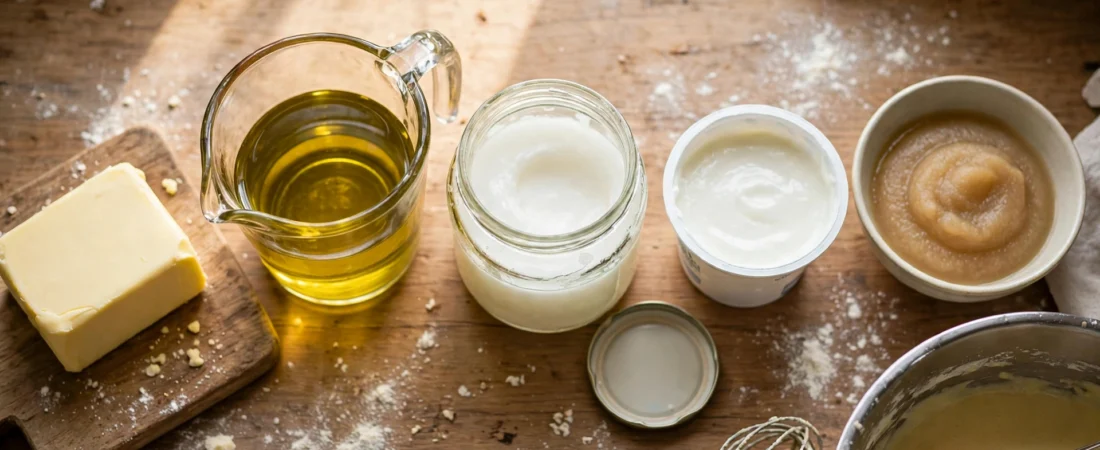
You’ve got the oven preheating, the flour measured, and then you open the fridge. No butter. Or your sister’s gone dairy-free since January and she’s coming for dinner. Either way, you need a butter substitute in baking, and you need one that won’t turn your cake into a brick.
Good news: you’ve probably got a workable swap in the cupboard already. Bad news: there’s no single substitute that does everything butter does, so the right pick depends on what you’re baking. A stick of butter is roughly 80% fat, 16–18% water, and a couple of percent milk solids, and it does three jobs at once. It tenderises the crumb, it carries flavour, and when you cream it with sugar it traps air that lifts the whole bake. A swap that nails one of those jobs can still fail the other two.
The quick ratio table
Here’s the short version. The detail — and the warnings — follow below.
| Swap | For 1 cup butter | Best for | Watch out for |
|---|---|---|---|
| Plant-based butter sticks | 1 cup (1:1) | Almost anything | Slightly less browning |
| Coconut oil (refined) | 1 cup (1:1) | Cookies, pie crust, bars | Can firm up a crumb when cool |
| Vegetable shortening | 1 cup (1:1) | Pie crust, tall cookies | Almost no flavour |
| Ghee | ¾ cup + 2 tbsp, plus 2 tbsp milk or water | Shortbread, enriched doughs | Cookies spread wider |
| Neutral oil | ¾ cup | Cakes, muffins, brownies | No good for pastry or frosting |
| Greek yogurt | Half the butter + ¼ cup yogurt | Muffins, quick breads | Tang, and a denser crumb |
| Unsweetened applesauce | Replace up to half the butter | Low-fat muffins, snack cakes | Denser, more cake-like texture |
1. Plant-based butter sticks — the closest match
If you want the swap most likely to disappear into the recipe, this is it. Plant-based butter sticks are built to imitate dairy butter: most brands land somewhere between 70% and 80% fat, they soften, cream, melt, and brown in roughly the same way, and you use them cup for cup, gram for gram.
Creaming is where they earn their ranking. A chocolate chip cookie recipe that starts with “cream the butter and sugar until light and fluffy” needs a solid fat that holds air. Plant sticks do that. Oil can’t, and that’s why oil cookies go flat. Stick with the block or stick format, though — the soft tubs sold for spreading are mostly water and air, and they’ll wreck a bake.
The one honest difference is flavour and browning. Dairy butter has milk solids that brown and taste like, well, butter. Plant sticks get close, but a plain shortbread made with them tastes a touch flatter. In anything with chocolate, spice, vanilla, or fruit, you won’t notice.
2. Coconut oil — the solid fat that behaves
Coconut oil is the only common swap that’s solid at room temperature, and that single fact makes it the most butter-like of the pantry options. It creams with sugar, it can be cut into flour for pastry, and it firms up a cookie dough so it holds its shape.
Use refined coconut oil unless you want a coconut note in the finished bake — refined is neutral, unrefined tastes faintly of coconut, which suits a macaroon and ruins a vanilla sponge. Match its state to the recipe: soft-solid when the recipe wants softened butter, melted when it wants melted butter. In a warm kitchen, chill it first; a tub that’s gone liquid on a summer afternoon won’t cream at all.
One caveat, and it’s a real one: coconut oil is even higher in saturated fat than butter. Treat this as a texture and dairy-free swap, not a health upgrade. It also firms the crumb as the bake cools, so a cake made with coconut oil can feel a touch drier on day two.
3. Vegetable shortening — tall cookies, flaky crust
Shortening is pure fat — no water, no milk solids — and that’s exactly why pastry cooks love it. Water in butter turns to steam in a hot oven, and steam is part of what lifts a crust. Shortening skips that entirely, which sounds like a loss until you see the result: the flakiest pie crust you’ve ever made, and cookies that bake up tall and tender instead of spreading into discs.
Swap it 1:1 for butter in pie dough, biscuits, and sugar cookies. The trade is flavour. Shortening tastes of nothing, so a butter-heavy recipe like shortbread or a buttercream made with it will taste flat. The fix is simple: add a teaspoon of vanilla, or swap only half the butter for shortening and keep the rest for flavour.
4. Ghee — nutty, and hotter than butter
Ghee is butter with the water and milk solids cooked out, which leaves pure butterfat with a toasted, nutty flavour. It’s a natural fit for baking because it’s still butter, just concentrated. Use ¾ cup plus 2 tablespoons for every cup of butter, and add 2 tablespoons of milk or water separately — that replaces the water the original butter would have contributed.
Where it shines is enriched doughs, crisp cookies, banana bread, and shortbread, where its nutty edge actually improves the recipe. It also handles heat better than butter, with a smoke point around 485°F (252°C).
The watch-out: cookies made with ghee spread wider and bake crisper, because there’s no water turning to steam and no milk solids holding structure. Chill the dough for 30 minutes before baking and you’ll keep most of the spread under control.
5. Neutral oil — the cake and muffin workhorse
For cakes, muffins, quick breads, and brownies, oil is the most reliable swap in the book. Use ¾ cup of a neutral oil — canola, sunflower, grapeseed, or avocado — for every cup of butter. (For one stick, that’s 6 tablespoons.) Butter is only about 80% fat while oil is nearly pure fat, so a little less oil keeps the fat level where the recipe expects it.
The payoff is a crumb that stays moist for days. Oil-based cakes don’t dry out the way butter cakes do, which is why so many bakery chocolate cakes are oil cakes under the hood. Add a splash of milk or water — a tablespoon or two per cup of butter replaced — to make up for the water butter would have added, and the crumb stays tender instead of dense.
Where oil fails is anything that needs a solid fat. Don’t use it in pie crust — you’ll get a tough, greasy shell instead of flakes. Don’t use it where the recipe creams butter and sugar, because oil can’t trap air, so cookies come out flat. And never use it in frosting: buttercream needs a solid fat to hold its shape, and oil frosting is a puddle. Olive oil works in the same ratio, but save it for bakes where its fruity, peppery note belongs — olive oil cake, focaccia, a citrus loaf. In a vanilla sponge it sticks out.
6. Greek yogurt — the half-swap that lightens
Greek yogurt is the swap to reach for when you want to lighten a bake without drying it out. Don’t replace all the butter with it, though. The ratio that works is half the butter plus a quarter cup of yogurt: for a recipe calling for 1 cup of butter, use ½ cup of butter and ¼ cup of full-fat plain Greek yogurt.
It brings moisture and a gentle tang, plus protein, which helps the crumb set. It suits muffins, quick breads, snack cakes, and biscuits — the sort of bakes where a little tang reads as richness rather than a mistake. Use full-fat yogurt; the fat-free kind is mostly water and thins the batter.
The trade is texture. Yogurt adds acidity, which can react with baking soda and give you a little extra lift, but it also makes the crumb denser and more pound-cake-like. In a light sponge that’s a problem; in a banana loaf it’s an improvement.
7. Unsweetened applesauce — the low-fat option
Applesauce is the classic low-fat swap, and it works — within limits. Replace up to half the butter with the same volume of unsweetened applesauce, and keep the other half as fat: half a cup of butter plus half a cup of applesauce in place of a full cup. Never do a full swap. With no fat at all, the bake turns out dense, rubbery, and stale by the next morning.
It suits muffins, quick breads, soft oatmeal cookies, and brownies — moist, forgiving bakes where a little extra fruit sweetness blends in. Buy unsweetened, or the added sugar will throw off the recipe’s sweetness and browning. And keep it to spiced or chocolate bakes where the apple note disappears; in a plain vanilla cake you’ll taste it.
Which swap for which bake?
The ranking above is general. Here’s the fast version by recipe, because the same swap can be perfect in one bake and a disaster in the next.
Chocolate chip cookies: plant-based butter sticks or solid coconut oil, 1:1, with the dough chilled for 30 minutes. Shortening gives a puffier cookie if you don’t mind losing some flavour.
Layer cakes and cupcakes: neutral oil at ¾ cup per cup of butter, plus a splash of milk. Or plant butter 1:1 if you want to cream.
Pie crust and pastry: shortening or solid coconut oil, 1:1, kept cold. Liquid oil is out — flake depends on cold, solid fat.
Brownies: neutral oil, ¾ cup per cup. Brownies love oil; they come out fudgier and stay moist longer.
Muffins and quick breads: oil, yogurt half-swap, or applesauce half-swap — all three work, and this is the most forgiving category in baking.
Frosting and buttercream: plant-based butter sticks only. Oil, yogurt, and applesauce are all out.
Frequently asked questions
Can I use oil instead of butter in cookies?
Not easily. Most cookie recipes cream solid butter with sugar to trap air, and oil can’t do that, so the cookies come out flat and greasy. If oil is all you have, use ½ to ⅔ cup per cup of butter, chill the dough for at least an hour, and expect a chewier, flatter cookie. Coconut oil or plant butter sticks are the better fix.
What’s the best butter substitute for baking overall?
Plant-based butter sticks. They swap 1:1, they cream, they brown, and they work in cookies, cakes, pastry, and frosting. Coconut oil is a close second for cookies and crusts, and neutral oil wins for cakes and muffins.
Can I substitute margarine for butter in baking?
Yes, if it’s the stick kind. Stick margarine swaps 1:1 and behaves much like butter. Soft tub margarine is mostly water and won’t hold up in baking — it makes cookies spread and cakes sink.
Does a butter substitute change baking time?
Usually not by more than a minute or two. Oil-based cakes sometimes need an extra minute because the batter is wetter, and cookies made with oil spread faster, so watch the edges rather than the clock. The temperature stays the same.
Is coconut oil healthier than butter?
No. Coconut oil is higher in saturated fat than butter, gram for gram. It’s a good dairy-free and texture swap, but if health is the reason you’re swapping, olive oil or a yogurt half-swap is the better move.
The bottom line
There isn’t one perfect butter substitute in baking — there’s a right one for the bake in front of you. Plant-based butter sticks if you want to stop thinking about it. Coconut oil or shortening when shape and flake matter. Neutral oil when moisture matters more than structure. And a yogurt or applesauce half-swap when you want to lighten things up without starting over.
Ran out of something else mid-recipe, too? Our free substitute finder covers the rest of the pantry — egg substitutes that hold a cake together, buttermilk swaps for pancakes and soda bread, and more. And if the recipe you’re scaling needs adjusting too, our guide to scaling a recipe up or down has the ratios worked out. Check the substitute finder before your next bake — it’s faster than a trip to the shop.