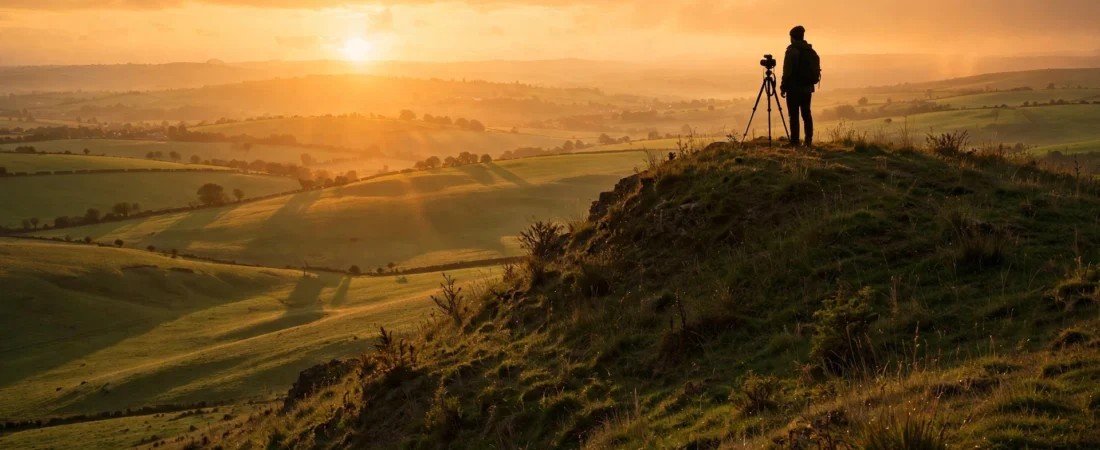
You’ve taken that photo. Midday, bright sun, a view that looked gorgeous to your eyes — and the picture comes out flat, washed out, with shadows like black holes under everyone’s chins. Same place, same camera, an hour before sunset, and suddenly everything glows. That’s golden hour, and it’s the closest thing photography has to a cheat code.
The short answer
Golden hour is the stretch just after sunrise and just before sunset when the sun sits low in the sky — roughly below 6 degrees above the horizon. The light comes in sideways instead of from overhead, so it’s soft, warm, and directional. Shadows stretch long, skin looks better, and landscapes pick up colour and depth the midday sun flattens out.
It happens twice a day, every day, everywhere. The catch is that it doesn’t last an hour. Most of the time it runs 25 to 60 minutes, and the exact length depends on where you are and what time of year it is. More on that below — it’s the part that decides whether you get the shot or miss it.
Photographers also call it the magic hour, a term borrowed from film sets, where directors schedule their most beautiful shots for it.
Why the light turns gold
The colour isn’t a filter — it’s physics, the same reason the sky is blue.
When the sun is high, its light takes the shortest possible route through the atmosphere. When it’s low, that light has to travel through far more air to reach you — several times more, in fact. Along the way, the shorter blue wavelengths get scattered off in every direction (this is Rayleigh scattering, the same effect that makes the daytime sky blue). What’s left by the time the light reaches your subject is the long end of the spectrum: yellows, oranges, reds.
Two things change at once. First, the colour temperature drops: midday daylight sits around 5,500K, while golden hour light runs closer to 3,000–4,000K, which reads as warm honey on camera. Second, the light gets softer — scattered and weakened by all that extra atmosphere, so the contrast between highlights and shadows drops. That’s why it’s so hard to blow out a face during golden hour: the light is doing the diffusing for you.
There’s a third effect people forget: direction. Light arriving from a low angle rakes across surfaces instead of pressing down on them. Texture shows up — the grain in a wooden fence, the ripples in a field, the lines on a face. Midday sun hides all of that. Golden hour reveals it.
How long does golden hour actually last?
Shorter than the name suggests, and it varies more than most people expect. The sun crosses the horizon almost vertically near the equator, so it drops through that low band quickly. Further from the equator, it crosses at a slant, and the low-sun window stretches out.
| Where you are | Around the equinoxes | Summer solstice | Winter solstice |
|---|---|---|---|
| Equator (0°) | ~25 minutes | ~30 minutes | ~30 minutes |
| 20° latitude | ~30 minutes | ~30 minutes | ~30 minutes |
| 40° latitude (New York, Madrid, Beijing) | ~35 minutes | ~40 minutes | ~45 minutes |
| 50° latitude (London, Brussels, Vancouver) | ~45 minutes | ~50 minutes | ~60 minutes |
| 60° latitude (Oslo, Helsinki, Anchorage) | ~55 minutes | ~80 minutes | ~130 minutes |
A few things jump out. Golden hour is shortest around the March and September equinoxes at every latitude, and up to about 40 degrees it stays between 25 and 45 minutes all year — well short of an hour. In a far-northern winter, though, the sun barely climbs above the horizon at noon, so nearly the whole short day is golden hour: two windows of about two hours each, with barely an hour between them.
The practical takeaway is simple. Don’t plan on sixty minutes. Plan on thirty, and treat anything extra as a bonus. The best light is usually in the second half of the evening window — the last fifteen or twenty minutes before the sun sets. Arrive early and be shooting before you think you need to be.
Morning or evening — which one wins?
Both windows give you the same quality of light, but they feel completely different to shoot in.
Morning golden hour starts the moment the sun clears the horizon. The air is cooler and often still, which means mist over fields and water, dew on grass, and fewer people around. For landscapes or street scenes, the morning is often the better bet — empty streets, soft fog, and a calm you just don’t get at 6pm. The downside is obvious: you have to get up for it. In midsummer at 50 degrees latitude, sunrise is before 5am, and golden hour is done by six.
Evening golden hour is the popular one, for good reason. You can plan around it after work, the light tends to run a touch warmer (the day’s dust and haze add to the scattering), and the sun sets into the west, which suits most western-facing viewpoints. It’s also more crowded. Every viewpoint worth shooting will have company at sunset.
If you can only pick one, pick the evening. It’s easier to get to and the light is at its most dramatic. But if you want a location to yourself, set the alarm.
How to find golden hour times where you are
Golden hour isn’t at the same time every day, and guessing from sunset alone will cost you shots.
The simplest route: find your sunrise and sunset times, then work backwards. Evening golden hour starts roughly an hour before sunset (at mid-latitudes; use the table above to adjust), and morning golden hour starts at sunrise and runs for about the same length. Our free sunrise and sunset tool gives you exact sunrise and sunset times for any city — check the sunrise and sunset times for your location, then subtract an hour from sunset for the evening session.
For more precision, photographers use apps built for this. PhotoPills and The Photographer’s Ephemeris are the two most popular — they show the sun’s exact path across the sky for any date and location, so you can see not just when golden hour starts but which direction the light will come from. That matters: a west-facing beach is a sunset location, an east-facing one is a sunrise location.
A few planning habits that save more shots than any app:
- Arrive 30 minutes before the window starts. Scouting and finding the angle take longer than you think.
- Check which way your subject faces. A building’s east face is lit at sunrise, its west face at sunset.
- Watch the clouds. Thin, high cloud can make golden hour even better by spreading the warmth across the sky. Thick low cloud kills it outright.
- Know when blue hour follows. Once the sun dips below the horizon, you get about 20–30 minutes of deep blue twilight. Worth staying for.
Settings that actually work
Golden hour is forgiving light, but a few settings choices make the difference between a good shot and a great one.
Shoot RAW if your camera or phone allows it. The warm colour is the whole point, and RAW lets you fine-tune the white balance afterwards without losing quality. If you’re shooting JPEG, set white balance to Cloudy or Shade — both add warmth and stop the camera from “correcting” the gold away, which is exactly what Auto white balance tries to do.
Keep the ISO low to start — 100 to 400 — and open the aperture up for portraits (f/2.8 to f/4 gives you a soft background while the rim light does its thing). For landscapes, go the other way: f/8 to f/11 keeps the whole scene sharp. As the light drops towards the end of the window, raise the ISO or slow the shutter — a tripod earns its keep here.
On a phone, the same ideas apply in simpler form. Tap your subject’s face to lock focus and exposure, then drag the exposure slider down a touch — phones love to over-brighten golden hour scenes and wash the warmth out. Most phones now have a RAW or Pro mode; use it if yours does.
What to shoot — and what to avoid
Golden hour flatters almost everything, but it flatters some subjects more than others.
Portraits are the classic. Put the sun behind your subject and you get rim light — a glowing outline around hair and shoulders that no studio light imitates well. Fill the shadow side with a cheap reflector — a white sheet of card works — or let it go dark for a moodier look.
Landscapes love side light. A low sun raking across hills, fields, or city rooftops picks out texture and throws long shadows that give the scene depth. Shoot with the sun at 90 degrees to your lens and watch the landscape turn three-dimensional. Silhouettes are the easy win, too: expose for the bright sky, let your subject go black, and you get a clean graphic shape — trees, people on a ridge, a boat on the water.
A couple of things to avoid. Don’t shoot straight into the sun without thinking about it — you’ll get flare, and not the pretty kind, plus a blown-out sky. Use your hand or a lens hood to shade the lens, or angle slightly away. And watch your backgrounds: a beautiful golden sky with a car park or a wheelie bin in the frame ruins the mood faster than bad light ever could.
When golden hour lets you down
Some days the light just doesn’t show up, and knowing why saves a wasted trip.
Heavy cloud is the main culprit. If the sun can’t break through, there’s no gold — just flat grey light. Light, high cloud is different: it can actually improve things by spreading the warm colour across the whole sky. The worst case is a clear sky with haze near the horizon, which can swallow the last twenty minutes of light entirely.
Pollution and dust cut both ways. A bit of haze warms the light further — some of the most dramatic sunsets happen after dust storms or wildfire smoke. Too much, and the sun turns into a dull red disc and the light goes muddy.
If the light doesn’t come, shoot anyway. Overcast golden hour still gives you soft, even light that’s far better than midday sun — you just won’t get the colour. The window is worth being out for regardless.
Frequently asked questions
What time is golden hour today?
It depends on your location and the date: evening golden hour runs for roughly the hour before sunset, morning golden hour for roughly the hour after sunrise. Check the sunrise and sunset times for your city and work back an hour from sunset.
How long does golden hour last?
Usually 25 to 60 minutes. Near the equator it’s about 25–30 minutes; at 40 degrees latitude 35–45 minutes; at 50 degrees 45–60 minutes. It’s shortest around the equinoxes and longest at high latitudes in summer and winter.
Is golden hour the same as sunset?
No. Golden hour is the window before sunset (and after sunrise). Sunset itself is just the moment the sun crosses the horizon — by then, the best light is already fading. If you arrive at sunset, you’ve missed most of it.
Can you shoot golden hour on a phone?
Absolutely. Lock exposure on your subject, drag it down slightly so the warmth doesn’t wash out, and shoot in RAW or Pro mode if your phone offers it. The light does most of the work.
What’s the difference between golden hour and blue hour?
Golden hour is warm light while the sun is just above the horizon. Blue hour is the cooler period after the sun dips below it (or before it rises), when the sky goes inky blue and city lights stand out. Golden hour lasts 25–60 minutes; blue hour about 20–30. They follow each other, so stay out for both.
Does golden hour happen on cloudy days?
Not really — heavy cloud blocks the low sun and there’s no warm light to speak of. Thin, high cloud can make it better by diffusing the gold across the sky. And even on a fully overcast day, the light in that window is still softer than midday, so it’s still worth shooting.
The short version
Golden hour is the hour after sunrise and the hour before sunset, when the sun sits below about 6 degrees and its light has to push through far more atmosphere — which strips out the blue, leaves the gold, and softens everything it touches. It lasts 25 to 60 minutes depending on where you are, and the last fifteen minutes of the evening window are usually the best of it.
The only real skill is being there. Check the sunrise and sunset times for your location, arrive half an hour early, and shoot. The light does the heavy lifting — your job is just to show up on time.