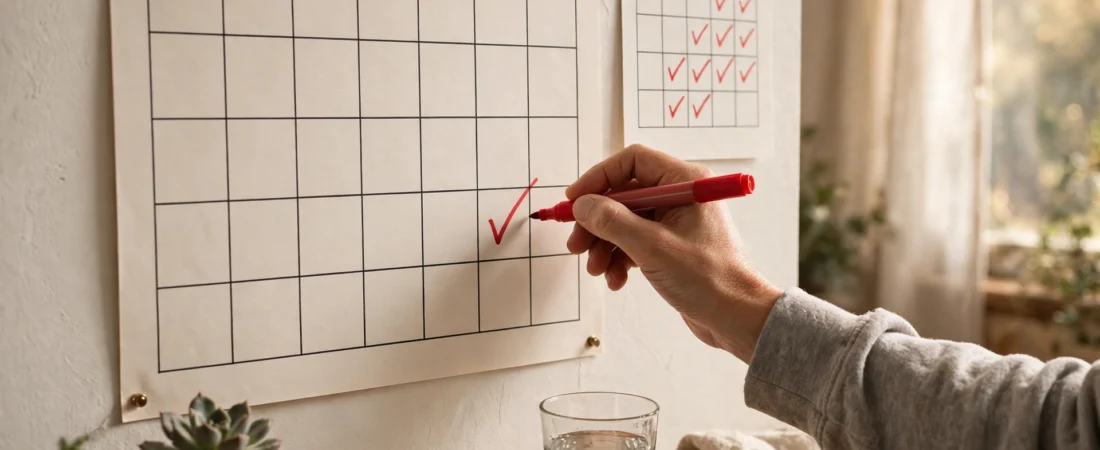
Most habits don’t die in week one. They die in week three, on an ordinary Tuesday, when the 6am alarm goes off and the run that felt so exciting on New Year’s Day suddenly feels like a chore. If you’re wondering how to stay consistent with habits past that first burst of enthusiasm, you’re asking the right question: starting a habit and keeping one are two different skills.
Motivation is a terrible engine for consistency — it shows up loud and leaves early. The people who stick with habits aren’t more disciplined than you; they’ve built systems that keep the habit going on days they don’t feel like it. Roughly 40% of what we do each day runs on habit, not decisions, so make the decision once and let the system carry it.
1. Give every habit a bad-day version
Most consistency plans are designed for your best day: twenty minutes of meditation, a full gym session, a home-cooked dinner from scratch. That works on a calm Sunday — not on the day your train is cancelled and your toddler is ill.
So give every habit two versions: the full one, and a floor version so small it feels almost silly. Ten press-ups becomes two, a 30-minute walk becomes a stroll to the end of the street, a chapter becomes one page. A habit you do badly still counts.
BJ Fogg’s formula: behaviour happens when motivation, ability and a prompt line up. On a bad day motivation is low, so make the habit easier — shrink it until skipping feels harder than doing it.
2. Decide the when and where before the day starts
“I’ll exercise more” fails because it has no appointment. “I’ll walk for twenty minutes after lunch, around the park by the office” has a time, a place and a trigger.
Psychologists call these if-then plans. You decide in advance: when situation X happens, I will do Y. A 2006 meta-analysis by Gollwitzer and Sheeran found these plans improved goal achievement with a medium-to-large effect. You stop spending willpower on deciding, because the decision is already made.
Write it in one sentence: “After my morning coffee, I will write for fifteen minutes at the kitchen table.” Coffee is the cue, the table is the place, fifteen minutes is the dose. No negotiation at 7am — yesterday-you already cast the vote.
3. Bolt the new habit onto an old one
New habits struggle because they need a reminder, and reminders are easy to ignore. Old habits don’t need reminding — you brush your teeth, make coffee and lock the front door without thinking. Attach the new behaviour to one of those.
This is habit stacking: the existing routine becomes the prompt. After I brush my teeth, I’ll floss one tooth; after I put the kettle on, ten squats while it boils; after I sit down on the train, I’ll open the language app. Duckworth and Milkman call this piggybacking one of the most reliable ways to guarantee a cue is there when you need it.
Pick an anchor that’s rock solid and happens at roughly the same time every day. “After lunch” works; “after I check my phone” doesn’t — too vague, and you’ll check your phone forty times.
4. Let your surroundings do the nagging
You can white-knuckle your way past a biscuit tin for a week, but probably not for a year. We respond to what’s in front of us far more than to what we intended at 8am.
So redesign the room instead of redesigning yourself. Want to read more? Book on your pillow, phone charger in another room. Want to drink more water? A bottle on your desk beats a phone reminder, because the bottle is a prompt you can’t swipe away. Every bit of friction you remove from the good habit — and add to the bad one — is consistency you don’t have to manufacture.
Walk through your kitchen, your desk and your phone’s home screen, and ask what each makes easy and what it makes hard. Then move three things.
5. Pair it with something you actually want to do
Some habits are just dull — no discipline makes a treadmill exciting. The trick is to bundle the dull thing with something you genuinely enjoy.
Katherine Milkman calls this temptation bundling. In a 2014 study, gym members could only listen to an engaging audio novel while exercising — and that group came to the gym more often than the control group, for seven weeks. The exercise didn’t get easier. It got something to look forward to.
Only listen to your favourite podcast while you walk, only watch that series on the exercise bike, and save the good coffee for writing mornings. Keep the rule strict — if the podcast plays without the walk, the bundle breaks.
6. Track the week, not the streak
Tracking helps — seeing your progress in black and white is one of the few things that reliably keeps people going. But the way you count matters more than the counting itself.
A day-by-day streak is a harsh judge: miss one day and the number drops to zero, which is exactly the moment most people give up. A weekly rate is kinder and more honest. Five out of seven days of walking is a genuinely consistent week; four out of seven is still a habit that’s alive. Count your weeks, not just your days, and a bad Tuesday stops being a failure and becomes a statistic you can improve.
Tick the days off somewhere visible — a wall calendar, a notebook, or a free habit tracker that shows your week at a glance — and review it every Sunday. Always missing Fridays? That’s information, not a verdict: maybe Friday needs a smaller version, or a different time slot.
If streaks motivate you, keep them — our guide to building a habit streak shows how to do it without letting it own you.
7. Put another person in the loop
Private habits are easy to abandon because nobody notices. The moment another person is involved, skipping has a small social cost, and small costs add up.
It doesn’t need to be dramatic: a walking partner, a friend learning Spanish too, a colleague you message after every gym session. Milkman’s research found rewarding people for exercising together produced more exercise than rewarding them alone — the social part was doing real work.
A large Swedish study of New Year’s resolutions found something similar: of over a thousand people followed for a year, about 55% rated themselves successful, and the group with a moderate amount of support did best. Pick one person, agree on a check-in, and keep it light.
8. Use fresh starts — and stop waiting for the perfect one
Mondays feel different from Thursdays. In 2014, Dai, Milkman and Riis showed that goal-related behaviour spikes after temporal landmarks: the start of a week, a month, a semester, a birthday. Gym visits in their data rose by about a third at the start of a plain week — nearly three times the bump New Year gave. Landmarks let you file past failures under a closed chapter.
Starting on a Monday is fine; so is the first of the month. The trap is the serial reset: waiting for the next landmark every time you slip, so you spend your life restarting instead of continuing. Every fresh start puts you back at the hardest stage. Take the landmark when it comes, but don’t let it become the excuse — the best start date is usually tomorrow, or better, today after lunch.
Frame the habit as something to start, not something to stop. In that Swedish study, people with approach goals — things to do more of — succeeded about 59% of the time, against 47% for avoidance goals. “Walk every day” beats “stop being lazy”.
9. Write the plan for the week it all goes wrong
Every habit meets its real test in a bad week: a work trip, a cold, a house move, a deadline that eats your evenings. Most people have no plan for that week, so the habit just stops — and stopping is what kills it.
Write the plan now, while things are calm. If I’m travelling, the ten-minute hotel-room version. If I’m ill, the two-minute version and nothing else. If work runs late, the habit moves to lunchtime. These are if-then plans pointed at obstacles instead of triggers — the decision is made before the stressful moment arrives.
Consistency is a rate, not a streak. A habit you do four days out of seven, most weeks, for a year, will change your life far more than a habit you do perfectly for three weeks and then never again. The people who stay consistent aren’t the ones who never miss — they’re the ones who planned for the miss.
Frequently asked questions
How long does it take for a habit to feel consistent?
Lally and colleagues (2010) followed 96 volunteers and found an average of 66 days for a behaviour to become automatic — but the range ran from 18 to 254 days, and a 2024 review put the median at 59 to 66 days. Our guide to how long it takes to form a habit has the full numbers; the short version is, don’t watch the calendar — watch whether the habit still needs a decision.
What should I do if I miss a day?
Get back to it the next day, at the smaller floor version if you need to. Lally’s study found one missed day didn’t materially change how the habit formed — the damage comes from the second and third. One miss is a blip. Two is a pattern starting.
How many habits should I try to build at once?
One, properly. Two at most, and only if they use different times of day. Every habit needs attention in its early weeks, and attention is scarce. Add a second only once the first runs without thinking — usually a month or two in, not a week.
Do I really need to track my habits?
Not forever, but yes at the start. A free habit tracker turns a vague feeling into evidence and shows you the pattern of your misses — the weekday, the time, the trigger — so you can fix the system instead of blaming yourself.
Why do I always quit after about two weeks?
Because two weeks is when the novelty wears off and the habit still isn’t automatic — the flat stretch James Clear calls the plateau of latent potential. If you always quit at two weeks, the habit isn’t too hard; the system around it is too thin. Shrink the daily version and fix one piece of friction.
Should I wait until Monday to start?
You can, but you don’t need to. Landmarks help, but the effect fades within days, and waiting for the perfect start date is usually procrastination in a respectable outfit. If it’s Wednesday, start Wednesday.
The short version
Staying consistent isn’t about more willpower. Shrink the habit until it fits a bad day, decide the when and where in advance, bolt it onto something you already do, make your surroundings help, pair it with something enjoyable, track the week not the streak, let one other person in on it, use fresh starts without waiting for them, and plan for the bad week. Pick one tactic — just one — and try it for seven days.
If you want somewhere simple to keep score, try our free habit tracker — no sign-up, no download, just a grid you tick each day and a weekly view that shows whether the habit is holding. A week from now, the ticks will tell you more than any pep talk could.