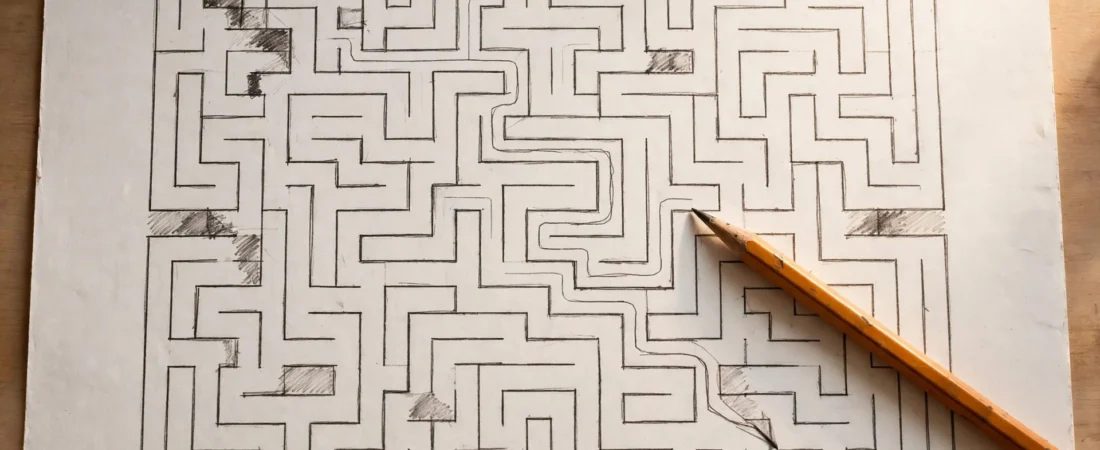
Most people attack a maze the same way. They dive in at the entrance, pick a corridor that looks promising, and hope for the best. It works. But it’s also the slowest way through, because you’re guessing at every fork while the route sits there waiting for anyone who stops guessing and starts using a method.
I timed myself on the same set of mazes twice: once by instinct, once with the techniques below. Mazes that took four minutes by feel took under ninety seconds with a system. These seven habits cut out the wandering, whether you’re racing the clock on a puzzle app or working through a printed maze with a pencil.
1. Start at the finish, not the entrance
Here’s the first thing to unlearn: the entrance isn’t the best place to begin. Flip the maze around and start from the exit instead.
The finish usually has one or two corridors feeding into it. The entrance often has five. So trace back from the goal — follow the only corridor leading away from it, and keep going until you reach a junction you can’t settle at a glance. Then switch to the start and head for that point. You’ve just turned one long search into two short ones that meet in the middle.
Maze designers also build their traps facing the entrance. The tempting false branches open in the direction you’re travelling, so they look like progress right up until they dump you in a dead end. Coming at them from the other direction, those same branches look like what they are: stubs that lead nowhere. If you only take one technique from this article, take this one.
2. Keep one hand on the wall
This is the famous one, the trick everyone half-remembers from school. Put your right hand on the wall to your right when you enter, and keep it there. Never lift it. Turn wherever the wall turns, walk into every dead end along that wall and back out again, and eventually the wall carries you to the exit.
It works because of how most mazes are built. In a maze where every wall connects back to the outer boundary — mathematicians call it “simply connected” — all the walls form one continuous edge, and following that edge means you pass every point on it, exit included.
But know its limits. If the finish sits in the middle of the maze on a detached island of wall, following the outer wall loops you around the outside forever and never touches the island. Loops do the same thing — your hand can end up circling an inner ring while the exit sits somewhere else entirely. So use the hand-on-wall rule on easy and medium mazes, where the grid is small, and switch to a different method the moment you spot loops or a centre finish.
3. Fill in the dead ends before you trace anything
If you can see the whole maze at once — on paper, or on a screen — this is the cleanest method there is, and it’s the one competition solvers reach for first. Instead of hunting for the right path, you delete everything that can’t be the path.
Scan the maze for dead ends: corridors with only one way in and no way onward. One like that can never be part of the route from entrance to exit, because going in means coming back out the same way. Lightly shade each one, working from its closed tip back to the first junction where it branched off.
Then do it again. Filling those stubs creates new dead ends at the junctions you just sealed, so shade those too. Keep repeating. When you can’t find any more dead ends, the corridors left unshaded form the solution — sometimes the only path left standing on the whole page.
One caveat: it only works when you can see the entire maze. It’s no use inside a hedge maze. But for printed mazes and puzzle apps, it’s the fastest approach going.
4. Leave breadcrumbs at every junction
When you can’t see the whole maze — you’re inside it, or the grid is too big to take in at a glance — you need a method that works from the ground. That’s where Trémaux’s algorithm comes in, named after the 19th-century French engineer Charles Pierre Trémaux and written up by the mathematician Édouard Lucas in the 1880s.
The idea is simple: mark every passage as you walk it. At a junction, always prefer a passage with no marks on it. If every passage has one mark, take any of them. And never, ever enter a passage that’s already marked twice — that’s a corridor you’ve walked both ways, which means it’s a dead end in disguise.
On paper, the marks can be tiny ticks at each junction. On a phone, most maze games let you tap back along your path or offer a few hints — our free arrow puzzle gives you three hints per level and lets you retrace by tapping any cell on your path. The marks do the remembering so you don’t have to. Trémaux’s method is slower than dead-end filling on a printed maze, but it’s the one method that guarantees a way out of any maze, loops included.
5. Look three moves ahead before you commit
Here’s the habit that probably saves more time than any other technique on this list, and it takes no learning at all. At every junction, glance down each branch before you draw anything.
Most wrong turns announce themselves early: a corridor narrowing to a stub within a few cells, a turn doubling straight back toward where you came from, a branch curling around to rejoin a corridor you’ve already walked. If you can see a branch closing off or curling back within a short distance, skip it without walking it.
Every wrong branch you walk costs you twice: once going in, once coming back out. On a maze with a dozen junctions, skipping just three bad branches can cut your time in half. It’s also the technique that separates fast solvers from slow ones in timed puzzle games — the fast ones spend a second looking and save ten seconds walking.
6. Find the bottleneck
Some corridors are doors that every route has to pass through. A long wall with a single gap in it. A narrow neck between two halves of the maze. A bridge between two clusters of corridors. Find those first, and the maze falls apart into smaller, independent chunks.
Once you’ve spotted the bottlenecks, solve the connections between them first — which gap do you need, in which order — and then fill in each section on its own. A big maze becomes three small ones, and small ones are easy.
Spotting bottlenecks takes practice, because you’re reading the shape of the whole maze rather than the corridor in front of you. Before you start, spend ten seconds just looking: find the walls that stretch furthest, and the gaps in them. More often than not, the solution runs straight through those gaps.
7. Climb a ladder, and time yourself
Speed comes from practice on the right difficulty, not from grinding the hardest maze you can find. Start on easy mazes until tracing without dead ends feels automatic. Move to medium when the corridors get longer and the junctions get busier. Step up to hard when dead-end filling starts to feel worth the effort.
And time yourself. A stopwatch changes how you solve — it forces you to use the techniques instead of drifting back into guessing, and it gives you a number to beat next time. Our free arrow puzzle game is built for exactly this: 100 levels climbing from gentle to genuinely tricky, with three hints per level when you get stuck. If you want a gentler start, the free maze games for kids are a good warm-up rung before the harder grids. And if you’re new to the game, our guide to how to play Arrow Puzzle covers the rules, the droplet lives and the hint system.
What slows most people down
Four mistakes account for most wasted time in maze solving, and all four are easy to fix.
First, solving in pen. A pen can’t be undone, so every wrong turn becomes a permanent mess. Use a pencil — or a puzzle app with an undo button — and backtracking stops costing you anything.
Second, tracing along the walls instead of down the middle of the corridors. Your line gets tangled with the maze’s own lines, and you can’t tell where you’ve been. Draw down the centre of each passage and your route stays readable.
Third, re-walking the same branch because you didn’t mark it. That’s what the breadcrumb method is for. If you keep arriving at the same junction with no idea which branches you’ve tried, you’re solving from memory, and memory is the first thing to go under time pressure.
Fourth, starting over from scratch after every dead end. Don’t. Backtrack to the last junction and try the next branch. The path behind you is still good — only the last choice was wrong.
Frequently asked questions
What’s the fastest way to solve a maze?
On paper or on screen, dead-end filling combined with spotting bottlenecks is the fastest approach. For small, simple mazes, the hand-on-wall rule is fast enough. The slowest approach is guessing at every junction with no method at all.
Does the right-hand rule always work?
No. It only works on mazes where all the walls connect to the outer boundary. If the maze has loops, or the finish sits on a detached island of wall in the middle, following one wall can loop you around forever. Switch to Trémaux’s method or dead-end filling instead.
Can you solve a maze without any guessing?
Mostly, yes. Dead-end filling leaves only the true path standing, with no guessing involved — but you need to see the whole maze. When you’re solving from inside, or on a very large grid, some trial and error at junctions is normal. The trick is making each guess cheap by marking where you’ve been.
How do I get faster at mazes?
Practise on a ladder: easy until it’s automatic, then medium, then hard. Time yourself, and learn one technique at a time — start with working backward from the exit, then add dead-end filling.
Do these techniques work on phone maze games?
Yes. Working backward and dead-end filling by eye both work on screen, and marking junctions is easier in an app because you can tap to retrace. Timed modes and hint limits in games like Arrow Puzzle are good training for solving under pressure.
What is Trémaux’s algorithm in simple terms?
Mark every passage as you walk it, prefer an unmarked one at each junction, and never walk a passage marked twice. It guarantees you’ll find the exit of any maze, even one with loops — just slower than dead-end filling when you can see the whole puzzle.
The short version
Mazes reward method, not luck. Work backward from the exit, keep a hand on the wall when the maze is simple, fill in the dead ends when you can see the whole puzzle, and leave marks at every junction when you can’t. Look ahead before you commit, find the bottleneck that splits the maze in two, and practise on a ladder that actually climbs.
The fastest way to make it stick is a few timed rounds right now. Our free arrow puzzle runs in your browser with no download and no sign-up — 100 levels, three hints per level, and a clock that keeps you honest. Try the techniques above on the first ten levels and watch your times drop.