“How many days until Thai Pongal 2027?” Here’s the short answer: the main day lands on Friday, 15 January 2027 — the first morning of the Tamil month of Thai, when half of Tamil Nadu is up before dawn boiling sweet rice in brand-new clay pots. The live timer above is counting down to that morning to the second, so whatever figure it shows you right now is the true number. No stale day-counts below, promise.
This one’s different from most of the festival countdowns on this site, and it’s worth saying so up front. Thai Pongal isn’t a single date on a lunar calendar — it’s a four-day harvest festival that runs on the Sun, with a dish of the same name at its centre. The “pongal” is literally the boiling over: rice, milk and jaggery bubbling up in a new earthen pot, and the shout of “Pongalo pongal!” when it does. Everything below is written for this festival — its dates, its days, and the one morning everything is timed around.
The date, properly nailed down
Friday, 15 January 2027. That’s the day India celebrates Thai Pongal, the second and main day of the four-day festival. And if you’re wondering why a few websites print the 14th instead — no, they haven’t made a mistake, and neither have we.
The reason is that Pongal is a solar festival. It marks the exact moment the Sun crosses into Capricorn (Makara), which is also the instant the Tamil calendar flips into the month of Thai. In 2027 that crossing happens on the evening of Thursday 14 January — astroyogi’s calculation puts the sankranti moment at 9:14 PM IST, divinesansar has it at 7:44 PM — so India wakes up on the 15th with the festival already underway. Calendars that date festivals by the solar moment can print the 14th; Tamil Nadu, Sri Lanka and most Indian sources observe the 15th. The same solar-moment quirk creates the 14/15 split on Makar Sankranti — the North Indian name for the same astronomical event — which our Makar Sankranti 2027 countdown article covers in detail.
One more wrinkle for readers outside India: in time zones far west of IST, the sankranti moment falls during Thursday daylight hours, so some diaspora calendars list 14 January. Drik Panchang’s Dublin page, for instance, shows Thursday the 14th for 2027. Same Sun, same festival, different side of the date line.
The weekday line-up for India, checked against the calendar:
- Bhogi — Thursday, 14 January
- Thai Pongal (main day) — Friday, 15 January
- Mattu Pongal — Saturday, 16 January
- Kaanum Pongal — Sunday, 17 January
A Friday main day into a weekend. The festival-planning gods were kind in 2027.
Four days, four different festivals
Pongal is one festival in name but four in practice, and each day has its own mood. Here’s the whole arc:
- Bhogi (Thursday 14 January) opens with fire. Before dawn, households burn old, worn-out things in bonfires — the literal burning of the past year — while homes are cleaned and freshly painted. It’s dedicated to Indra, the god of rain, with thanks for the water that made the harvest possible. Think of it as the festival’s spring clean, with flames.
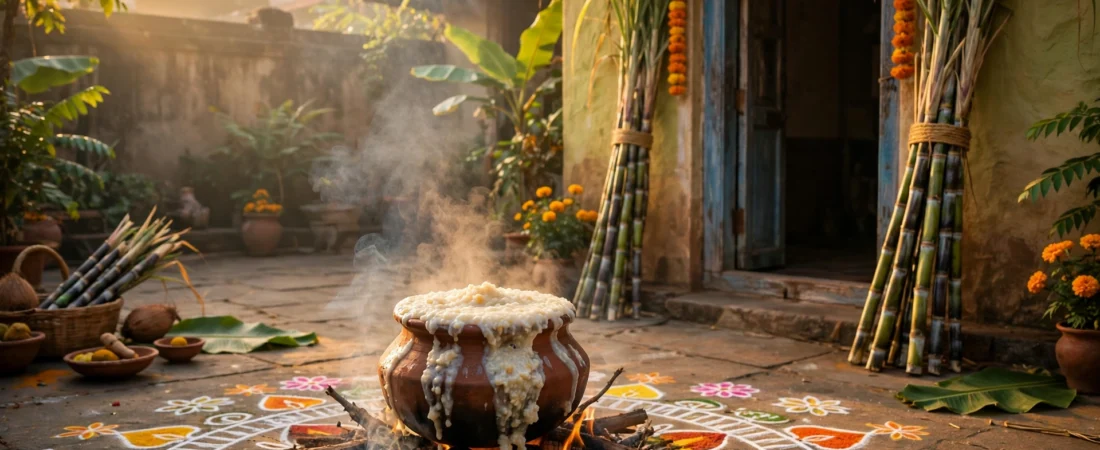
- Thai Pongal (Friday 15 January) is the main event. The Sun god Surya is worshipped at dawn, and the sweet pongal dish is cooked outdoors — usually in the courtyard or on a terrace — in a new earthen pot, facing the rising sun. The first helping goes to Surya. New clothes, fresh kolams on the doorstep, sugarcane stalks tied at the doorway: this is the postcard day.
- Mattu Pongal (Saturday 16 January) belongs to the cattle. Cows and bulls are bathed, their horns painted in bright colours, garlanded with flowers and bells, and fed the sweet pongal. It is a day of open gratitude for the animals that pulled the plough — and in rural Tamil Nadu it’s the day of Jallikattu, the famous bull-taming sport, most famously at Alanganallur near Madurai.
- Kaanum Pongal (Sunday 17 January) is the exhale. Families pack food, head outdoors, visit relatives, and spend the day together. In Chennai the beaches fill up; in villages it’s picnics under trees. The festival ends the way it should: with people.
“Pongalo pongal!”
The moment that gives the festival its name deserves its own section. The sweet pongal — sakkarai pongal, or chakkara pongal in some households — is deceptively simple: newly harvested rice, milk, jaggery, ghee, cashews and cardamom, simmered in a brand-new clay pot until it thickens and climbs. When it boils over the rim, everyone shouts “Pongalo pongal!” — may the pongal overflow. The overflowing is the whole point: it’s prosperity spilling out of the pot and, by extension, into the year ahead.
A couple of things visitors get wrong. First, it’s cooked outdoors and in daylight, with the family gathered round — the communal cooking is part of the ritual, not a convenience. Second, don’t confuse it with ven pongal, the savoury cousin made with pepper, cumin and ghee. Ven pongal is an everyday Tamil breakfast; sakkarai pongal is the festival dish, and it’s the sweet one that gets offered to the Sun first.
Around the pot, the house is doing its own decorating. Kolams — intricate patterns drawn in rice flour — appear on doorsteps and courtyards (they double as breakfast for ants and birds, which is rather lovely). Fresh turmeric plants and sugarcane stalks get tied at entrances. If you walk through a Tamil neighbourhood on the morning of the 15th, you’ll smell jaggery and woodsmoke before you see any of it.
The festival’s roots run deep: Thai Pongal traces back to Thai Niradal, a thanksgiving to the Sun celebrated during the Sangam period over two thousand years ago. Few festivals on the Indian calendar can claim a lineage that old and still be cooked, quite literally, the same way.
Cattle, courage, and Jallikattu
Mattu Pongal is the day most outsiders find most striking, and it’s worth understanding on its own terms. In an agrarian economy the cow and the bull aren’t symbols — they’re colleagues. The bathing, the painted horns, the marigold garlands, the feeding of the festival dish: it’s a day of thanks with no intermediary, and it’s genuinely moving to watch in a village.
Jallikattu is the louder half of the day. The bull-taming sport, held in arenas across rural Tamil Nadu during the Pongal season, draws enormous crowds — Alanganallur, Palamedu and Avaniyapuram near Madurai are the famous venues. An honest note: the sport has been fiercely debated and litigated over the years, and today it runs under regulation with veterinary oversight. Whatever your view, if you go, go to the established venues on the official days rather than an ad-hoc village event.
Will you get the day off?
In Tamil Nadu, yes — Thai Pongal is a state public holiday, and the state government typically declares a holiday run across the festival days. Sri Lanka observes Tamil Thai Pongal Day as a public holiday too. In the rest of India it’s generally a restricted holiday, so check your office calendar rather than assuming.
If you’re planning to be in Tamil Nadu for it, treat Thursday 14 through Sunday 17 January as peak days — that’s the guidance from travel planners, and the trains out of Chennai will agree. Book transport and stays early, especially if Madurai and the Jallikattu venues are on your list; accommodation around Alanganallur fills fast. The Friday main day falling into a weekend means you can do the whole four-day arc on minimal leave, which rarely happens this neatly.
Want the exact wait pinned down? The live countdown above is tracking the main day — Friday, 15 January 2027 — to the second. You can also set the same date on our free countdown timer tool if you’d like your own version ticking on your phone.
Thai Pongal 2027: FAQs
Is Thai Pongal the same as Makar Sankranti?
Same astronomical event, different festival. Both mark the Sun entering Capricorn, but Makar Sankranti is the North Indian observance while Thai Pongal is Tamil Nadu’s four-day harvest festival with its own rituals, dishes and days.
Why do some calendars say 14 January and others 15 January?
The Sun’s crossing into Capricorn happens on the evening of the 14th IST in 2027, so India celebrates on the 15th. Calendars that date the festival by the solar moment itself — or that sit in time zones west of India — may print the 14th.
What’s the difference between sweet pongal and ven pongal?
Sakkarai (sweet) pongal is made with jaggery and offered to the Sun god on the festival morning; ven pongal is the savoury, pepper-and-cumin version eaten as an everyday breakfast. Only the sweet one is the festival dish.
What actually happens on Mattu Pongal?
Cattle are bathed, their horns painted, garlanded and fed sweet pongal, in thanks for their work in the fields. In rural Tamil Nadu it’s also the day of Jallikattu, the traditional bull-taming sport.
Is Jallikattu really part of the Pongal celebrations?
Yes — it’s held during the Pongal season, most famously at Alanganallur near Madurai. It runs under regulation today, so stick to the official venues if you want to watch.
Where is Thai Pongal 2027 a public holiday?
Tamil Nadu and Sri Lanka observe it as a public holiday; in most other Indian states it’s a restricted holiday.
Counting down to the harvest
Thai Pongal 2027 — Friday, 15 January, with Bhogi the day before and Mattu and Kaanum Pongal rounding out the weekend — is one of the oldest continuously celebrated harvest festivals anywhere, and it still runs on the thing it has always run on: the Sun, the harvest, and a pot boiling over. The live countdown at the top of this page is tracking the main morning to the second. And if you’re counting down to something of your own, our free countdown timer will do the same job for any date you give it — no sign-up, no app, just the timer.