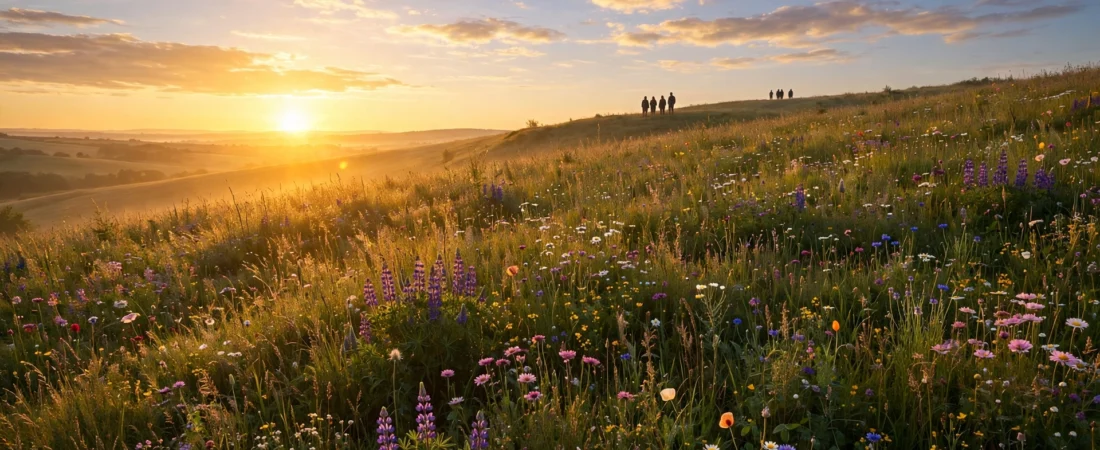
Summer 2027 arrives on Monday, 21 June — and if you’re already counting down to it, you’re not alone. The solstice is the one date on the calendar that’s set by the sky rather than by a committee, and it’s worth knowing exactly when it lands, because “summer” means two different things depending on who you ask. The timer at the top of this page counts it down to the second, so you don’t have to do the maths yourself. Here’s everything behind that date: the exact moment, how long the longest day runs where you live, and why the solstice has had people gathering at stone circles for thousands of years.
When does summer 2027 actually start?
There are two honest answers, and both are right.
Astronomical summer starts at the June solstice: Monday, 21 June 2027, at 14:11 UTC. That’s the figure published by the US Naval Observatory, and it’s the one most calendars use. A few sources round it to 14:10 UTC — same instant, different rounding — so don’t be thrown if you see both. The moment itself is a single instant, the same everywhere on Earth; only the clock reading changes. In New York it’s 10:11 in the morning, in London 3:11 in the afternoon, in Los Angeles 7:11 in the morning, and in India it’s 7:41 in the evening.
Meteorological summer starts three weeks earlier, on 1 June. Weather services use the calendar months — June, July, August — because it makes seasonal records tidier to compare. So if your idea of summer is warm evenings and the first proper barbecue, the season is already under way by the time the solstice arrives. If your idea of summer is the longest day of the year, that’s the 21st.
For most of us the solstice is the date that matters. It’s the turning point: the longest day, the shortest night, and the day after which the evenings start — almost imperceptibly at first — to shrink again.
What actually happens at the solstice?
On 21 June 2027, the Earth’s northern half is tilted as far toward the Sun as it ever gets: 23.44 degrees. The Sun climbs to its highest midday point of the year, takes its longest, highest arc across the sky, and stays up longer than on any other day.
That tilt is the whole story. The Earth doesn’t move closer to the Sun in June — in fact, we’re near our farthest point from it in early July. What changes is the angle. A tilted hemisphere catches sunlight more directly and for more hours, which is why a June afternoon feels so different from a December one even at the same temperature.
There’s a small quirk most people never notice. The earliest sunrise of the year in New York falls around 14 June, and the latest sunset around 27 June — the solstice sits between them rather than on top of either. The day itself is still the longest overall; the sunrise and sunset just don’t peak on the same date. If you’re planning a sunrise photo or an evening out, that’s worth knowing, because the “best” evening light actually lingers for a week or so after the solstice.
And the solstice doesn’t fall on the 21st every year. It drifts between 20, 21 and 22 June because the calendar year and the orbital year don’t match exactly. In 2026 it was 21 June, in 2027 it’s 21 June again, and in 2028 it slips to 20 June. Leap years nudge it back, which is why the date wanders around the same three days instead of marching steadily forward. If you’re curious about the mechanics behind the seasons, our guide to why days get longer in summer walks through the tilt and the orbit in plain language.
How long is the longest day where you live?
Day length on 21 June 2027 depends almost entirely on latitude. Near the equator the change is barely noticeable; head north and it becomes dramatic.
| Location | Daylight on 21 June 2027 |
|---|---|
| Equator | 12 hours 7 minutes |
| Mumbai (19°N) | 13 hours 17 minutes |
| Miami (26°N) | 13 hours 45 minutes |
| New Delhi (29°N) | 13 hours 58 minutes |
| New York (41°N) | 15 hours 6 minutes |
| Seattle (48°N) | 15 hours 59 minutes |
| London (52°N) | 16 hours 38 minutes |
| Stockholm (59°N) | 18 hours 37 minutes |
| Anchorage (61°N) | 19 hours 22 minutes |
| Fairbanks (65°N) | 21 hours 50 minutes |
| Arctic Circle (66.6°N) | 24 hours, the sun doesn’t set |
A few things jump out of that table. London gets nearly nine hours more daylight on the solstice than it does at the winter solstice, when the Sun is up for about 7 hours 50 minutes. Stockholm’s 18 hours 37 minutes means dusk barely turns into night at all. And in Fairbanks, Alaska, the Sun is up for almost 22 hours — people there mow their lawns at midnight in June, and they’re only half joking about it.
The differences between the days around the solstice are tiny. In New York, 20, 21 and 22 June differ in length by about two seconds each. So if clouds ruin the 21st, the 22nd is, for all practical purposes, the same day.
Midsummer, Stonehenge and the festivals around the solstice
People have marked this day for far longer than anyone has written the date down. The solstice sunrise lines up with the stones at Stonehenge, and thousands of people still gather there before dawn on 21 June to watch the Sun rise over the Heel Stone. English Heritage opens the site for the night, and it’s one of the few times you’re allowed to walk right up among the stones.
Scandinavia treats the solstice as midsummer rather than the start of summer, which is why its big celebration lands a few days after the astronomical date. In Sweden, Midsummer’s Eve falls on the Friday between 19 and 25 June — in 2027 that’s Friday 25 June — and Midsummer Day is the Saturday, 26 June. It’s one of the biggest days of the Swedish year: maypoles raised and danced around, flower crowns, pickled herring and new potatoes, and one of the few days the whole country genuinely stops working. Finland celebrates on the same weekend, and Latvia’s Jāņi on 23 June is the biggest night of the Latvian year.
The older European tradition tied the festivities to St John’s Day, 24 June, which the church laid over the solstice after the conversion — that’s why so many midsummer bonfires in Cornwall, Ireland and the Baltic states burn on the 23rd or 24th rather than the 21st itself. Further afield, Peru’s Inti Raymi, the Festival of the Sun, is held in Cusco on 24 June, a direct descendant of the Inca winter-solstice ceremony — June being winter in the southern hemisphere, where the same date means the opposite thing.
Modern pagans mark the solstice as Litha, one of the eight festivals on their Wheel of the Year. Whatever the label, the pattern is the same everywhere: the longest day is a natural excuse to be outside together, and it has been for thousands of years.
The southern hemisphere flips the whole thing
It’s easy to forget, sitting in the northern half of the world, that 21 June 2027 is the shortest day of the year for everyone south of the equator. In Sydney the Sun is up for just 9 hours 54 minutes — winter solstice, the start of astronomical winter. Buenos Aires, Cape Town and Auckland are all in the same boat, counting down to their own longest day in December instead.
So the countdown on this page is a northern-hemisphere countdown. If you’re reading from Australia or South America, the date still matters — it’s your midwinter marker, the day the light starts coming back. The solstice is the hinge for both halves of the planet; it just swings in opposite directions.
Planning around the longest day
The solstice is a good anchor for summer plans, because it sits right at the start of the season’s best weeks. A few things worth doing with the date in mind:
Book the trip early. The weeks around the solstice are peak season in northern Europe — Stockholm, the Scottish Highlands, Iceland — and the hotels and flights that are cheap in February aren’t cheap in May. If you’re aiming for the midnight sun above the Arctic Circle, the window is roughly late May to late July, with the solstice at its heart. Our guide to the best time to visit Europe to avoid the crowds has the month-by-month picture if you’re still choosing dates.
Use the light. Photographers call the hour after sunrise and the hour before sunset the golden hour, and on 21 June those hours stretch: in Berlin the Sun rises at 4:43 and doesn’t set until 21:33. That’s a long, slow evening for portraits, and it’s why so many wedding photographers quietly love late June. If you want the exact sunrise and sunset for your own town, our sunrise and sunset tool gives you the times for any date.
Mind your sleep. The flip side of 16-plus hours of daylight is that your body clock gets confused — blackout curtains are worth their weight in June, especially in the north. And if you’re travelling across time zones to chase the solstice, check the time difference between New York and London before you book, because a 14:11 UTC solstice lands at 10:11 in New York and 15:11 in London, and jet lag on top of a 19-hour day is a real thing.
Keep the countdown handy. The timer on our free countdown tool is already set to summer 2027 — open it any time and it shows the days, hours, minutes and seconds left, live. If you want the same countdown on your own page or in a message, the pre-set link is https://savehd.app/countdown/#n=Summer%202027&d=2027-06-21 — it opens the timer already pointed at 21 June 2027.
Frequently asked questions
When is the first day of summer 2027?
It depends on the definition. Astronomical summer starts at the solstice on Monday 21 June 2027 at 14:11 UTC. Meteorological summer, the one weather services use, starts on 1 June 2027.
What time is the summer solstice in 2027?
The solstice instant is 14:11 UTC on Monday 21 June 2027, per the US Naval Observatory. That’s 10:11 am in New York, 3:11 pm in London, 7:11 am in Los Angeles and 7:41 pm in India.
Is 21 June always the longest day of the year?
In the Northern Hemisphere, yes — the June solstice is always the longest day, though the date itself drifts between 20 and 22 June from year to year. In 2028 it falls on 20 June.
Why is the solstice on a Monday in 2027?
Because the solstice is an astronomical instant, not a calendar appointment — it lands on whatever weekday 21 June happens to be. In 2027 that’s a Monday, so the weekend celebrations (like Sweden’s Midsummer) fall on the Friday and Saturday after it.
What’s the difference between the solstice and Midsummer?
The solstice is the astronomical event on 21 June. Midsummer is the festival built around it, and in Scandinavia it’s celebrated on the nearest weekend — in 2027, Midsummer’s Eve is Friday 25 June and Midsummer Day is Saturday 26 June.
Is it summer in Australia on 21 June 2027?
No — it’s the opposite. 21 June is the winter solstice in the Southern Hemisphere, so Sydney gets its shortest day of the year (about 9 hours 54 minutes of daylight) and astronomical winter begins.
The countdown is already running
Summer 2027 starts on Monday 21 June at 14:11 UTC, and the timer above is already ticking toward it. Whether you’re planning a trip to the midnight sun, a Midsummer weekend, or just the first evening you can eat outside without a jacket, the longest day of the year is a good thing to have on the calendar. Open our free countdown timer any time to see exactly how long is left — down to the second.