If you’ve landed here asking how many days until Navratri 2027, here’s the short version: Sharad Navratri opens with Ghatasthapana on Thursday, 30 September 2027 and closes with Vijayadashami — Dussehra — on Saturday, 9 October 2027. As of mid-October 2026 that’s roughly a year of anticipation, and the live timer below is counting every second of it down. Nine nights, nine forms of the goddess — and, depending on where you live, either garba floors, pandal queues, or a golu doll display in your living room. This guide covers how the 2027 dates were confirmed, what each night actually honours, and how to plan ahead while you’ve got nearly a year of runway.
The exact 2027 dates (checked against the panchangs)
Sharad Navratri isn’t pinned to a Gregorian date — it’s tied to the lunar calendar, specifically the first nine days of the bright fortnight (Shukla Paksha) of the month of Ashwin. That’s why it drifts between mid-September and mid-October each year, and why the date has to be pulled from a panchang every single time rather than read off a wall calendar.
For 2027, the panchang sources agree. Drik Panchang’s 2027 Ghatasthapana page lists Thursday, 30 September for the kalash-sthapana that opens the festival. 4to40’s Navratri tables, calendarena’s festival calendar, and jyotishgen’s New Delhi page all print the same window: Thursday, 30 September to Saturday, 9 October 2027. The nine nights run from the 30th through Friday, 8 October (Maha Navami), and the festival closes on Dashami — Dussehra 2027, which falls on Saturday, 9 October.
One wrinkle worth knowing: a couple of panchang sources — including lagna360’s India table and a Kolkata-based panchang — mark Day 1 on Friday, 1 October instead. This isn’t a disagreement about the moon; it’s a convention difference. When the Pratipada tithi is read against sunrise rather than midnight, the observance shifts a day. The majority of Indian panchangs — and this article — lead with 30 September. If your family follows a Kolkata-style panjika, double-check which convention your household uses before you plan the Ghatasthapana.
And since people often ask which Navratri this is: 2027 has four of them. Chaitra (spring) Navratri ran 7–15 April 2027, the two quieter “gupt” Navratris fall in February and July, and this one — Sharad, the autumn festival — is the big public one, the one with the garba grounds and the pandals.
Nine nights, nine goddesses
The festival’s engine is an old story: the buffalo-demon Mahishasura had a boon that no man could kill him, so the gods pooled their powers into a warrior goddess. Durga fought him for nine nights and killed him on the tenth — which is why the nine nights of worship end with the tenth day’s victory celebration. Navratri literally means “nine nights,” and each night honours a different form of the goddess, the Navadurga:
- Day 1 — Shailaputri (Thu 30 Sep): the daughter of the mountains, riding the bull Nandi, trident in hand.
- Day 2 — Brahmacharini (Fri 1 Oct): the ascetic form — rosary and water pot, penance and calm.
- Day 3 — Chandraghanta (Sat 2 Oct): the warrior with the crescent-moon bell on her forehead, ten arms, ready for battle.
- Day 4 — Kushmanda (Sun 3 Oct): the creator of the universe with her smile, associated with warmth and energy.
- Day 5 — Skandamata (Mon 4 Oct): mother of Kartikeya (Skanda), shown holding the infant god.
- Day 6 — Katyayani (Tue 5 Oct): the fierce form born to sage Katyayana — the one the Mahishasura story centres on.
- Day 7 — Kalaratri (Wed 6 Oct): the dark, fearsome form who destroys ignorance and negativity.
- Day 8 — Mahagauri (Thu 7 Oct): the serene, fair form — Maha Ashtami, one of the festival’s biggest puja days.
- Day 9 — Siddhidatri (Fri 8 Oct): the granter of supernatural powers; Maha Navami.
Day 10 — Saturday, 9 October — is Vijayadashami, the day of victory. The nine nights belong to the goddess; the tenth morning belongs to the celebration.
Ghatasthapana: what actually happens on day one
Thirty September 2027 isn’t just “the start date” — it’s a specific ritual morning. Ghatasthapana means the installation of the kalash: an earthen or metal pot filled with water, ringed with mango leaves, topped with a coconut, and set on a bed of soil in which barley seeds (jau) have been sown. The pot is invoked as the goddess herself, and it stays in the home shrine for the full nine days.
Two details people get wrong: the kalash should be installed during the morning muhurat — Drik Panchang publishes city-wise timings each year, and it’s usually a tight 90-minute-to-two-hour window — and many households light an akhand jyot, a lamp that must not go out for the entire festival. If you’re doing the nine-day version at home, the practical prep is unglamorous but real: a diya that can burn unattended, enough ghee or oil for nine days, and someone around to mind it.
How different parts of India celebrate it
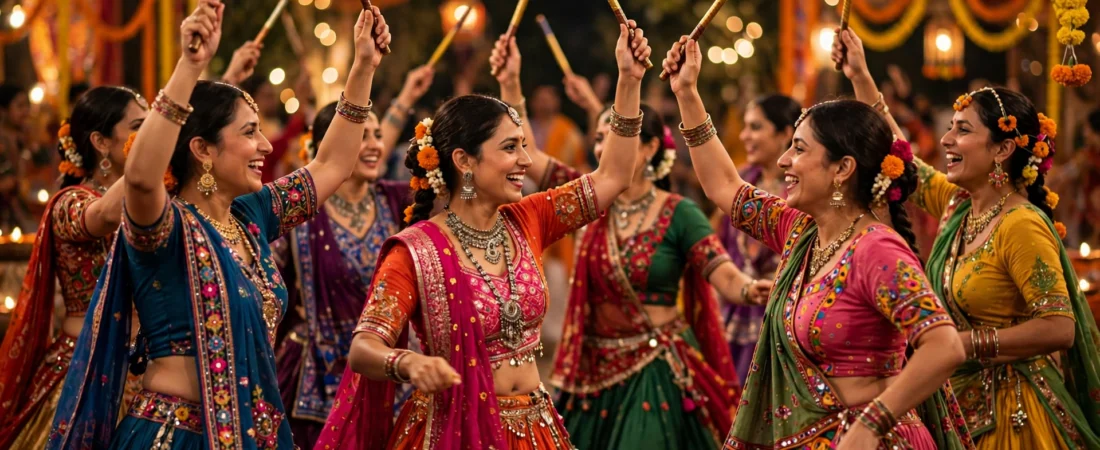
Say “Navratri” in Ahmedabad and people hear music. Gujarat’s garba and dandiya raas turn the nine nights into the world’s longest-running dance festival — massive grounds in Ahmedabad and Vadodara (Vadodara’s United Way garba is the famous one) fill with thousands of dancers in chaniya cholis and kediyus, circling to live music until well past midnight. If you’ve never been, 2027 is as good a year as any: you’ve got eleven months to learn the basic garba steps and buy the outfit.
Head east and the same nine nights look completely different. In West Bengal, Assam, Odisha and Tripura, the festival is Durga Puja — and in 2027 the overlap is exact: Durga Puja 2027 runs from Maha Shashthi on Tuesday, 5 October to Bijaya Dashami on Saturday, 9 October, sitting squarely inside Navratri’s second half. Same goddess, same victory story — expressed through pandals, dhak drums, and sindoor khela instead of dance circles.
Down south, Tamil Nadu and Karnataka set up golu — stepped displays of dolls and figurines telling mythological stories — in living rooms and community halls. Ayudha Puja, the worship of tools and instruments, falls on the ninth day. Kerala gives the festival’s end a scholarly twist: on Vijayadashami, toddlers are initiated into learning in the Vidyarambham ceremony, tracing their first letters in rice. Up north, the Ramlila stages build through the nine nights toward the burning of Ravana’s effigies on Dussehra.
Fasting rules, without the guesswork
Plenty of observers fast all nine days, and the rules are stricter than most people expect the first time. The standard vrat plate swaps regular grains for sabudana (tapioca), kuttu (buckwheat) or rajgira (amaranth) flour, samak rice, potatoes, and fruit — with sendha namak (rock salt) instead of table salt. Onion, garlic, lentils, rice, wheat and most spices are out for strict fasters; some keep it lighter and fast only on the first and last days, or on Ashtami and Navami.
The festival’s other big food ritual is Kanya Pujan, usually on Ashtami (7 October 2027) or Navami (8 October): nine young girls are invited home, fed a meal of halwa, puri and chana, and given small gifts — they’re honoured as living forms of the goddess. If you’re hosting for the first time, the honest advice is to confirm the date with your family’s tradition rather than the internet: Ashtami-vs-Navami for Kanya Pujan is one of those things every household is quietly sure about and no two households agree on.
Planning for Navratri 2027
Eleven months of lead time is a luxury — use it. If Gujarat’s garba is the goal, the big venues in Ahmedabad and Vadodara sell passes well in advance, and the well-known grounds fill up; booking travel and stay early is the difference between dancing and watching from outside the fence. Chaniya cholis and dandiya sticks are cheaper bought in the off-season than in the September rush. If Kolkata’s pandals are the goal instead, remember the overlap: Durga Puja’s main days (5–9 October 2027) are Navratri’s final stretch, so hotels near the big pandals will be priced for the Puja crowd — book those months ahead, not weeks.
For time off work, the calendar is kind in 2027: the festival runs Thursday 30 September to Saturday 9 October, swallowing two weekends, and Dussehra itself (Saturday, 9 October) is a gazetted holiday. And if you want the precise ticking figure rather than “roughly eleven months,” open this pre-set link — it loads the countdown already running toward Ghatasthapana morning.
Navratri 2027 FAQs
When is Navratri in 2027?
Sharad Navratri 2027 runs from Thursday, 30 September (Ghatasthapana) to Saturday, 9 October (Vijayadashami/Dussehra). A minority of Kolkata-based panchangs mark Day 1 on Friday, 1 October.
Why is it called “nine nights” if the festival spans ten days?
The worship covers nine nights (nava-ratri), one for each form of Durga. The tenth day, Vijayadashami, is the victory celebration — part of the festival arc, but not counted among the nine nights.
Is Navratri the same as Durga Puja?
They honour the same goddess and the same victory story, but they’re different regional expressions. Durga Puja (Bengal, Assam, Odisha) concentrates on the last five days — 5 to 9 October 2027 — while Navratri as celebrated in Gujarat or the South spans the full nine nights from 30 September.
What are the nine forms of Durga worshipped during Navratri?
Shailaputri, Brahmacharini, Chandraghanta, Kushmanda, Skandamata, Katyayani, Kalaratri, Mahagauri and Siddhidatri — one per night, in that order, ending with Maha Navami on 8 October 2027.
Why do some calendars show 1 October as the start?
A tithi (lunar day) doesn’t align with midnight-to-midnight, so panchangs that read the Pratipada tithi at sunrise place Ghatasthapana on 1 October. Most Indian panchangs use the 30 September convention.
How many days are left until Navratri 2027?
Roughly eleven months as of mid-October 2026 — but the exact figure changes every second. The live countdown at the top of this page tracks it in real time.
That’s the full picture: Ghatasthapana on Thursday, 30 September 2027, nine nights of the Navadurga, and Vijayadashami on Saturday, 9 October. Watch it tick down with our free countdown timer — this link opens it pre-set to Navratri 2027 — and if you’re mapping the whole autumn festival season, the Dussehra 2027 and Durga Puja 2027 countdowns are already live too.