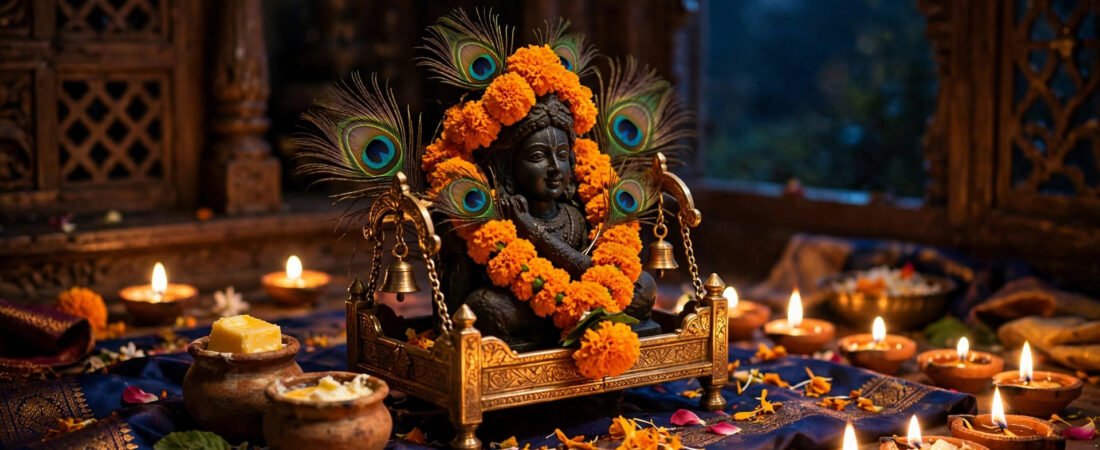
If you’re wondering how many days until Janmashtami 2027, the short answer is this: Krishna Janmashtami falls on Wednesday, 25 August 2027, roughly ten months out as of mid-October 2026. For the exact count ticking down by the second, use the timer above, or open this pre-set link that loads the countdown already running.
This one is a birthday celebration, and devotees treat it like one — homes stay decorated, the midnight hour is kept sacred, and the festival is kept simple in a way that suits a god who spent his childhood stealing butter.
The 2027 date, checked against the panchang
Janmashtami moves with the moon, so the date has to be pulled from a panchang every year rather than read off a wall calendar. The festival sits on the eighth lunar day (Ashtami) of the dark fortnight (Krishna Paksha) in the month of Bhadrapada.
For 2027, the tithi timings from Shubh Panchang are:
Ashtami tithi begins: Tuesday, 24 August 2027, 8:24 PM IST
Ashtami tithi ends: Wednesday, 25 August 2027, 7:19 PM IST
Rohini Nakshatra: Tuesday, 24 August 12:37 PM → Wednesday, 25 August 12:28 PM IST
Nishith Puja (midnight birth moment): 12:19 AM – 1:05 AM, the night of 25–26 August
Drik Panchang’s 2027 pages — the main Krishna Janmashtami page and its separate ISKCON page — both list Wednesday, 25 August 2027 for India. That’s worth noting, because in some years the Smarta and ISKCON traditions observe on different days when the tithi boundaries fall awkwardly. In 2027, both agree: the 25th.
2027 also brings a particularly auspicious alignment. The Rohini Nakshatra overlaps the Ashtami tithi through the night of the 25th — the same combination the tradition records for Krishna’s actual birth in Mathura. Some sources count this as the 5254th birth anniversary of Krishna.
Why the date shifts — and why 2027 is straightforward
Janmashtami isn’t fixed to a Gregorian date because it’s pinned to lunar geometry: the moon has to be in its waning eighth-day phase (Ashtami), inside the month of Bhadrapada, and — for the ideal version of the festival — the Rohini constellation has to be rising.
That lunar pinning means Janmashtami lands anywhere from mid-August to early September. Recent years show the drift: 2025 fell on 15 August, 2026 on 3 September, 2027 on 25 August, and 2028 will be 12 August.
Where it gets complicated is when Ashtami starts late one evening and ends early the next morning — different schools split the observance across two days. It doesn’t happen in 2027: the tithi spans a generous 23 hours, cleanly covering the night of the 25th, which is when the midnight puja happens. One date, no split, for both Smarta and ISKCON calendars. The only mild wrinkle is for devotees in the Americas, where the tithi windows land in local morning hours — but Indian calendars everywhere still mark the 25th, and Drik Panchang’s US city pages do too.
The story in brief
The festival marks the birth of Krishna, the eighth avatar of Vishnu. The story is set in Mathura, where the tyrant king Kamsa had imprisoned his sister Devaki and her husband Vasudev after a prophecy told him Devaki’s eighth child would kill him. One by one, Kamsa murdered the couple’s first six children; the seventh, Balaram, was miraculously transferred to the womb of Rohini. On the eighth pregnancy, at midnight on Ashtami, Krishna was born — and that night the prison doors sprang open, the guards fell asleep, and Vasudev carried the infant across the flooded Yamuna to Gokul, where he was raised by Yashoda and Nanda.
Krishna grew up in Gokul and Vrindavan as the divine cowherd boy — the Makhan Chor who stole butter from hanging pots, the flute-player, the child the gopis adored. Janmashtami celebrates the birth moment specifically, which is why everything centres on midnight: the puja peaks at the Nishith Kaal (12:19–1:05 AM in 2027), the hour tradition says he was born.
How the festival is actually celebrated
The midnight puja. This is the heart of it. Temples and homes perform the birth ritual at midnight — bathing the Balakrishna idol in milk, honey, ghee and curd (panchamrit), dressing it in new clothes and jewellery, placing it in a decorated cradle, and rocking it as devotees sing birth songs. The Shodashopachara (sixteen-step) puja is the full traditional version. If you only do one thing for Janmashtami 2027, make it the midnight hour.
Fasting. Most devotees observe a day-long fast on the 25th — many take nothing at all until midnight, others keep a phalāhār fast (fruit, milk, sabudana) through the day. The fast is traditionally broken (parana) the next day after both Rohini Nakshatra and Ashtami tithi have ended: as per Dharma Shastra after 6:21 AM on 26 August, or in the modern household tradition right after the midnight puja, roughly 1:05 AM. Check which your family follows; both are valid, and arguing about it is a Janmashtami tradition in its own right.
Dahi Handi — the day after. On Thursday, 26 August 2027, Maharashtra (and increasingly cities across India) stages Dahi Handi: human pyramids of Govindas trying to smash a clay pot of curd hung high above the street, re-enacting the Makhan Chor’s childhood raids. Mumbai’s famous handis draw pyramids ten tiers tall and prize money running into lakhs. If you’re travelling, the big public celebrations are worth seeing at least once.
Mathura and Vrindavan. The birthplace keeps the festival on another scale entirely. Temples across the Braj region — Krishna Janmabhoomi in Mathura, Banke Bihari and ISKCON in Vrindavan — run multi-day celebrations with Raslila performances, processions, and midnight crowds in the lakhs. For 2027, book trains and hotels early: Mathura’s mid-August weather is humid, the crowds are dense, and rooms near the temples sell out weeks ahead.
ISKCON and the diaspora. ISKCON temples worldwide — Delhi, Mumbai, Vrindavan, and abroad — observe on the same 25 August in 2027, with full-day kirtan, abhishek, and midnight aarti. Tamil Nadu’s Gokulashtami and Tamil Nadu/Karnataka observances often centre on homemade murukku, seedai and thattai, plus tiny Krishna footprints drawn in rice flour leading from the door to the puja room.
Planning for Janmashtami 2027
A few practical notes if you’re marking the date well in advance:
Midnight means midnight. The Nishith puja window (12:19–1:05 AM, night of 25–26 August) is the festival’s centre of gravity. Napping in the evening of the 25th is standard strategy among serious observers.
Fasting prep. If you’re keeping a nirjala (waterless) fast, eat a proper meal the evening of the 24th — the tradition itself prescribes a single meal the day before.
Travel. Mathura/Vrindavan for the real thing, or any ISKCON temple abroad — both observe the same Wednesday in 2027. Book early.
Puja shopping. Balakrishna idols, jhula (cradles), panchamrit ingredients and new clothes for the idol are the usual pre-festival buys. Do them the week before, not the day of.
FAQs
On which date is Janmashtami in 2027? Wednesday, 25 August 2027. Ashtami tithi runs from 8:24 PM on Tuesday, 24 August to 7:19 PM on Wednesday, 25 August (IST), per Shubh Panchang, with Drik Panchang confirming the same date for both the Smarta and ISKCON calendars.
Is Janmashtami 2027 on 25 or 26 August? The 25th. The midnight puja falls in the early hours of the 26th (12:19–1:05 AM), which is why some people loosely say “the night of the 26th” — but the festival date itself is Wednesday, 25 August. Dahi Handi celebrations follow on the 26th.
What time is the Janmashtami puja in 2027? Nishith Puja muhurat is 12:19 AM to 1:05 AM IST, the night of 25–26 August. Devotees in other cities follow local Hindu midnight; Drik Panchang publishes city-wise timings (roughly 11:45 PM–1:05 AM across Indian metros).
When should the Janmashtami fast be broken in 2027? Traditionally after both Rohini Nakshatra and Ashtami tithi have ended — after 6:21 AM on Thursday, 26 August, as per Dharma Shastra. Many households follow the modern practice of breaking the fast right after the midnight puja (around 1:05 AM).
Why do some years have Janmashtami on two different dates? When the Ashtami tithi starts late and ends early, Smarta and ISKCON traditions can place the festival a day apart. That doesn’t happen in 2027 — the tithi is a clean 23-hour span, so both schools observe on the 25th.
How many days are left until Janmashtami 2027? Roughly ten months as of mid-October 2026 — but the precise figure changes every second. The live countdown at the top of this page counts it down in real time.
That’s the full picture for Janmashtami 2027: Wednesday, 25 August, midnight puja at 12:19 AM, Dahi Handi the morning after. Watch the countdown tick with our free countdown timer — open this pre-set link to have it already counting to the festival. And the season doesn’t stop there: Raksha Bandhan 2027 (Tuesday, 17 August) is just a week earlier, and Ganesh Chaturthi 2027 (Saturday, 4 September) follows ten days later — both countdowns are already live.