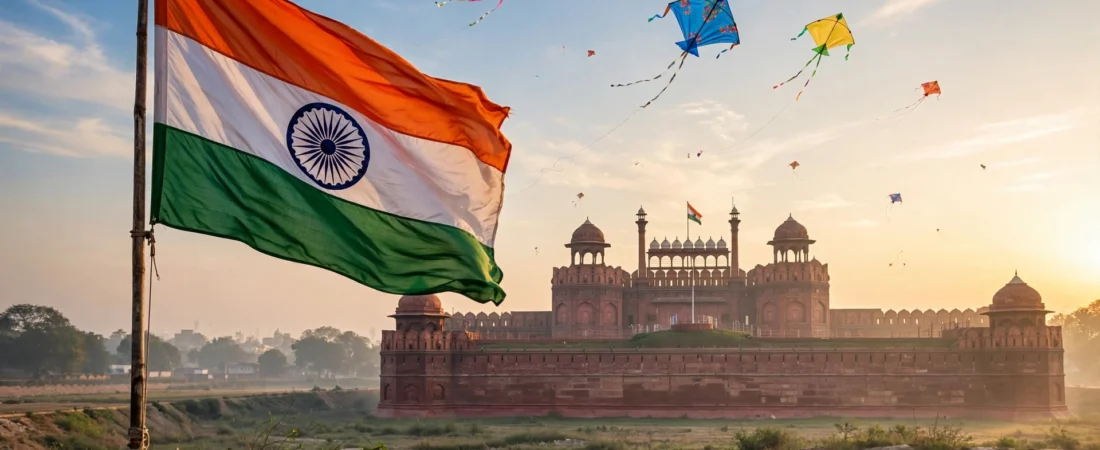
India’s next Independence Day falls on Sunday, 15 August 2027. It’s the country’s 81st — eighty years on from the midnight hour that ended British rule — and it lands on a weekend, which changes how most people will experience the holiday.
Below you’ll find a live countdown ticking down to the day, plus the history behind it, how India celebrates, and what a Sunday Independence Day means for your plans.
The short answer
Independence Day 2027 is on Sunday, 15 August 2027. It’s a gazetted national holiday, so government offices, banks, and most businesses close for the day — but since it’s already a Sunday, the “holiday” doesn’t buy most people an extra day off.
That’s a shame for anyone hoping for a long weekend. But it also means the celebrations concentrate into one big day: flag hoisting in the morning, the Prime Minister’s address from the Red Fort, and neighbourhood programmes, sweets, and kite-flying through the afternoon.
How India marks the day
The centrepiece is Delhi. The Prime Minister hoists the tricolour at the Red Fort and addresses the nation — a tradition that goes back to 1947, when the first flag was raised there. The address is followed by a ceremonial parade with contingents from the armed forces and police, tableaus from the states, and cultural performances by schoolchildren.
Away from the capital, the day looks different but no less serious. Schools and colleges hold flag-hoisting ceremonies in the morning, often with students marching, singing patriotic songs, and competing in essay or speech competitions. Housing societies organise their own small ceremonies. Streets and marketplaces get a fresh coat of saffron, white, and green, and in cities like Delhi, Jaipur, and Lucknow, rooftops fill with kite flyers — kite fighting on Independence Day is a genuine tradition, especially in Old Delhi, where the sky turns into a battlefield of paper and string.
If you’re travelling, expect the Red Fort area and central Delhi to be locked down with heavy security, and many monuments to be decorated. Most tourist sites stay open, though government offices and banks are firmly shut.
What the 81st means
Do the arithmetic and 2027 marks eighty years since 1947, making it the 81st Independence Day. Milestone anniversaries get the big treatment in India — the 75th in 2022 came with the Har Ghar Tiranga campaign, which asked every household to hoist the flag. There’s no official word yet on what the government has planned for the 80th year of independence, but it’s reasonable to expect something beyond the usual programme.
Worth knowing: India counts its independence from midnight on the night of 14–15 August 1947, when Jawaharlal Nehru gave the “Tryst with Destiny” speech to the Constituent Assembly. That’s why the celebrations begin on the morning of the 15th, even though the moment of independence was technically the night before.
A Sunday Independence Day: what it means for you
Here’s the practical bit. Since 15 August 2027 is a Sunday:
- Most offices are closed anyway, so the holiday adds nothing for the Monday-to-Friday crowd.
- Schools, which run Monday to Saturday in many states, lose their usual in-school celebration day — though most still hold programmes on the Saturday before.
- There’s no automatic long weekend. But Friday 14 August is a normal working day, so taking one day of leave gives you a four-day stretch from the 13th evening through the 16th — one of the cheapest long weekends on the calendar.
If you’re the sort who plans holidays around public holidays, this is exactly the kind of date worth running through a date calculator before the year fills up. And if you want to watch the countdown to other national days too, our free countdown timer handles any date you throw at it.
Making your own countdown
Want to keep the day on your radar? A countdown timer is the simplest way. Set the target to 15 August 2027, and you’ll see the days, hours, and minutes shrink every time you check. Some people use them for trip planning — booking trains or flights well before the August rush — and others just like watching a big date approach.
You can also count down to anything else: birthdays, exams, weddings, or the next long weekend you’re engineering out of a Sunday holiday.
Frequently asked questions
On which day is Independence Day in 2027?
Sunday, 15 August 2027. It’s a gazetted public holiday across India.
How many years of independence will India complete in 2027?
Eighty years, making it the 81st Independence Day.
Is 15 August 2027 a public holiday?
Yes — it’s a gazetted holiday, so government offices, banks, and most businesses are closed. Since it falls on a Sunday, it won’t feel like an extra day off for most people.
Why is Independence Day celebrated on 15 August?
15 August 1947 is the date India became independent from British rule, marked by the transfer of power at midnight on 14–15 August. The date was chosen by Lord Mountbatten, the last Viceroy, and announced months in advance.
What is the difference between Independence Day and Republic Day?
Independence Day (15 August) marks freedom from British rule in 1947. Republic Day (26 January) marks the day India’s Constitution came into force in 1950, making India a republic. Both are national holidays with flag ceremonies — the flag is hoisted on Independence Day and unfurled on Republic Day.
Will there be a long weekend around Independence Day 2027?
Not automatically — the holiday falls on a Sunday. Take Friday 14 August off and you’ll have four days in a row, from the evening of Thursday the 13th through Sunday the 16th.
Don’t let the date sneak up on you
Independence Day 2027 is still months away, but August travel in India books up fast — trains, flights, and hotel rooms around any national holiday go quickly. Set a reminder, plan around the Sunday, and check back here for the live countdown as the day approaches. Our free countdown tool will keep the exact time remaining, down to the second.