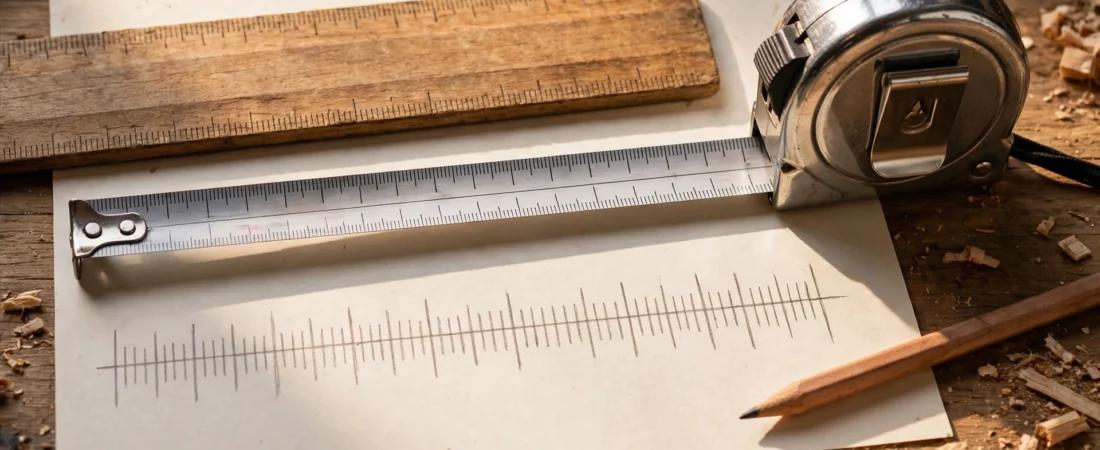
If you’ve ever stared at a tape measure that shows inches on one side and centimetres on the other, you’ve probably asked the same question: how many cm in an inch? The short answer is 2.54 cm — and unlike most conversions, that number isn’t rounded. It’s exact, by international agreement. So 1 inch = 2.54 cm, 2 inches = 5.08 cm, and 10 inches = 25.4 cm, every time, with no fudge factor hiding in the background.
That exactness is handy, because inches and centimetres keep colliding in ordinary life. A laptop bought in the US is sold by its diagonal in inches, a sewing pattern from Europe is marked in centimetres, and a bookshelf kit might give you both — sometimes on the same page, in different units. Once you know the one number and the one formula, the rest falls into place.
The formula (and how to go backwards)
Converting inches to centimetres is one multiplication:
centimetres = inches × 2.54
So a 7-inch phone screen diagonal works out to 7 × 2.54 = 17.78 cm. A 12-inch ruler is 12 × 2.54 = 30.48 cm. That’s it — no extra step, no second constant to remember.
Going the other way, you divide instead:
inches = centimetres ÷ 2.54
A 30 cm ruler, for example, is 30 ÷ 2.54 = 11.81 inches. A 100 cm table is 100 ÷ 2.54 = 39.37 inches, which is just over 3 feet 3 inches. If you’re converting a lot of numbers at once, try our free unit converter (https://savehd.app/unit-converter/) — it handles the arithmetic for you and saves the back-and-forth with a calculator.
A quick note on rounding: for most household jobs, one decimal place is plenty. Say 17.8 cm instead of 17.78 cm when you’re measuring a phone, and 30.5 cm instead of 30.48 cm for a ruler. But if you’re cutting fabric, fitting a part, or working from a technical drawing, keep two decimal places or the full result. Small rounding errors stack up fast over a long run of cuts.
Why 2.54, and why “exactly” matters
The number 2.54 wasn’t measured off a ruler and rounded to something tidy. It was agreed. Before 1959, the US inch and the British inch were microscopically different — the US version worked out to about 2.540005 cm. Nobody noticed while hanging a picture, but engineers making parts on opposite sides of the Atlantic did, because a bolt made in one country was supposed to fit a nut made in another.
In 1959, the US, the UK, Canada, Australia, New Zealand, and South Africa signed the International Yard and Pound Agreement. It defined the yard as exactly 0.9144 metres. Since a yard is 36 inches, the maths writes itself: 91.44 ÷ 36 = 2.54. From that day on, the inch was defined in metric terms — 25.4 millimetres, exactly — rather than by a physical bar kept in a vault somewhere.
That history also explains an old footnote you might meet in land-survey records: the US survey inch, a pre-1959 variant that lingered in surveying for decades. For anything you buy, build, sew, or print today, forget it. The international inch is the one in use, and it’s 2.54 cm everywhere.
A conversion chart you’ll actually use
Tables are boring until you need one at midnight with a flat-pack box open on the floor. Here are the values that come up most often, in one place:
| Inches | Centimetres |
|---|---|
| 1 | 2.54 |
| 2 | 5.08 |
| 3 | 7.62 |
| 4 | 10.16 |
| 5 | 12.70 |
| 6 | 15.24 |
| 7 | 17.78 |
| 8 | 20.32 |
| 9 | 22.86 |
| 10 | 25.40 |
| 12 (1 foot) | 30.48 |
| 15 | 38.10 |
| 18 | 45.72 |
| 24 (2 feet) | 60.96 |
| 36 (3 feet) | 91.44 |
| 48 (4 feet) | 121.92 |
| 60 (5 feet) | 152.40 |
| 72 (6 feet) | 182.88 |
Fractions trip people up more than whole inches, so keep these beside the chart: 1/8 inch = 0.32 cm, 1/4 inch = 0.64 cm (0.635 exactly), 1/2 inch = 1.27 cm, and 3/4 inch = 1.91 cm (1.905 exactly). If a pattern says “seam allowance 5/8 inch”, that’s 1.59 cm — close enough to call it 1.6 cm at the cutting table, but write down 1.59 cm if precision matters.
The mental trick for when there’s no calculator
Multiply by 2.5, then add a little. That’s the whole trick, and it’s within about 1.6% of the right answer — fine for a rough check in a shop, not fine for cutting a shelf to fit a gap.
Take 8 inches. 8 × 2.5 = 20. Add 8 × 0.04 = 0.32, and you land on the exact 20.32 cm. If you skip that last step, 20 cm is close enough to know an 8-inch tablet is roughly a 20 cm tablet, but don’t cut anything to 20 cm and expect it to match an 8-inch slot.
The other direction has a trick too: to guess inches from centimetres, divide by 2.5 and nudge down slightly. 50 cm ÷ 2.5 = 20 inches, but the exact answer is 19.69 inches, so “just under 20 inches” is the honest way to say it. For anything that has to fit, use our free unit converter (https://savehd.app/unit-converter/) or do the full division by 2.54 — guessing is for shopping, not for sawing.
Where this conversion bites: screens, paper, and sewing
Screens are the classic trap. A “55-inch TV” is 55 inches diagonally, not across. That diagonal is 139.7 cm, but the screen itself is about 121.8 cm wide and 68.5 cm tall on a 16:9 set, before the bezel and stand. A 65-inch TV sounds only 10 inches bigger, yet its diagonal is 165.1 cm and it needs roughly 143.9 cm of width. Measure your wall in centimetres, then check the width and height — not just the headline diagonal — before you order.
Paper sizes hide the same mix-up. US Letter paper is 8.5 × 11 inches, which is 21.59 × 27.94 cm. A4, the standard almost everywhere else, is 21 × 29.7 cm, or about 8.27 × 11.69 inches. They’re close enough to look interchangeable and different enough to jam a printer tray or leave a strange margin when you swap one for the other. If a form asks for A4 and you only have Letter, expect about 6 mm less height and a slightly wider sheet.
Sewing is where a lazy “1 inch ≈ 2.5 cm” habit costs real money. Over a single seam, 0.04 cm per inch is nothing. Over a 60-inch length of fabric, using 2.5 instead of 2.54 puts you 2.4 cm short — nearly an inch of missing fabric on a curtain or a dress panel. Patterns are written for the exact figure, so convert with 2.54, mark with a proper ruler, and save the 2.5 shortcut for rough estimates only. The same logic applies to knitting gauge, quilting blocks, and any project where ten small errors become one visible one.
Three mistakes that keep showing up
First, mixing up centimetres and millimetres. One inch is 2.54 cm but 25.4 mm — a factor of ten apart. If a drill bit is listed as 6 mm and you read it as 6 cm, you’ve just ordered something ten times too big. Write the unit down every time, even when it feels obvious.
Second, converting only one dimension. A rug listed as 120 × 180 cm isn’t “about 47 inches” — it’s about 47 × 71 inches. Convert the length and the width separately, or you’ll buy a rug that fits one way and not the other.
Third, rounding too early. If you round 2.54 down to 2.5, then multiply by 40, you’ve lost 1.6 cm. Round at the end, not at the start, and keep the full 2.54 in the middle of the calculation. Your future self, holding a piece that actually fits, will be grateful.
Frequently asked questions
Q: Is 1 inch exactly 2.54 cm, or just approximately?
A: Exactly. Since the 1959 International Yard and Pound Agreement, the inch has been defined as 25.4 millimetres, which is 2.54 cm. There’s no rounding in the definition itself.
Q: How many cm are in 5 inches?
A: 12.7 cm. That’s 5 × 2.54, and it’s a handy one to remember — it’s just over half a standard 30 cm ruler.
Q: How do I convert cm to inches?
A: Divide by 2.54. For example, 20 cm ÷ 2.54 = 7.87 inches, and 100 cm ÷ 2.54 = 39.37 inches.
Q: Is an inch the same in the UK and the US?
A: Yes, today it is. Both countries use the international inch of exactly 2.54 cm. The old US and British inches differed by a few millionths of a centimetre before 1959, which only mattered for precision engineering and old survey records.
Q: How many millimetres are in an inch?
A: 25.4 mm. Multiply inches by 25.4 for millimetres, or by 2.54 for centimetres — just don’t swap the two.
Q: Can I just use 2.5 cm per inch?
A: For a rough guess, yes, but you’ll be about 1.6% short every time. On 10 inches that’s 0.4 cm; on 100 inches it’s 4 cm. Use 2.54 whenever the result has to fit, match, or be cut.
So: one inch is 2.54 cm, exactly, and the formula is one multiplication away whenever you need it. Keep the chart above bookmarked for the common sizes, use 2.5 only as a rough check, and convert both dimensions when you’re dealing with anything flat — a screen, a rug, a sheet of paper. And if you’d rather skip the arithmetic altogether, try our free unit converter (https://savehd.app/unit-converter/): type in the inches, get the centimetres, and get on with the project. If you work with temperatures as often as lengths, our guide to the Celsius to Fahrenheit formula (https://savehd.app/celsius-to-fahrenheit-formula/) covers the other conversion that causes just as much head-scratching.