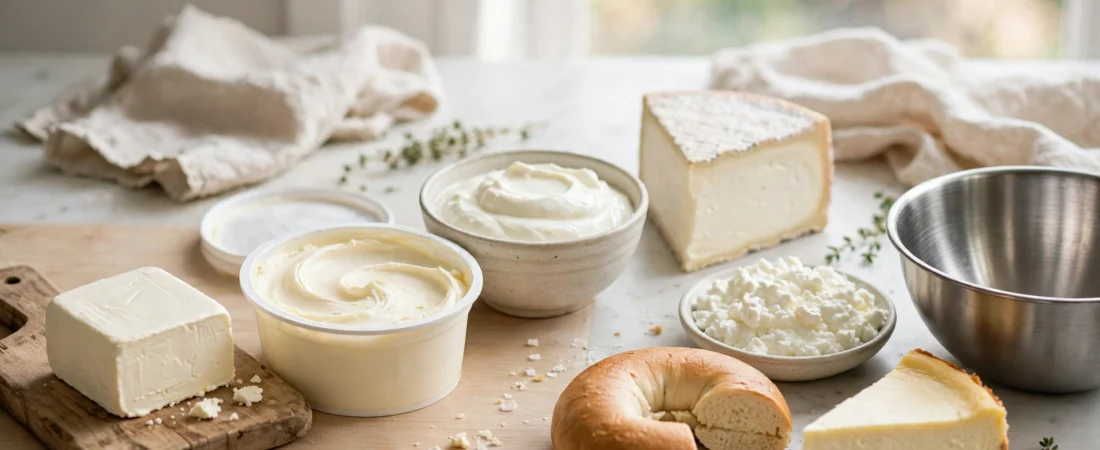
You open the fridge, reach for the cream cheese, and find an empty spot where the block should be. The cheesecake batter is half mixed, the bagels are already toasted, and the shops closed twenty minutes ago. Don’t bin the recipe. A tub of Greek yogurt saves a dip and ruins a baked cheesecake. Mascarpone makes glorious frosting and a cheesecake that’s a touch too rich. Pick by the job, not by what’s closest to hand.
Cream cheese does three things at once: it gives body, it brings a soft tang, and it adds richness. US federal rules say it must contain at least 33% milkfat and no more than 55% moisture, which is why it’s so firm straight from the fridge. Most substitutes are wetter — full-fat Greek yogurt is about 81% water, cottage cheese nearly 80% — and that extra water is what makes a swapped cheesecake weep or a frosting slide off a cake. So the golden rule: match the texture first, then fix the flavour.
The Quick Pick: Which Swap for Which Dish
| Swap | Ratio | Best for | Watch out for |
|---|---|---|---|
| Neufchâtel | 1:1 | Everything — closest match | Slightly softer, a touch less rich |
| Mascarpone | 1:1 | Frosting, no-bake cheesecake | Almost no tang; richer than cream cheese |
| Greek yogurt (strained) + butter | ⅔ cup yogurt + ⅓ cup butter | Spreads, dips, light frosting | Won’t hold stiff piping peaks |
| Cottage cheese (blended) | 1:1 | Dips, lasagne, savoury bakes | Must be blended dead smooth |
| Ricotta (drained) | 1:1 | Cheesecake filling, dips | Grainy unless drained and blitzed |
| Sour cream + butter | ¾ cup + ¼ cup | Frosting, dips, sauces | Thinner; add butter for body |
| Cashew cream cheese | 1:1 | Dairy-free dips, no-bake desserts | Pricey; flavour varies by brand |
If you’re in a rush and just need one answer: grab Neufchâtel if you can find it. It’s the only swap that works 1:1 in practically everything without a tweak.
1. Neufchâtel — The Closest Swap There Is
Neufchâtel looks like cream cheese, spreads like cream cheese, and tastes almost exactly like it. It’s the lower-fat French cousin, capped at 65% moisture, so it’s a little softer and a little less rich — but in a cheesecake, a frosting or a bagel spread, most people won’t notice the difference.
Use it 1:1, straight out of the packet, no prep at all. It holds its shape in frosting well enough to pipe, though very tall swirls may slump slightly on a warm day. For a baked cheesecake, it’s the safest swap you can make: the water content is close enough that you don’t need to change the eggs, the flour or the baking time. If your recipe calls for 225g of cream cheese, use 225g of Neufchâtel and carry on.
One honest caveat: it can be hard to find. Some supermarkets stock it next to the cream cheese, others don’t carry it at all. If yours doesn’t, the rest of this list is your backup plan.
2. Mascarpone — Richest, Smoothest, Sweetest
Mascarpone is the Italian triple-cream cheese that makes tiramisu what it is. It’s silkier than cream cheese, noticeably richer — around 43g of fat per 100g against cream cheese’s 34g — and it has almost no tang at all. For frosting, swap 1:1 and you’ll get something smoother and more luxurious than the original. Add half a teaspoon of lemon juice per 225g if you miss the tang. For no-bake cheesecake it’s near-perfect: the high fat helps the filling set firm in the fridge, and the result is dense and creamy.
Baked cheesecake is where mascarpone gets tricky. Its lower protein and higher fat mean a cheesecake made entirely from mascarpone comes out denser, richer and more likely to crack or turn greasy. If you’re set on using it, go 50/50 — half mascarpone, half whatever cream cheese you have left, or half Neufchâtel. That blend keeps the richness while the other half supplies the structure.
3. Greek Yogurt — Great for Dips, Needs Help for Frosting
Full-fat Greek yogurt is the swap most people reach for first, because it’s usually already in the fridge. It has the tang, it’s thick and creamy, and for dips and spreads a straight 1:1 swap works nicely. But yogurt is about 81% water, and that changes everything in baking. A baked cheesecake made with yogurt alone turns out wet and soft in the middle. Frosting is worse: plain yogurt won’t hold a peak, and your carrot cake frosting will slide off in a sad puddle.
Two fixes make it work. First, strain it. Line a sieve with cheesecloth or a clean tea towel, tip in the yogurt and leave it in the fridge for at least two hours — overnight is better. You’ll lose a surprising amount of whey, and what’s left is much closer to cream cheese in body. Second, for frosting, use the blend that test kitchens keep coming back to: for every 225g of cream cheese, use 150g of strained Greek yogurt plus 75g of softened butter. The butter gives the frosting the structure the yogurt can’t.
And use full-fat. Low-fat Greek yogurt is 84% water with barely 2% fat — it has nothing to hold the frosting up with.
4. Cottage Cheese — Blend It or Don’t Bother
Cottage cheese sounds like a strange swap until you blend it. Straight from the tub it’s curdy and wet, and nobody wants lumps in their cheesecake. But blitzed in a food processor or high-speed blender for a full minute, it turns into a smooth, mild, protein-rich cream that’s surprisingly close to cream cheese in texture.
Drain it first: tip it into a fine sieve for 30 minutes and let the liquid run off, then blend until completely smooth. Use it 1:1. It shines in savoury cooking — lasagne filling, stuffed pasta shells, creamy casseroles — where its mild, slightly salty flavour fits right in. Where it doesn’t work: frosting. Even blended smooth, cottage cheese won’t whip into stiff peaks, and the flavour is too lactic for a sweet frosting. And skip it for a baked cheesecake unless you’re willing to add an extra egg or a couple of tablespoons of flour to help the centre set — the water content is just too high otherwise.
5. Ricotta — Drain It, Blitz It, Then Trust It
Ricotta is the swap people forget about, which is a shame, because drained and blended ricotta makes a genuinely good cheesecake filling. The trick is the draining: fresh ricotta holds a lot of whey. Line a sieve with cheesecloth, leave the ricotta in the fridge for several hours, then blend it smooth. Use it 1:1, and add a teaspoon of lemon juice and a pinch of salt per 225g to bring back some of the tang cream cheese would have given you.
It works best in rustic bakes — a baked ricotta-style cheesecake, a carrot cake filling, a pasta bake.
6. Sour Cream + Butter — The Two-Ingredient Fix
Sour cream on its own is too thin. It’s tangy, sure, but it’s pourable, and no amount of wishful thinking will make it hold a cheesecake together. Pair it with butter, though, and the two cover each other’s weaknesses: the sour cream brings the tang, the butter brings the body.
For every 225g of cream cheese, use 170g of sour cream plus 55g of softened butter, beaten together until smooth. That mix works well in frosting — it’s tangier than a mascarpone frosting and lighter than the real thing — and in dips and sauces, where the extra moisture doesn’t matter. It’s the swap to reach for when your fridge is nearly empty. Most people have sour cream and butter on hand even when the cream cheese has run out, and the two minutes it takes to beat them together is faster than a trip to the shop.
7. Cashew Cream Cheese — The Dairy-Free Option
If dairy is the problem rather than an empty fridge, shop-bought cashew cream cheese is the most convincing dairy-free swap. The block-style ones — the kind sold in a foil-wrapped block, not a tub — behave most like real cream cheese, and you can use them 1:1 in dips, spreads and no-bake desserts.
Quality varies a lot by brand, so taste before you commit it to a recipe. Some are beautifully tangy, others taste mostly of cashews. The homemade version is simple if you have a blender: soak 150g of raw cashews overnight, drain, then blend with two tablespoons of lemon juice, a tablespoon of nutritional yeast and a pinch of salt until completely smooth. It keeps in the fridge for about five days.
What About Cheesecake Specifically?
Cheesecake is the hardest recipe to swap in, because it leans on cream cheese for structure, not just flavour. Here’s the honest ranking:
- Best: Neufchâtel, 1:1, no changes. Or a 50/50 blend of mascarpone and Neufchâtel if you want extra richness.
- Good with tweaks: drained ricotta or blended cottage cheese, plus one extra egg or two tablespoons of flour to help the centre set.
- Only for no-bake: mascarpone, strained Greek yogurt, cashew cream cheese. These set in the fridge rather than the oven, so the water problem never really shows up.
- Skip: plain Greek yogurt, sour cream on its own, and anything labelled “spread” — whipped cream cheese spreads are mostly air and water, and they’ll collapse in the oven.
What About Frosting?
Frosting is the second-hardest job, because it needs to hold its shape. Mascarpone is the winner here — it whips up beautifully and pipes clean swirls, provided you keep it cool. Neufchâtel is a close second. The strained-yogurt-and-butter blend works for a light sheet-cake frosting that you spread rather than pipe, but don’t try to build tall rosettes with it.
Swaps to Avoid
Not everything creamy belongs in a cream cheese recipe. Soft goat cheese is too strong and earthy for most bakes. Mayonnaise has the tang but none of the structure. Cream on its own is just liquid. And the tubs of “cream cheese spread” with herbs or garlic already mixed in will flavour your cheesecake in ways you don’t want. If a substitute’s name includes the word “spread”, keep it for bagels and look elsewhere for baking.
Frequently Asked Questions
Can I use Greek yogurt instead of cream cheese in cheesecake?
Yes, but only in a no-bake cheesecake, and only if you strain it first. Line a sieve with cheesecloth, drain the yogurt for at least two hours, and chill the finished cheesecake longer than usual. For a baked cheesecake, Neufchâtel is a much safer swap.
What’s the best cream cheese substitute for frosting?
Mascarpone, used 1:1. It’s smooth, rich and pipes well if you keep it cool. Add half a teaspoon of lemon juice per 225g if you want the tang back. Neufchâtel is the runner-up and works in every frosting recipe without adjustment.
Can I use mascarpone instead of cream cheese 1:1?
Yes, in frosting, no-bake cheesecake, dips and spreads. For a baked cheesecake, use a 50/50 blend of mascarpone and Neufchâtel instead — a full mascarpone cheesecake tends to be dense and prone to cracking.
Is Neufchâtel the same as cream cheese?
Almost. It’s a softer, slightly lower-fat French cheese with nearly identical flavour and a very similar texture. In most recipes you can swap it 1:1 and nobody will notice. It’s capped at 65% moisture, a touch wetter than cream cheese’s 55% limit, which is why it’s a little softer.
What’s a good dairy-free cream cheese substitute?
Block-style cashew cream cheese is the closest match — use it 1:1 in dips, spreads and no-bake desserts. For baking, blended silken tofu works in vegan cheesecakes. Both need a squeeze of lemon to replace cream cheese’s tang.
Can I use cottage cheese instead of cream cheese in lasagne?
Yes, and it’s one of the best swaps for the job. Drain it for 30 minutes, blend it completely smooth, and use it 1:1. It adds protein, it’s cheaper than cream cheese, and in a baked pasta dish the flavour difference disappears.
The Bottom Line
The best cream cheese substitute depends on the dish, not the dairy aisle. Neufchâtel wins on versatility — 1:1, no prep, works everywhere. Mascarpone wins on frosting and no-bake desserts. Strained Greek yogurt and blended cottage cheese win on dips and savoury cooking, as long as you respect their water content. And for dairy-free baking, cashew cream cheese or silken tofu will get you there.
Want more swaps like this? Our free substitute finder (https://savehd.app/substitutes/) covers dozens of common ingredients — if you’ve ever wondered what to use instead of butter, try our butter substitute guide (https://savehd.app/butter-substitute-in-baking/), and if you’re scaling a recipe up or down while you swap, our recipe scaling guide (https://savehd.app/how-to-scale-a-recipe-up-and-down/) has the maths worked out. For egg swaps, the egg substitute guide (https://savehd.app/egg-substitute-in-baking/) covers eight options that actually work in baking.