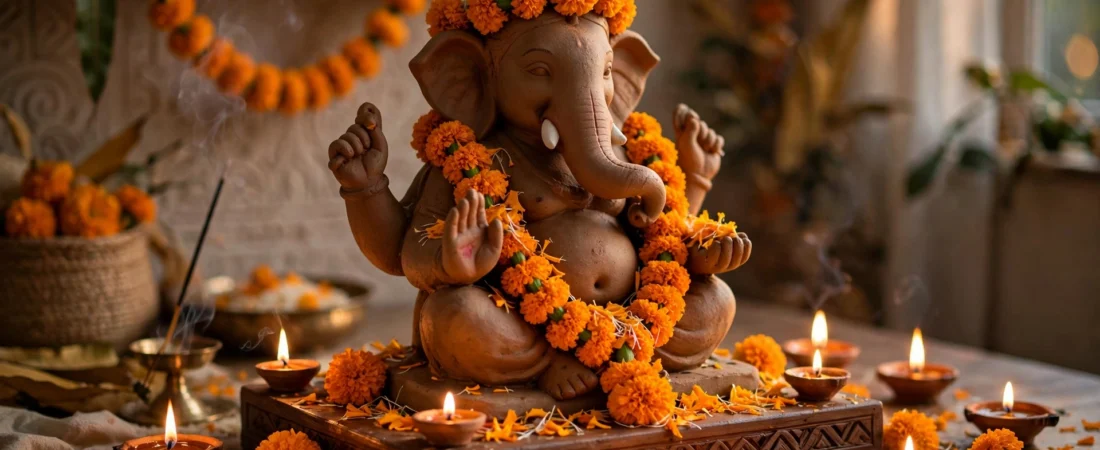
If you’re wondering how many days until Ganesh Chaturthi 2027, here’s the short answer: the festival falls on Saturday, 4 September 2027, which is roughly ten and a half months away as of mid-October 2026. For the exact figure — ticking down by the second — use the countdown tool below, or open this pre-set link that loads it already counting: countdown to Ganesh Chaturthi 2027.
Ganesh Chaturthi is Lord Ganesha’s birthday, and the start of Ganeshotsav — the ten-day stretch when Maharashtra essentially runs on modaks and drumbeats, and the rest of India joins in with home shrines of its own. Here’s everything worth knowing about the 2027 date: how the panchang fixes it, the tithi timings, the moon-sighting rule most people forget, and how to plan for it while you’ve got the better part of a year.
The date — and how the panchang lands on it
Ganesh Chaturthi isn’t tied to a Gregorian date at all. It falls on the Chaturthi tithi (the fourth lunar day) of the Shukla Paksha — the waxing fortnight — in the Hindu month of Bhadrapada. Because a lunar year runs about eleven days shorter than a solar one, the festival drifts across late August and September on our calendars: it was 27 August in 2025, 14 September in 2026, and now 4 September in 2027.
The tithi itself is short this time. Per shubhpanchang.com’s 2027 festival page, Chaturthi begins Friday, 3 September at 2:19 PM IST and ends Saturday, 4 September at 12:25 PM IST — so the festival is observed on Saturday. The madhyahna (midday) puja muhurat, the window most families and public pandals use for the idol installation, runs 11:24 AM to 12:25 PM on the 4th. I cross-checked the date against drikpanchang, timeanddate.com, calendarena.com, datetimeonline.com, and Wikipedia’s festival listing — all six agree on Saturday, 4 September 2027 for India, and the calendar arithmetic confirms the weekday.
One wrinkle worth knowing: if you’re outside India, your date might be Friday, 3 September. Tithis are read against local sunrise, and in London, New York, Toronto, and Dubai the Chaturthi boundaries fall a day earlier — jyotishgen.com’s city-by-city table lists all four on the 3rd. Worth a glance at your local temple’s announcement before you plan the day around it.
Ten days, from sthapana to visarjan
The festival doesn’t end when the 4th does — that’s just the beginning. Ganesh Chaturthi opens with sthapana, the installation of the idol, and pranapratishtha, the ritual that invites Ganesha’s presence into it. Then come the daily rhythms: morning and evening aarti, offerings of durva grass and red hibiscus (his favourites), and the sweet he never refuses — ukadiche modak, steamed rice-flour dumplings packed with coconut and jaggery, ideally still warm.
Not everyone keeps the idol the full ten days. Families immerse after a day and a half, three, five, or seven days depending on tradition and practicality. The grand finale — Anant Chaturdashi — falls on Tuesday, 14 September 2027. That’s when the big public idols go out in procession, streets fill with dhol-tasha pathaks, and the chant goes up one last time: Ganpati Bappa Morya, Pudhchya Varshi Lavkar Ya — come back soon next year. The immersion, visarjan, symbolises Ganesha carrying away the household’s obstacles as he returns to his celestial home.
The one rule everyone forgets: don’t look at the moon
Here’s the tradition that catches people out every year. On the night of Ganesh Chaturthi, you’re not supposed to look at the moon — Chandra Darshan is considered inauspicious, inviting mithya dosha, the blemish of false accusation.
The story goes back to the Ganesha Purana. Ganesha was riding home on his mouse after a feast when the mouse stumbled on a stone and he tumbled off, food everywhere. Chandra, the moon god, watched from above and burst out laughing at the sight. Ganesha didn’t take it well: he cursed the moon, declaring that anyone who looked at it on Bhadrapada Chaturthi would face false allegations and dishonour. Chandra begged forgiveness, and Ganesha softened the curse — the moon would wax and wane instead of vanishing — but the Chaturthi warning stayed.
And then there’s the proof story everyone cites: Krishna himself. Per the Bhagavata Purana, Krishna was once accused of stealing the radiant Syamantaka jewel after its owner Satrajit’s brother was killed by a lion while wearing it. Sage Narada traced the false accusation back to its root — Krishna had unknowingly caught the moon’s reflection in a bowl of milk on Chaturthi that year. He tracked down the jewel, cleared his name, and the episode became the tradition’s favourite evidence that nobody’s exempt.
Saw the moon by accident? Tradition has a fix: hear or recite the Syamantaka Mani story, offer a short prayer to Ganesha, and consider the slate clean. Many households also keep it simple by only avoiding the moon during the exact hours of the tithi rather than the whole night.
Why Maharashtra goes all out
In most of India, Ganesh Chaturthi is a home festival — a small idol, family aarti, modaks. In Maharashtra, it’s a civic event. The public (sarvajanik) celebrations trace back to 1893, when Lokmanya Tilak recast the festival as a community gathering — a way to bring people together in public at a time when the British discouraged large assemblies. It worked so well that the format never left.
Mumbai’s Lalbaugcha Raja, installed since 1934, draws millions over the ten days; the queue for darshan can run past midnight. Pune has its five revered Manache Ganpati — Kasba, Tambdi Jogeshwari, Guruji Talim, Tulshibaug, and Kesariwada — each with its own procession traditions. If you’re anywhere near either city in early September 2027, the pandal circuit is genuinely worth a day: the big mandals compete on themes, from social messages to elaborate replicas, and the evening aartis pull whole neighbourhoods into the street.
Clay or plaster? The eco-friendly question
The one real debate around the festival is what the idol’s made of. Traditional shadu mati (clay) idols dissolve in water within hours. Plaster of Paris ones don’t — they linger, and the chemical paints wash into rivers and the sea. After years of court orders and civic campaigns, the shift toward clay is well underway: Mumbai’s municipal corporation sets up artificial immersion ponds across the city every year so idols stay out of natural water bodies, and several states now restrict plaster idols outright.
If you’re celebrating at home, the simplest green option is a small clay idol immersed in a bucket or tub at home — the water, clay and all, can go straight into your garden or potted plants. Natural colours, no glitter, and you’ve sidestepped the whole visarjan logistics question. Order from a local kumhar (idol-maker) early; the good clay ones sell out well before September.
Planning ahead while you’ve got time
Roughly ten and a half months is a comfortable runway — here’s how to use it:
- Order the idol early. If you want a clay idol from a specific maker, don’t leave it to the last week of August. The popular kumhars take bookings months ahead.
- Travel plans. Trains into Mumbai and Pune around Ganeshotsav fill fast, and hotels near the big pandal routes go first. If you’re visiting family or doing the pandal circuit, book transport before summer 2027.
- It’s a Saturday. In 2027 the festival lands on a weekend, which makes pandal-hopping and family gatherings easy without burning leave. Note it’s a restricted (optional) holiday rather than a full public one — most offices outside Maharashtra stay open, so check your employer’s holiday list.
- Modak practice. Ukadiche modak are fiddly the first time — the rice-flour shell tears if the dough cools. One trial batch in August beats a crisis on the 4th.
What it’s called where you are
The festival wears different names across the country, and you’ll see all of them in 2027 coverage: Vinayaka Chaturthi or Vinayagar Chaturthi in Tamil Nadu, Chavithi in Andhra Pradesh and Telangana, Chovoth in Goa, Ganeshotsav across Maharashtra. In Maharashtra the festival also overlaps with Gauri’s arrival — Goddess Gauri is welcomed a day or two after Chaturthi in many homes, so you’ll hear “Gauri-Ganpati” as a combined reference. Same elephant god, same ten days, slightly different local flavour everywhere.
Frequently asked questions
What is the date of Ganesh Chaturthi 2027?
Saturday, 4 September 2027 in India — the Chaturthi tithi of Bhadrapada Shukla Paksha. In the US, UK, Canada, and Dubai, many temples observe it Friday, 3 September because the tithi falls differently against local sunrise.
When is Ganesh Visarjan in 2027?
The final immersion day, Anant Chaturdashi, is Tuesday, 14 September 2027. Many families immerse earlier — after 1.5, 3, 5, or 7 days — depending on household tradition.
Why shouldn’t you see the moon on Ganesh Chaturthi?
Tradition holds that looking at the moon on Bhadrapada Chaturthi invites mithya dosha — false accusation or dishonour — stemming from Ganesha’s curse on Chandra for mocking him. The prescribed remedy is hearing or reciting the Syamantaka Mani story.
How long does Ganeshotsav last?
Ten days, from Ganesh Chaturthi (4 September 2027) to Anant Chaturdashi (14 September 2027).
Is Ganesh Chaturthi a public holiday in 2027?
It’s a restricted (optional) holiday in most Indian states — and in 2027 it falls on a Saturday anyway. Maharashtra typically treats it as a full holiday; elsewhere, most offices remain open, so confirm with your employer.
What’s the shubh muhurat for Ganesh Sthapana 2027?
The madhyahna puja muhurat on 4 September 2027 runs 11:24 AM to 12:25 PM IST, per shubhpanchang.com. Timings vary slightly by panchang, so it’s worth confirming with your local one closer to the date.
The countdown is on
That’s the full picture for 2027: Saturday, 4 September for the sthapana, Tuesday, 14 September for the visarjan, and ten days of modaks, aartis, and Ganpati Bappa Morya in between. Watch the days tick down with our free countdown timer — this pre-set link loads it already counting to the festival — and if you’re mapping out the rest of the season, the Dussehra 2027 countdown (Saturday, 9 October) and the Diwali 2027 countdown (Friday, 29 October) are already live.