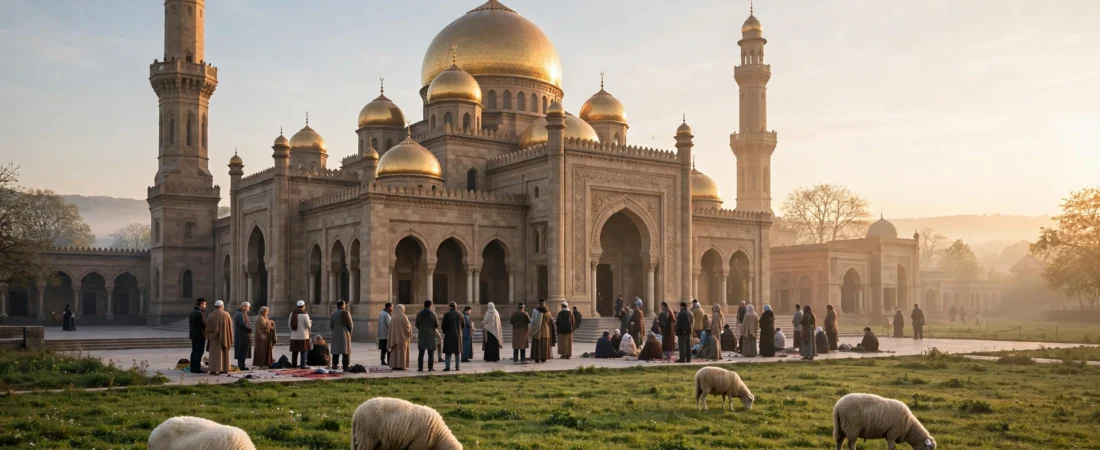
Wondering how many days until Eid al-Adha 2027? Here’s the straight answer: the Festival of Sacrifice is expected on Monday, 17 May 2027 — 10 Dhul-Hijjah 1448. As of mid-October 2026, that’s roughly seven months out, and the live timer below ticks it down to the second. Underneath, you’ll find the part that actually matters: how the date was pinned down, why Saudi Arabia may celebrate a day earlier, what happens across the four days, and how Qurbani really works.
Live countdown to Eid al-Adha 2027
The timer below counts down live — days, hours, minutes and seconds — to the main day of Eid al-Adha 2027. And if you’ve got another date on your mind, you can build your own countdown with our free countdown timer for anything from a flight home to the whole Eid holiday.
Monday 17 May 2027 — and how the date was verified
Islamic holidays don’t come from a fixed calendar announcement years out; they come from the moon. But the astronomical math is settled, and the consensus for 2027 is unusually clean. timeanddate.com lists Monday, 17 May 2027 as the US observance (marked tentative, as always). The Indonesian government has it in its official 2027 national-holiday list for the same Monday, with a collective leave day added on Tuesday 18 May — Jakarta plans its whole holiday economy around this date, so that’s a strong signal. History.com, calendardate.com, National Today, Muslim Hands USA, Awareness Days and Time Out Abu Dhabi all land on the same day, and the calendar check confirms 17 May 2027 is a Monday.
There’s one honest caveat, and it’s a big one: the Gulf may go a day earlier. Saudi Arabia runs on the Umm al-Qura calendar, and on that calculation 10 Dhul-Hijjah falls on Sunday, 16 May 2027 — with Arafah on Saturday 15 May and the Saudi private-sector holiday running 15–18 May. Indonesia’s Ministry of Religious Affairs and sites following the Saudi announcement track this line too. Meanwhile, countries with local moon-sighting committees — India, Pakistan, Bangladesh — can land a day later, on Tuesday 18 May. So treat 17 May as the consensus and keep one eye on the official announcement in your own country. Every Islamic date in this article carries that moon-sighting asterisk.
Why the moon gets the final say
The Islamic calendar is lunar: months begin when the new crescent is actually sighted, not when a spreadsheet says it should be. The astronomical new moon for Dhul-Hijjah 1448 occurs on 6 May 2027, and the crescent should be visible across most of the world on the evening of 7 May — but “should” and “was seen” are different things. Sighting committees in Saudi Arabia, the UAE, Indonesia, India and Pakistan each make their own call on the evening of 29 Dhul-Qa’dah. If the crescent isn’t seen, the month completes thirty days and everything shifts by a day.
That’s why two mosques in the same city can celebrate on different days: one follows the Saudi announcement, the other follows the local committee. Neither is making it up. The rule is the sighting, not the calendar — which is also why published dates this far out are always marked tentative. Watch for the official announcement on the evening of 6–7 May 2027, and don’t book non-refundable travel for the exact morning until it lands.
What Eid al-Adha actually commemorates
The festival remembers the story of Ibrahim and his son. In the Quranic telling, Ibrahim dreams that Allah commands him to sacrifice his son Ismail as a test of obedience. He prepares to do it — and at the last moment Allah intervenes, sending the angel Jibreel with a ram to sacrifice instead. The “Adha” in Eid al-Adha means sacrifice, and the ram that took Ismail’s place is why the day is still marked with the ritual slaughter of an animal.
It sits at the hinge of the Hajj pilgrimage, the fifth pillar of Islam. Eid falls on the final day of Hajj, when the roughly two to three million pilgrims who have stood at the plains of Arafah the day before perform the rite of sacrifice at Mina. That’s the scale of it: a single morning’s prayer repeated in hundreds of thousands of congregations, tied to the largest annual gathering on earth.
How the four days unfold
The Day of Arafah comes first — 9 Dhul-Hijjah, expected Saturday 15 May on the Saudi calendar, Sunday 16 May elsewhere. Pilgrims stand at Arafah from noon to sunset; it’s considered the pinnacle of Hajj. For everyone else, fasting on Arafah is a recommended Sunnah, and many Muslims treat it as the spiritual warm-up to the festival.
Eid morning itself starts before sunrise. The routine is old and specific: ghusl (ritual washing), best clothes, the Takbeer recited on the way to the prayer ground — Allahu Akbar, Allahu Akbar, La ilaha illa Allah — then the Eid prayer, two rak’ahs in congregation, followed by the khutbah. Only after that comes the Qurbani. Then the visiting starts: family, friends, food, gifts for the kids. Eid al-Adha is the longer, meatier, more communal of the two Eids — four days of it, not one.
The three days after Eid are the Days of Tashreeq (11–13 Dhul-Hijjah). Qurbani can still be performed on any of them, pilgrims at Mina perform the stoning of the Jamarat, and fasting is forbidden across all four days. The tradition’s instruction for these days is simple: eat, drink, and remember.
The Qurbani, and where the meat goes
The sacrifice isn’t symbolic theatre; the meat has a mandated destination. Tradition divides it into thirds: one third for the household, one third for relatives and friends, and one third for the poor and needy. That last third is the point of the exercise — Eid al-Adha is structured so that families who couldn’t otherwise afford meat eat well that week. In many countries the distribution is organized through mosques and charities, which collect and distribute Qurbani meat (and accept Qurbani donations from people who can’t perform the sacrifice themselves).
The animals are specific: sheep, goats, cows, camels — healthy, of the right age, slaughtered according to halal practice. And it’s a religious duty with a means test: the sacrifice is expected of those who can afford it, not of those who can’t. No one is supposed to go into debt for a goat.
If you’re booking travel around it, plan for the wobble
Mid-May 2027 is peak movement season in the Muslim world, and the moon-sighting asterisk applies to your itinerary too. A few practical notes: Saudi Arabia’s private-sector break runs roughly 15–18 May, with banks closed 16–20 May under the SAMA schedule — move any mid-May payments earlier. Indonesia pairs the 17 May holiday with collective leave on 18 May, so domestic travel in the world’s largest Muslim-majority country will be at its busiest that weekend. Flights into and out of the Gulf in the days before Eid run full and expensive; if you’re flying to be with family, book the earlier date and keep a buffer day, because a one-day moon shift can strand a tight connection.
For Qurbani logistics, the other thing to sort early is the animal or the charity donation — prices rise sharply in the final week, and the reputable charities close their Qurbani donation windows a few days before Eid. Sort it in April and it’s one less thing competing with the holiday rush.
The calendar keeps sliding
One detail worth knowing: Eid al-Adha 2026 fell on 27 May. The 2027 date is about ten to eleven days earlier, because the Islamic lunar year is roughly 354 days — eleven days shorter than the Gregorian year. The festival slides backwards through the seasons, completing a full loop every 33 years or so. Eid al-Adha spent the 2010s in high summer; by the early 2030s it’ll be arriving in April. The May timing of 2027 sits right in the middle of that long migration — warm enough for the outdoor Eid prayer grounds, without the punishing heat of the August Eids a decade back.
Frequently asked questions
When is Eid al-Adha 2027?
Monday, 17 May 2027 is the consensus date for the main day (10 Dhul-Hijjah 1448). Saudi Arabia’s Umm al-Qura calendar puts it on Sunday, 16 May, and local-sighting countries like India and Pakistan may observe it on Tuesday, 18 May. All dates await the official moon-sighting announcement.
How many days is Eid al-Adha?
Four. The main day is 10 Dhul-Hijjah, followed by the three Days of Tashreeq (11–13 Dhul-Hijjah). Qurbani can be performed on any of the four days, and fasting is forbidden throughout.
What’s the difference between Eid al-Adha and Eid al-Fitr?
They’re the two Eids of Islam, about two months apart. Eid al-Fitr (expected 10 March 2027) marks the end of Ramadan’s fasting; Eid al-Adha marks the culmination of Hajj and centers on the sacrifice. Eid al-Adha runs four days to Eid al-Fitr’s one to three, depending on the country.
Do I have to fast on the Day of Arafah?
It’s not obligatory, but fasting on 9 Dhul-Hijjah is a strongly recommended Sunnah for non-pilgrims — tradition holds it expiates the sins of the previous year and the coming one. Pilgrims at Arafah don’t fast; they need their strength for the standing.
Who has to perform Qurbani?
Those who can afford it. The sacrifice is a religious obligation on Muslims of means — roughly, anyone above the nisab threshold — and not required of those who can’t afford it. Many people fulfill it through a trusted charity that performs and distributes the sacrifice on their behalf.
Can the date still change?
Yes, by a day in either direction. Every date here is the astronomical expectation; the official date is confirmed by moon-sighting committees on the evening of 29 Dhul-Qa’dah (around 6–7 May 2027). If the crescent isn’t sighted, everything moves a day later.
Marking the wait
Seven months is a long runway — long enough to sort the Qurbani, book the flights, and warn the group chat. The timer at the top of this page counts it down to the second, and if you’re tracking the rest of the Islamic calendar too, our Ramadan 2027 countdown guide covers the fasting month that opens this whole season. Or set a countdown for anything — the Eid holiday itself, the flight home, the family dinner. The moon will do what the moon does; the planning is yours.