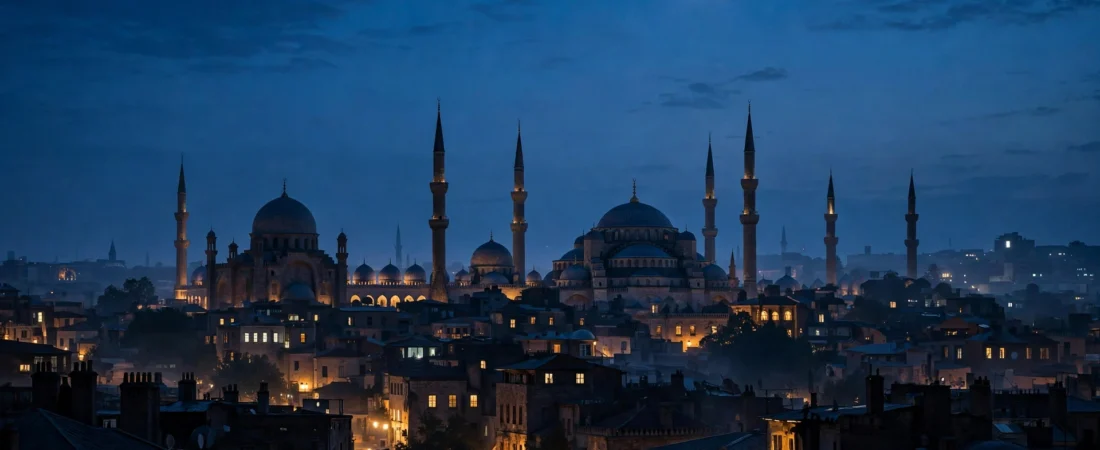
Wondering how many days until Ramadan 2027? Here’s the answer: the first day of fasting is expected on Monday, 8 February 2027. As of mid-October 2026, that’s roughly four months out — the earliest start Muslims have had in years. The timer below ticks down to the first suhoor in real time. Underneath it, you’ll find everything that actually decides the date: the moon-sighting evening, the taraweeh question, why some countries start a day later, and what this winter Ramadan will feel like.
Live countdown to Ramadan 2027
The timer below counts down live — days, hours, minutes and seconds — to the first fast of Ramadan 2027. And if you’re counting down to something else too, you can build your own:
Tip: you can set up a countdown for any date with our free countdown timer — the last ten nights, iftar with family, Eid, anything.
The dates that actually decide it
Ramadan’s date isn’t fixed by decree; it’s confirmed by sky. Here’s the sequence, as calculated by the Umm al-Qura calendar used in Saudi Arabia and backed by astronomical data from the UAE Astronomy Centre and Indonesia’s BMKG:
- Sunset, Sunday 7 February 2027 — the 29th of Sha’ban. Moon-sighting committees look for the new crescent. In Saudi Arabia, the Supreme Court asks Muslims to look and report; in the UAE, it’s the official Moon Sighting Committee.
- Sunday evening, 7 February — if the crescent is sighted, the first taraweeh prayers are prayed that night, after Isha.
- Monday, 8 February 2027 — the first full day of fasting, beginning before dawn (Fajr) and ending at sunset (Maghrib).
- Tuesday, 9 February 2027 — the fallback: if the crescent isn’t seen on the Sunday evening, Sha’ban completes thirty days and the first fast moves here.
That asterisk is real, not decorative. India, Pakistan and Bangladesh routinely start a day after the Gulf — their local sighting committees often announce Tuesday 9 February while Saudi Arabia fasts on Monday. Within a single city, two mosques can even differ: one follows the Saudi announcement, the other follows the local moon. Neither is wrong; the rule is the sighting, not the calendar.
Why Ramadan keeps arriving earlier every year
Ramadan runs on the Hijri calendar — twelve lunar months, about 354 days — which is roughly eleven days shorter than the Gregorian year. So the month slides backwards through the seasons, completing a full loop every 33 years or so. Ramadan 2026 began on 18 February 2026; the 2027 start is about ten days earlier, making it one of the earliest starts in recent memory.
The practical upshot: this is a winter Ramadan for most of the northern hemisphere. In London, the first fast runs roughly 11 hours 14 minutes — suhoor ending around 5:51 AM, iftar at 5:05 PM. Compare that with the summer Ramadans of the mid-2010s, when fasts in Scandinavia pushed past 18 hours and Edinburgh mosques wrestled with iftar near 10 PM. February fasting is cooler, shorter, and — for anyone working daytime hours — considerably easier on the body.
It won’t stay like this. By the early 2030s, Ramadan will be brushing up against December and January, and around 2030 it will fall twice inside a single Gregorian year — once in early January and again from late December. The calendar keeps marching; February is just where we happen to be.
What the first night actually looks like
If the crescent is sighted on Sunday 7 February, the month begins that evening — because in the Islamic calendar, the night comes before the day it belongs to. The first taraweeh isn’t on the first morning; it’s on the evening before the first fast.
So picture it: Sunday evening, after Isha, mosques fill for the long standing prayer that only exists in Ramadan. The imam recites the entire Quran across the month, one juz’ a night. Then the house goes quiet, and in the small hours before dawn, the first suhoor of 2027 is eaten — in the UAE and Saudi Arabia that’s around 4–5 AM — before the fast begins at Fajr on Monday morning.
It’s worth planning for the first three days specifically. The body needs time to adjust: headaches and mid-afternoon slumps are normal while the caffeine and meal schedule shift. Most people find that eating a proper suhoor — oats, eggs, dates, water rather than something sweet and quick — makes the first week noticeably smoother. The routine clicks in fast, but those first couple of dawns are the hard ones.
The month ahead in 2027
Ramadan lasts either 29 or 30 days, decided by a second moon sighting at the end of the month. On the Umm al-Qura calendar, the last fast falls on Monday 8 March 2027, with Eid al-Fitr expected on Tuesday 9 March — though if the month runs the full thirty days, Eid moves to Wednesday 10 March. We’ve covered the whole festival in our Eid al-Fitr 2027 countdown guide, including Chand Raat, the Eid morning prayer, and why dates differ by country.
The nights that matter most sit in the final stretch. The odd nights of the last ten are when Muslims seek Laylat al-Qadr, the Night of Power — believed to be better than a thousand months. In 2027 the 27th night lands around Friday 5 March, and mosques will be packed that evening: many people take the following day off work, and taraweeh runs longer and later.
And if you’re booking around the month — flights for Umrah, time off, family visits — build slack into the plan. The start date can shift by a day when the official announcement lands on 7 February, and Eid can shift by a day at the other end. Book the earlier date, keep one buffer day, and you’ll never be caught out.
Frequently asked questions
When does Ramadan 2027 start?
Ramadan 2027 is expected to begin on Monday, 8 February 2027 — that’s the first day of fasting. The date is subject to the official moon sighting on Sunday evening, 7 February.
When is the first taraweeh prayer in 2027?
The first taraweeh is prayed on Sunday evening, 7 February 2027, after Isha — the night before the first fast, assuming the crescent is sighted. Taraweeh is the special night prayer performed only during Ramadan.
Why might Ramadan start a day later where I live?
Because the month begins on an actual moon sighting, not a printed date. Countries like India, Pakistan and Bangladesh usually confirm their own sighting a day later, so they’d start fasting on Tuesday 9 February. The Gulf states generally follow Saudi Arabia’s announcement.
How long will the fasts be in Ramadan 2027?
Shorter than recent years. It’s a winter Ramadan in the northern hemisphere — in London the first fast is roughly 11 hours 14 minutes. Fasts get slightly longer as the month runs into March and the days lengthen.
When is Eid al-Fitr 2027?
Eid al-Fitr is expected on Tuesday 9 March or Wednesday 10 March 2027, depending on whether Ramadan runs 29 or 30 days. Our Eid al-Fitr 2027 guide has the full breakdown.
Is Ramadan always in winter?
No — it cycles through every season roughly every 33 years because the Islamic lunar year is about eleven days shorter than the solar year. 2027’s February start is just where the cycle happens to be; in the mid-2030s Ramadan will be landing in December.
Before the crescent rises
Four months out, the most useful thing you can do is know the shape of the calendar: watch for the crescent on the evening of Sunday 7 February, expect the first fast on Monday 8 February, and don’t be surprised if your local mosque announces Tuesday. Everything else — the long taraweeh nights, the pre-dawn suhoors, the last ten nights in March — flows from those two evenings. And if you want to mark any of it, you can build your own countdown for the first fast, the 27th night, or Eid itself — the timer above is already running.