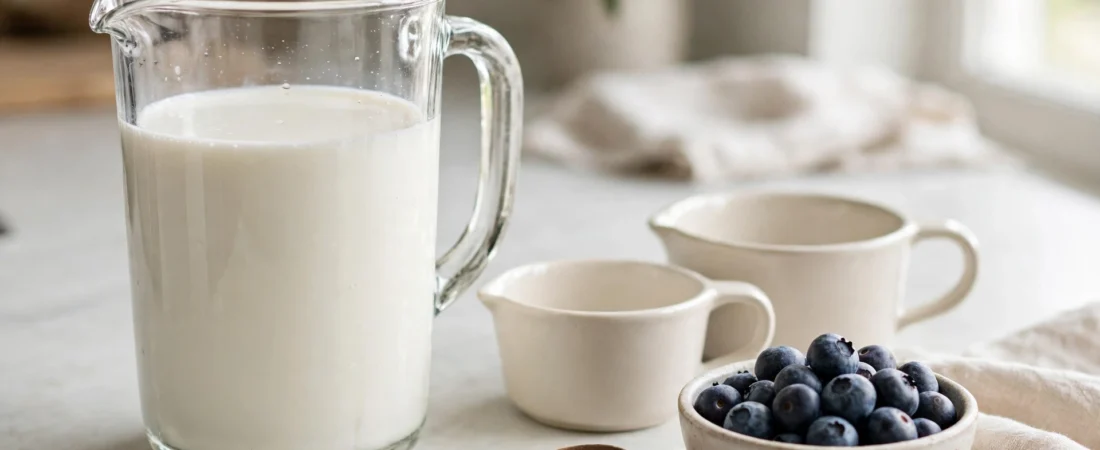
Two cups — that’s how many cups in a pint, if you’re cooking in the US and measuring liquid. A pint of milk, a pint of cream, a pint of stock: two cups, sixteen fluid ounces, done.
But pints have a habit of not being that simple. A British pint is bigger, a dry pint — the kind berries come in at the farmers’ market — is bigger still and measured in a completely different way, and a recipe from the other side of the Atlantic can leave you half a cup short without you ever spotting why the sauce came out wrong.
So here’s the full picture: which pint you’re actually dealing with, and the conversions you’ll reach for again and again.
The Short Answer: 2 Cups in a US Pint
In the US customary system, the maths is clean. One cup holds 8 fluid ounces. One pint holds 16. Divide 16 by 8 and you get 2 — two cups per pint, every time, no rounding, no exceptions.
That’s the number that matters for nearly every American recipe. When a soup recipe calls for a pint of stock, it wants two cups. When a cocktail recipe asks for a pint of cream, it wants two cups. The pint is just a bigger bucket for the same unit, and the ratio never changes.
It also slots neatly into the rest of the US volume ladder:
- 1 cup = 8 fluid ounces
- 2 cups = 1 pint = 16 fluid ounces
- 2 pints = 1 quart = 32 fluid ounces
- 4 quarts = 1 gallon = 128 fluid ounces
If you can remember “two of each makes the next one up” — two cups to a pint, two pints to a quart, four quarts to a gallon — you’ve got the whole system. If you’d rather not do the maths at all, try our free unit converter — it handles pints, cups, millilitres and everything in between in one click.
The UK Pint Is 20% Bigger
Cross the Atlantic and the pint grows. A British imperial pint holds 20 imperial fluid ounces — about 568 ml against the American 473 ml. That’s a full 95 ml extra, roughly a fifth more liquid in a glass that looks, at a glance, like the same size.
The split goes back a long way. In 1824, Britain standardised its gallon under the Weights and Measures Act, defining it as the volume of ten pounds of water. The US kept the older Queen Anne wine gallon instead. Two different gallons meant two different pints, and nobody has bothered to reconcile them in the two centuries since.
What does that mean in cups? It depends which cup you’re holding:
- 1 UK pint = about 2.4 US cups (568 ml ÷ 237 ml)
- 1 UK pint = about 2.27 metric cups (568 ml ÷ 250 ml)
- 1 UK pint = exactly 2 old-style UK cups — the traditional British cup was 284 ml, exactly half an imperial pint
That last one is the trap. Plenty of older British recipes say “a pint” and plenty of American cooks measure it as two US cups. You’re now 4 fluid ounces short — half a cup of liquid missing from a batter, a sauce, or a custard. A cake might survive it; a bread dough won’t forgive it.
Dry Pints: The Berry Basket Problem
Then there’s the dry pint, and this is where even careful cooks get tripped up. In the US, dry goods get their own pint — used for produce like berries, cherry tomatoes, and sprouts — and it’s not the same size as the liquid pint at all.
A US dry pint is defined by volume in cubic inches: 33.6 of them, against the liquid pint’s 28.9. In millilitres that’s about 551 ml, roughly 15% more than a liquid pint, or about 2.3 US cups by volume. You’ll never see it on a measuring jug, because it lives in those little green cardboard punnets at the farmers’ market.
In practice, though, nobody measures berries by the cup at the stall. A “pint of blueberries” is a container, loosely filled, and its weight wanders: usually around 340 g (12 oz) for blueberries, closer to 340–400 g for strawberries depending on size. Recipes that call for “1 pint of berries” are really saying “one of those punnets” — and if you swap in two level cups of berries from a bag, you’ll be near enough. For anything where precision matters, weigh it.
Pints to Cups Conversion Chart
| Pints | US cups | Fluid ounces | Millilitres |
|---|---|---|---|
| ¼ pint (US) | ½ cup | 4 fl oz | 118 ml |
| ½ pint (US) | 1 cup | 8 fl oz | 237 ml |
| ¾ pint (US) | 1½ cups | 12 fl oz | 355 ml |
| 1 pint (US liquid) | 2 cups | 16 fl oz | 473 ml |
| 1 pint (US dry) | ~2.3 cups | ~18.6 fl oz equiv. | 551 ml |
| 1 pint (UK imperial) | ~2.4 US cups | 20 imp fl oz | 568 ml |
| 1½ pints (US) | 3 cups | 24 fl oz | 710 ml |
| 2 pints (US) | 4 cups | 32 fl oz | 946 ml |
| 3 pints (US) | 6 cups | 48 fl oz | 1,419 ml |
| 4 pints (US) | 8 cups | 64 fl oz | 1,893 ml |
Cups, Pints, Quarts, Gallons: The Whole Ladder
Pints don’t exist in isolation, and once you see the full ladder, conversions stop feeling like guesswork. In the US system, every step up doubles (until the gallon, which quadruples from quarts):
- 1 gallon = 4 quarts = 8 pints = 16 cups = 128 fluid ounces
- 1 quart = 2 pints = 4 cups = 32 fluid ounces
- 1 pint = 2 cups = 16 fluid ounces
- 1 cup = 16 tablespoons = 48 teaspoons = 8 fluid ounces
The UK ladder looks the same on the surface — 2 pints to a quart, 4 quarts to a gallon — but every rung is 20% bigger, because the imperial gallon (4.546 litres) is bigger than the US gallon (3.785 litres). Same count, different volume.
Where This Actually Goes Wrong in Real Kitchens
Following a British recipe with American cups. This is the big one. A pint of milk in a Mary Berry recipe is 568 ml; two US cups gives you 473 ml. You’re nearly 100 ml short in a cake batter, and the crumb comes out dry. Fix it by adding roughly another ⅓ cup (about 5 tablespoons) per pint, or just measure 568 ml on a jug that shows millilitres.
Halving and doubling recipes. Halve a recipe that calls for a pint and you need one cup. Double a recipe that calls for a cup and you need a pint. It’s the cleanest conversion in the US system, which is probably why recipe writers lean on pints so heavily in the first place.
Fast Conversions Without a Calculator
If you cook from both American and British sources, three rules of thumb cover almost everything:
- US pints to cups: multiply by 2. A pint and a half is 3 cups; three pints is 6 cups.
- UK pints to US cups: multiply by 2.4. One imperial pint is about 2⅓ US cups; two is about 4¾.
- US pints to millilitres: multiply by 473 (or just call it 475 and don’t sweat the 2 ml). A UK pint is 568 ml.
For anything fiddlier than that — say, converting a recipe that mixes pints, grams and millilitres — run the numbers through our free unit converter instead of doing it in your head.
A Pint of Water Weighs a Pound — a Pint of Honey Doesn’t
Here’s a confusion that catches even experienced cooks: fluid ounces and ounces are not the same thing. Fluid ounces measure volume — how much space something takes up. Ounces measure weight — how heavy it is. They share a name and nothing else.
For water, the two line up almost exactly: a pint of water (16 fluid ounces) weighs about a pound, which is where the old saying “a pint’s a pound the world around” comes from. But pour a pint of honey and it weighs closer to 680 g, about a pound and a half, because honey is denser than water. A pint of flour weighs far less — around 240 g, depending on how you scoop it — because flour is mostly air.
This matters when a recipe switches units mid-stream. “A pint of cream” is a volume: two cups, measured in a jug. “Eight ounces of cream cheese” is a weight: use scales. Swapping one for the other works for water and milk and not much else. If you want the full breakdown of where volume and weight part company, our guide to how many ounces are in a cup covers it in detail.
Where the Pint Came From
The word comes from the Old French pinte, which traces back to the Latin picta — a painted mark. In medieval markets, vessels had a painted line showing the measure, and the line gave the unit its name. The pint survived every attempt to kill it because it’s a human-sized measure: a cup is a mouthful, a gallon is a chore, and a pint is a glass of milk or a round at the bar — a quantity you can hold in one hand and finish in one sitting.
Metric Cups, Legal Cups, and the 250 ml Problem
One more wrinkle, and then the picture is complete. Not every cup is 237 ml. The US has two cups in common use: the customary cup you measure flour with (236.6 ml) and the “legal” cup used on nutrition labels (exactly 240 ml). The difference is 3.4 ml — about half a teaspoon — and no recipe will ever notice it.
The metric cup is another matter: exactly 250 ml, used in Australia, Canada, New Zealand and much of Europe. That’s a 13 ml difference per cup, or 26 ml per pint — just over 5%. Fine for a soup, risky for a cake.
The safest habit is the simplest one: when a recipe’s country is unclear, check whether it measures in grams and millilitres (metric, use 250 ml cups) or in cups and ounces (American, use 237 ml cups). That one check settles the pint question before it starts — and if your recipe is metric through and through, our guide to how many cups are in a litre covers the litre side of the same question.
Frequently Asked Questions
How many cups are in a pint?
Two US cups in one US liquid pint (16 fluid ounces, 473 ml). A UK imperial pint holds about 2.4 US cups, and a US dry pint holds about 2.3 US cups by volume.
Is a dry pint the same as a liquid pint?
No. A US dry pint is about 551 ml (33.6 cubic inches) while a liquid pint is 473 ml (28.9 cubic inches), so the dry pint is roughly 15% larger. Dry pints are used for produce like berries, and in practice they’re sold as a filled container rather than a precise measure.
How many cups are in a UK pint?
About 2.4 US cups. In metric cups (250 ml) it’s about 2.27 cups, and in traditional UK cups (284 ml, half an imperial pint) it’s exactly 2 cups.
How many ounces are in a pint?
A US liquid pint is 16 US fluid ounces. A UK imperial pint is 20 imperial fluid ounces. Note the fluid ounces themselves differ slightly too — a US fluid ounce is about 29.6 ml, an imperial one about 28.4 ml.
How many pints are in a gallon?
Eight pints in both systems — but a US gallon (3.785 litres) and an imperial gallon (4.546 litres) are different sizes, so the pints inside them differ too.
How many cups are in a pint of ice cream?
Two cups. A standard US pint tub holds 473 ml, which is exactly 2 US cups — handy when a recipe calls for melted ice cream by the cup.
The Bottom Line
In an American kitchen, a pint is two cups — full stop. It’s the one conversion in the US system that needs no rounding and no asterisks. The asterisks only appear when you cross borders: a British pint adds about half a US cup, and a dry pint adds a little less than that again, measured by the basket rather than the jug.
Know which pint your recipe means, and the rest is simple arithmetic. And when the recipe jumps between systems — grams here, pints there, millilitres everywhere — skip the mental maths and run it through our free unit converter. Two cups to a pint, two pints to a quart, and dinner back on track.