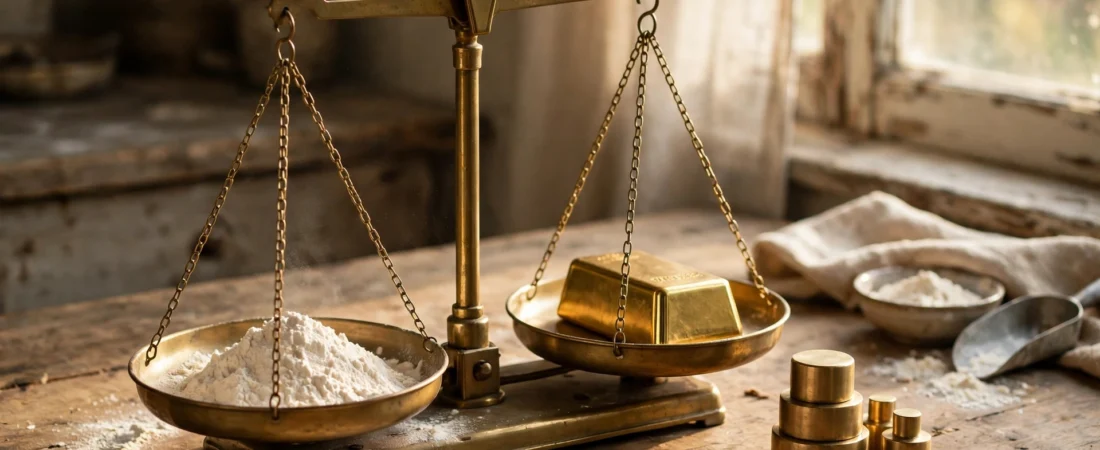
How many ounces in a pound? Sixteen — if you’re weighing flour, butter, or yourself. Weigh a bar of gold instead and the answer drops to twelve, even though each of those twelve ounces is heavier than the normal kind. That sounds like a trick question, but it’s just two different weight systems sharing the same words. Once you know which pound you’re dealing with, the number never changes, and converting between the two is mostly a matter of multiplying or dividing by 16.
This guide covers the everyday answer, the gold exception, the fluid-ounce trap that catches out plenty of cooks, and the gram and kilogram equivalents you’ll actually use.
The short answer: 16 ounces in a pound
One avoirdupois pound — the pound on your kitchen scale, on a bag of sugar, and on the bathroom scales — holds exactly 16 avoirdupois ounces. Not roughly 16, not 16 on a good day. The relationship is fixed by definition, so it holds whether you’re weighing a pinch of salt or a sack of potatoes.
Two formulas cover every conversion you’ll ever need:
- Ounces = pounds × 16
- Pounds = ounces ÷ 16 (or ounces × 0.0625, which is the same thing)
A 2 lb bag of flour is 32 oz. A 5 lb chicken is 80 oz. And going the other way, a 24 oz steak is 1.5 lb, because 24 divided by 16 is 1.5.
The fractions are worth memorising, because they turn up constantly in recipes and on packaging:
| Pounds | Ounces | Grams (rounded) |
|---|---|---|
| ¼ lb | 4 oz | 113 g |
| ½ lb | 8 oz | 227 g |
| ¾ lb | 12 oz | 340 g |
| 1 lb | 16 oz | 454 g |
| 2 lb | 32 oz | 907 g |
| 3 lb | 48 oz | 1,361 g |
| 5 lb | 80 oz | 2,268 g |
| 10 lb | 160 oz | 4,536 g |
If you only remember one row, make it the first three. Half a pound is 8 ounces, a quarter pound is 4 ounces — those two cover most of what a recipe will ever ask of you. For anything bigger, our free unit converter does the arithmetic in a click, including the jump to grams and kilograms.
Why 16? A pound’s odd history
Sixteen is a strange number to build a system on. Metric units step neatly in tens; the pound steps in sixteens, fourteens, and two-thousands. The reason is that the pound wasn’t designed. It grew, over centuries, out of trade.
The word “pound” comes from the Latin libra, a Roman unit of weight — which is why the abbreviation is “lb” and not “p”. The Roman libra was divided into 12 unciae, and “ounce” comes from uncia. So the original pound had 12 ounces, not 16, and the troy pound kept that twelve-part split.
The 16-ounce pound arrived in England in the 1200s with the avoirdupois system, a name from Old French roughly meaning “goods of weight”. It was built for merchants, especially wool traders, who needed a standard that worked at market stalls rather than in a scholar’s study. Sixteen has a practical charm: it halves cleanly four times over — 16, 8, 4, 2, 1 — which suited the beam scales of the day. A trader could split a pound into halves and quarters with a set of nested weights and never need a fraction smaller than an eighth.
For centuries, though, the pound was a moving target — different towns used different pounds. That was settled in 1959, when the US, the UK, and the rest of the Commonwealth signed the International Yard and Pound Agreement. Since 1 July 1959, the avoirdupois pound has been defined as exactly 0.45359237 kilograms, the same number in London and Los Angeles. That one definition pins everything else down: a pound is exactly 7,000 grains, so one ounce is exactly 437.5 grains and 28.349523125 grams. The long decimals are just 453.59237 divided by 16 — the system is exact, and only our everyday rounding makes it look approximate.
The one time the answer is 12: troy weight
Here’s where the pub-quiz answer changes. Gold, silver, platinum, and gemstones aren’t weighed in avoirdupois ounces at all. They use troy weight, a separate system that survived from medieval European trading, and in troy weight a pound holds 12 ounces.
The confusing part is that a troy ounce is heavier than an ordinary ounce — 31.1034768 grams against 28.349523125 grams, about 9.7% more. But because a troy pound only has 12 of them, it ends up lighter overall: 373.2417216 grams against the avoirdupois pound’s 453.59237 grams, roughly 18% less.
That quirk is the secret behind an old riddle: which weighs more, a pound of feathers or a pound of gold? Most people say they’re equal — a pound is a pound. They’re wrong. Feathers are weighed in avoirdupois pounds (454 g) and gold in troy pounds (373 g), so the feathers win by about 81 grams. It’s a parlour trick built on two systems sharing the same words.
The practical rule is simple. If it’s food, luggage, body weight, or anything you’d put on a kitchen or bathroom scale, the answer is 16. If it’s gold, silver, or platinum, ask whether the price is per troy ounce — it almost certainly is — and leave the pound out of it.
Don’t mix up ounces and fluid ounces
The second trap is a different unit wearing the same name. A fluid ounce measures volume, not weight — how much space something takes up, not how heavy it is. A pint of water and a pint of honey fill the same jug, but the honey weighs far more.
In the US, 16 fluid ounces make one pint, which is a coincidence of naming and not the same ounce at all. The two units only line up neatly for water, and even then not exactly: one US fluid ounce of water weighs about 1.04 avoirdupois ounces, close enough that cooks often treat them as interchangeable, but not identical.
That gap matters the moment you leave water behind. A fluid ounce of honey weighs about 1.5 ounces, because honey is dense. A fluid ounce of olive oil weighs about 0.91 ounces, because oil is lighter than water. So “8 oz of chocolate” in a recipe means 8 ounces by weight — weigh it on a scale — while “8 fl oz of milk” means 8 fluid ounces by volume — pour it into a measuring jug. Swap the two and a cake can come out noticeably wrong. Cups have the identical problem, as our guide to how many ounces are in a cup explains.
Pounds and ounces in grams and kilograms
Most of the world cooks and weighs in metric, so the imperial-to-metric jump is the conversion people actually do most often. The anchors are worth learning:
- 1 ounce = 28.349523125 grams — call it 28.35 g in your head
- 1 pound = 453.59237 grams — call it 454 g
- 1 kilogram = 2.20462 pounds — call it 2.2 lb
- 1 gram = 0.035274 ounces
Going from pounds to grams, multiply the pounds by 454. A 3 lb bag of apples is about 1,361 g, or 1.36 kg. Going the other way, divide grams by 28.35 to get ounces: 100 g is about 3.5 oz, 250 g is about 8.8 oz, and 500 g is about 17.6 oz — just over a pound.
One thing to watch for in older British recipes: some UK cookbooks, Delia Smith’s among them, round an ounce to 25 g rather than 28 g. That’s a convention from a time when kitchen scales weren’t precise enough for the difference to matter, and it stuck. If a vintage recipe says 4 oz of flour and you weigh out 100 g, you’ll be about 13 g short — not enough to ruin a stew, but enough to notice in pastry. Modern recipes use the true 28.35 g figure. Our guide to how many grams are in an ounce covers the full chart if you want every value from 1 to 16 ounces.
Converting in your head
Dividing by 16 sounds awkward until you realise it’s just halving four times. Take 48 ounces: halve it to 24, halve again to 12, again to 6, once more to 3. That’s 3 pounds, and you never had to do any real division. The same trick works in reverse — to turn pounds into ounces, double four times. Two pounds: 2, 4, 8, 16, 32 ounces.
For rough work, two shortcuts cover nearly everything:
- Halves and quarters. A quarter of a pound is 4 oz, half is 8 oz, three-quarters is 12 oz. Most recipe quantities are one of those three, so you can answer without any sums at all.
- The 28-gram rule. An ounce is about 28 grams, a pound about 450 grams. If a recipe calls for 6 oz of butter, that’s roughly 170 g — close enough for anything that isn’t baking at competition standard. For baking, use the exact figures or a scale; a 10% error in flour is the difference between a sponge and a brick.
And if mental arithmetic isn’t your thing, that’s fine — that’s what converters are for. Punch the number into our free unit converter and it handles ounces, pounds, grams, and kilograms in one go, including the awkward decimals that hand calculation fudges.
Everyday weights, in ounces and pounds
Abstract numbers stick better with familiar objects attached, so here are some weights most people have held:
- A stick of butter: 4 oz, exactly a quarter of a pound.
- A standard tin of soup: about 14 to 15 oz, just under a pound.
- A bag of sugar: 2 lb, or 32 oz.
- A litre of water: 2.2 lb, or about 35 oz — a handy check on your mental maths.
- A newborn baby: around 7 lb, or 112 oz.
- A carry-on suitcase packed to the limit: 15 to 22 lb, depending on the airline.
Notice the pattern: food packaging hovers in the 4-to-16-ounce band, body weight is talked about in pounds, and luggage is where pounds start feeling large. That matches how the units grew up — ounces for the market stall, pounds for the sack.
US vs UK: the same pound, different neighbours
One question that comes up a lot is whether the American pound and the British pound are the same. Since 1959, yes — exactly the same, 0.45359237 kg, 16 ounces, 7,000 grains. If a US recipe says a pound and a UK recipe says a pound, they mean the same weight. The confusion comes from everything around the pound, not the pound itself.
The UK still uses the stone for body weight: 14 pounds to a stone, so someone who is 11 stone weighs 154 lb, or 2,464 oz. The US never adopted the stone, so Americans just say 154 pounds. Same weight, different packaging.
Tons diverge too. A US (short) ton is 2,000 lb; a UK (long) ton is 2,240 lb; and the metric tonne is 1,000 kg, about 2,205 lb. Shipping and freight are where this bites — a “ton” on a US invoice and a “ton” on a UK invoice differ by 240 lb, which is no rounding error. But for everyday cooking, shopping, and weighing yourself, the pound is the pound on both sides of the Atlantic.
Frequently asked questions
How many ounces are in a pound?
16 avoirdupois ounces. That’s the pound used for food, body weight, shipping, and everything else in daily life. The only exception is troy weight, used for precious metals, where a pound holds 12 troy ounces.
How many ounces are in a pound of gold?
12 troy ounces — but a troy ounce (31.1 g) is heavier than an ordinary ounce (28.35 g), so a troy pound still weighs less than a normal pound: 373 g against 454 g. Gold is priced per troy ounce, so the pound rarely comes into it.
Is 16 oz the same as 1 lb?
Yes, by weight. A product labelled 16 oz and a product labelled 1 lb contain the same mass. The one exception is fluid ounces: 16 fl oz is a volume measure (a US pint), not a weight, and it only equals about a pound when the liquid is water.
How many ounces are in half a pound?
8 ounces. A quarter of a pound is 4 ounces, and three-quarters is 12 ounces. Those three fractions cover most recipe quantities.
How many grams are in a pound?
453.59237 grams — call it 454 g. One ounce is 28.349523125 g, so a pound is 16 times that. A kilogram is 2.20462 pounds.
Are UK and US pounds the same?
Yes. Since the International Yard and Pound Agreement of 1959, both countries use the identical avoirdupois pound of exactly 0.45359237 kg. The stone (14 lb) is a UK-only neighbour, and the ton differs between the two countries, but the pound itself is the same.
Wrapping up
Sixteen ounces to the pound is one of those facts that feels too simple to need a whole guide — until gold, fluid ounces, or an old British recipe proves otherwise. Keep the core rule (pounds × 16 = ounces, ounces ÷ 16 = pounds), remember that troy weight plays by different rules, and never let a fluid ounce stand in for a weight ounce. For everything else — grams, kilograms, or a number with too many decimal places to do in your head — try our free unit converter. It turns any weight into any other weight in a second, no halving four times required.