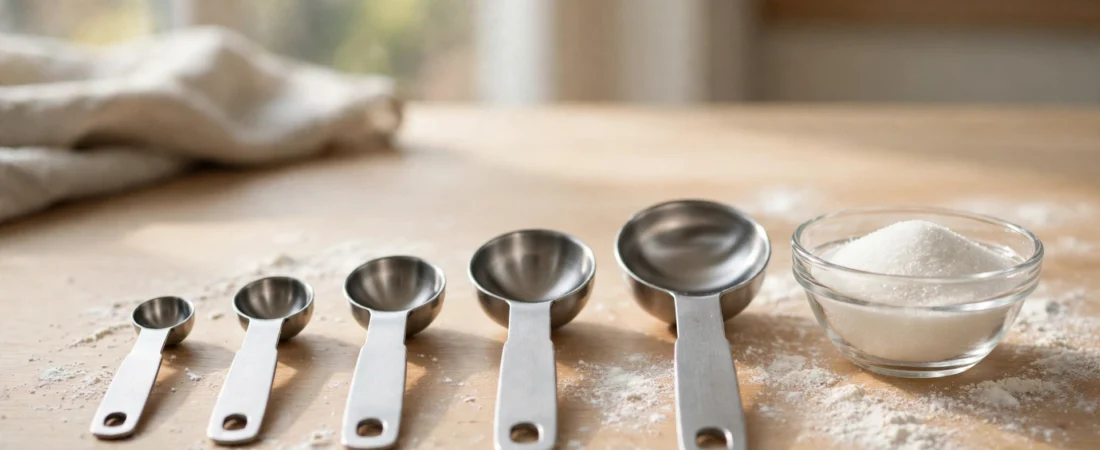
You’re halfway through a recipe, hands covered in flour, and it calls for a tablespoon of baking powder. Your tablespoon measure is in the dishwasher. Three teaspoons will do it. That’s the answer, and it’s the same in the US, the UK, and just about every metric kitchen on the planet: one tablespoon holds exactly three teaspoons.
The only place the rule breaks is Australia, where a tablespoon is bigger and holds four. If you’ve ever followed an Australian recipe and wondered why the cake came out flat, that might be why.
This guide covers the quick conversion, the millilitre numbers behind it, and the few situations where small differences actually matter. If you only needed the number, you’ve got it. Keep reading for the charts.
The short answer: 3 teaspoons
One tablespoon equals three teaspoons. It’s a clean 3:1 ratio, and it holds whether you’re measuring liquids or dry ingredients — a level tablespoon of flour is three level teaspoons of flour, same as with water or oil.
| Amount | Teaspoons | Millilitres (metric) |
|---|---|---|
| 1 tablespoon | 3 tsp | 15 mL |
| ½ tablespoon | 1½ tsp | 7.5 mL |
| ⅓ tablespoon | 1 tsp | 5 mL |
| 2 tablespoons | 6 tsp | 30 mL |
| 4 tablespoons (¼ cup) | 12 tsp | 60 mL |
In everyday cooking, that’s all you need. The rest of this article is for the times when a recipe comes from another country, or when you’re scaling something up and the numbers stop being round.
Why three? A short history
The ratio isn’t an accident. In the US customary system, a tablespoon was defined as half a fluid ounce, and a teaspoon as one third of that tablespoon. The definitions trace back to 18th-century apothecary measures, and they were standardised in the 19th century when cookbooks started giving exact quantities instead of “a pinch” and “a spoonful”.
The US National Institute of Standards and Technology (NIST) pins the modern values down precisely: a US teaspoon is 4.92892 mL and a US tablespoon is 14.7868 mL. Metric countries simply rounded those to 5 mL and 15 mL, which made the maths cleaner and kept the 3:1 ratio intact. The gap between the American 14.79 mL and the metric 15 mL is about 1.4% — far too small to taste in anything you’ll ever cook.
The Australian exception
Here’s where people get caught out. Australia uses a 20 mL tablespoon, which holds four 5 mL teaspoons instead of three. It’s the only major cooking system that does this.
That matters more than it sounds. If you follow an Australian recipe with American measuring spoons, you’re under-measuring every tablespoon by a quarter. Two tablespoons of baking powder in an Australian recipe is 40 mL; with US spoons you’d add 30 mL — a full tablespoon short. A cake that needs the lift won’t get it. The reverse is just as bad: an American recipe measured with Australian spoons overdoses everything by a third.
The fix is simple. If a recipe comes from an Australian site or cookbook, check whether it says 20 mL anywhere — many do, precisely because of this confusion. And if you’re buying measuring spoons, the set you want is stamped 15 mL for the tablespoon, not 20 mL, unless you cook from Australian recipes all the time. For anything beyond spoon measures, try our free unit converter to switch between cups, millilitres, grams and ounces in one place.
US, UK and metric side by side
The 3:1 ratio survives across all the major systems, even though the millilitres differ slightly. What changes is the size of the spoon itself, not how many teaspoons fit in it.
| System | 1 teaspoon | 1 tablespoon | Teaspoons per tablespoon |
|---|---|---|---|
| US customary | 4.93 mL | 14.79 mL | 3 |
| Metric (UK, Canada, NZ, EU) | 5 mL | 15 mL | 3 |
| UK imperial (pre-1970 recipes) | 5.92 mL | 17.76 mL | 3 |
| Australia | 5 mL | 20 mL | 4 |
Two things worth noting. First, the old imperial tablespoon of 17.76 mL still shows up in British cookbooks from before metrication, so if you’re resurrecting a grandmother’s recipe, don’t assume modern spoon sizes. Second, the dessertspoon — 10 mL, or exactly two teaspoons — is a real unit in the UK and Australia. It sits between the teaspoon and the tablespoon, and it appears in older recipes more often than you’d expect.
Converting in both directions
The maths is just multiplying or dividing by three, but it helps to have the common ones memorised.
Teaspoons to tablespoons: divide by 3. Nine teaspoons is three tablespoons. Twelve teaspoons is four tablespoons, which is also a quarter of a cup.
Tablespoons to teaspoons: multiply by 3. Two tablespoons is six teaspoons. Half a tablespoon is one and a half teaspoons — the conversion that comes up most often, because so many recipes ask for half a tablespoon of something and nobody owns a half-tablespoon measure.
A few conversions that save you mid-recipe:
- ⅓ cup = 5 tablespoons + 1 teaspoon (exactly, in US measures)
- ¼ cup = 4 tablespoons = 12 teaspoons
- 1 cup = 16 tablespoons = 48 teaspoons
- 1 tablespoon = ½ fluid ounce
Scaling works the same way. Doubling a recipe that calls for 1 tablespoon of spice? That’s 2 tablespoons, or 6 teaspoons if your tablespoon measure is dirty. Halving one that calls for a tablespoon? 1½ teaspoons. The numbers stay friendly because three divides so neatly — one of the reasons the ratio has survived two centuries of kitchen reform.
Does the 0.21 mL gap ever matter?
Short version: no, not in any home kitchen. The difference between a US tablespoon (14.79 mL) and a metric one (15 mL) is 0.21 mL — roughly four drops. Even if you scale a recipe up four times, four tablespoons of baking powder measured with US spoons instead of metric ones puts you short by less than a millilitre total. No cake has ever failed over that.
What does matter, and by a lot more, is how you fill the spoon. A heaped tablespoon can hold 30–50% more than a level one, and that’s the error that actually ruins baking. Recipes assume level measures: fill the spoon, then sweep the top flat with the back of a knife. It’s a five-second habit and it matters more than which country’s spoon set you own.
The other real source of error is the spoon itself. A tablespoon from the cutlery drawer is not a measuring tablespoon — it’s a serving spoon, and its capacity varies wildly from one set to another. That’s the next section’s problem, and it’s a bigger one than any unit conversion.
Your cutlery drawer is lying to you
Grab the tablespoon from your cutlery drawer and the tablespoon from your measuring set. They look similar. They are not the same thing.
Measuring spoons are calibrated: a tablespoon measure holds 15 mL (or 14.79 mL in the US) when filled level, every time. Cutlery is designed to look good and feel right in the hand, not to measure anything. A dining tablespoon can hold anywhere from about 10 mL to over 20 mL depending on the pattern, and a dining teaspoon is just as unreliable. Using cutlery as a measuring tool can throw a recipe off by a third or more — ten times the error you’d get from mixing up US and metric spoons.
That doesn’t mean you need fancy equipment. A basic set of measuring spoons costs very little and lasts forever, and it’s the single cheapest upgrade you can make to your baking. Keep the set in the drawer you actually reach for, not in the back of a cupboard. If you’re converting between spoon measures and cups or grams as well, our free unit converter handles all of it without any mental maths — and if you want the cup-side version of this question, there’s a matching guide to how many tablespoons are in a cup.
Quick-reference chart
Pin this to the fridge, or just remember the first line and work from there.
| Teaspoons | Tablespoons | Millilitres | Also equals |
|---|---|---|---|
| 1 tsp | ⅓ tbsp | 5 mL | — |
| 1½ tsp | ½ tbsp | 7.5 mL | — |
| 2 tsp | ⅔ tbsp | 10 mL | 1 dessertspoon |
| 3 tsp | 1 tbsp | 15 mL | ½ fl oz |
| 6 tsp | 2 tbsp | 30 mL | 1 fl oz |
| 9 tsp | 3 tbsp | 45 mL | — |
| 12 tsp | 4 tbsp | 60 mL | ¼ cup |
| 24 tsp | 8 tbsp | 120 mL | ½ cup |
| 48 tsp | 16 tbsp | 240 mL | 1 cup |
One more useful fact: there are 48 teaspoons in a US cup. It’s a number that comes up constantly when you’re scaling recipes down — a cup of stock reduced to a quarter cup is 12 teaspoons, and now you can measure it with the smallest spoon you own.
Frequently asked questions
How many teaspoons are in a tablespoon?
Three, in the US, UK, Canada, New Zealand and most metric countries. Australia is the exception: an Australian tablespoon holds four teaspoons because it’s 20 mL instead of 15 mL.
How many teaspoons is half a tablespoon?
One and a half teaspoons. This is the conversion you’ll use most, since recipes often call for half a tablespoon of spices, extracts or leavening and no set includes a half-tablespoon measure.
Is a tablespoon 15 mL?
In metric countries and on US nutrition labels, yes — exactly 15 mL. A US customary tablespoon is 14.79 mL, which rounds to 15 mL in every recipe. An Australian tablespoon is 20 mL.
How many tablespoons are in a cup?
Sixteen US tablespoons make one cup. That also means 48 teaspoons per cup, which is handy when you’re scaling a recipe down and only have small spoons clean.
Can I use a regular spoon from the drawer instead of a measuring spoon?
Roughly, for things like sugar in tea — but not for baking. Cutlery isn’t calibrated, so a dining spoon can hold far more or less than a measuring spoon. For anything where the amount matters, use real measuring spoons.
What’s the difference between a teaspoon and a dessertspoon?
A dessertspoon is 10 mL, exactly two teaspoons, and it’s a standard unit in the UK and Australia. You’ll see it in older British recipes and in Australian ones; it’s twice a teaspoon and two-thirds of a (metric) tablespoon.
The bottom line
Three teaspoons make a tablespoon, everywhere except Australia, where it’s four. The millilitre values behind that — 4.93 mL per teaspoon and 14.79 mL per tablespoon in the US, a clean 5 mL and 15 mL in metric kitchens — explain the small differences you’ll see between sources, but none of them change the answer in practice. Level your spoons, use real measuring spoons for baking, and double-check the origin of any recipe that uses tablespoons heavily.
And if you’re juggling cups, grams, ounces and millilitres at the same time, try our free unit converter — it handles spoon measures, cup conversions and weight conversions in one place, so the maths never interrupts the cooking.