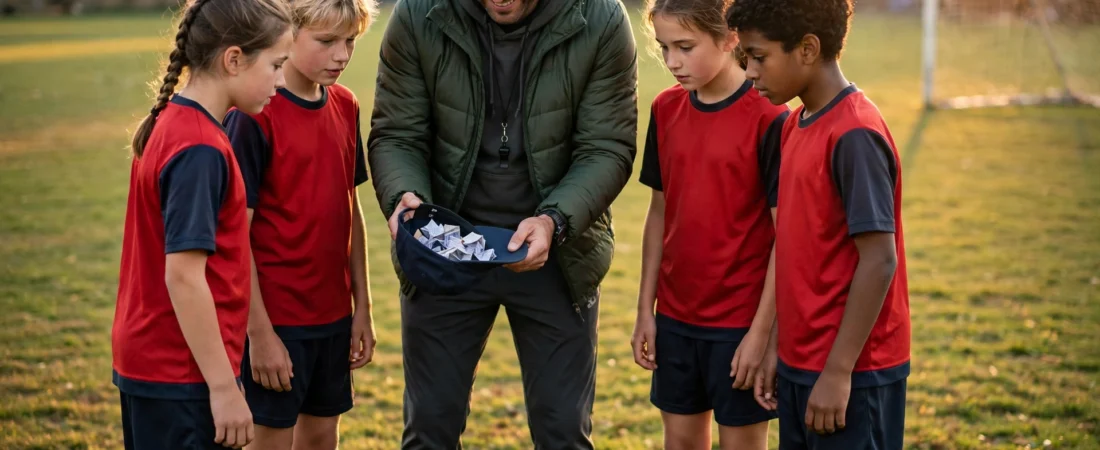
Fourteen people have turned up for five-a-side, and somebody has to pick the teams. The two loudest players volunteer as captains, the picking starts, and within a minute everyone knows where they stand. A random team generator skips all of that. Paste the names, shuffle, and let chance do the picking — nobody’s feelings get hurt, nobody can accuse the captain of favouritism, and the whole thing takes about thirty seconds.
That’s the whole appeal. A random team generator takes one list of people and deals them out into even groups by chance, with no human deciding who goes where. Here’s how to do it properly — including where random falls short.
How a Random Team Generator Actually Works
Strip away the interface and there’s only one real idea: shuffle the full list first, then deal names out one at a time, like cards. Shuffle a class of 24 and deal them into four groups of six, and every group ends up the same size.
The shuffle itself matters. A proper generator uses your browser’s cryptographic random number generator — the same class of randomness behind security tokens — so every name has an exactly equal chance of landing anywhere. Drawing slips from a hat feels fair, but hats are terrible shufflers. A digital shuffle doesn’t have habits.
One thing to get straight: random and balanced are two different promises. A generator balances headcount, not ability. It can hand one football team three of the strongest players and the other team none, purely by chance. For a classroom activity or a pub quiz, that’s exactly what you want. For a competitive match, you’ll want the skill fix further down this page.
Split Your Group in Five Quick Steps
You don’t need an app or an account. Here’s the process using our free random name picker, which has an elimination mode built for exactly this job.
- Paste your list. One name per line — a class register, a squad list, the guest list for game night. Add last initials if two people share a first name.
- Remove anyone who’s absent. The step everyone skips — and the one that causes the most re-draws.
- Hit Shuffle. The list gets mixed properly, so the order you pasted the names in stops mattering.
- Set the draw size to your team size. For teams of five, set the winners count to five and tick “Remove winners from the list” — elimination mode, so nobody can be drawn twice.
- Draw team by team. The first draw is Team 1, the next is Team 2, and so on until the list is empty.
The whole thing takes under a minute for a group of thirty, and because everything runs in your browser, the list never gets uploaded anywhere.
When the Numbers Don’t Divide Evenly
Real groups almost never split cleanly. Twenty-three players into teams of five gives you four teams of five and one team of three — lopsided, and everyone notices. Spread the leftovers instead, one extra person to the first few teams: four teams of six and one team of five, so no team is ever more than one person bigger than another.
A few combinations come up so often they’re worth memorising: 24 splits into four teams of six or six teams of four; 25 works as five teams of five; 27 students in groups of four leaves one group of three — use groups of three instead and make nine of them.
Odd numbers cause the other classic headache — the odd one out. In a PE lesson, the spare player becomes the referee or first substitute, rotated in every few minutes. In a classroom, a group of three where everyone else has four is rarely a problem. What you don’t want is a group of one: if the maths leaves a single person alone, shrink the team size by one and re-draw.
Random Isn’t the Same as Balanced — Here’s the Fix
Say you’re organising a five-a-side league night and you know exactly who the four strongest players are. A straight random draw could stack three of them on one side, and the game is over before it starts. Randomness didn’t fail — it just wasn’t the promise you needed.
The fix is to seed first, then randomise the rest. Pull the strongest players out and deal one to each team — that’s your anchor. Then run everyone else through the generator. You keep the neutrality of the draw for the 90% of players nobody can rank confidently, and you stop the one outcome everyone would complain about. For genuinely competitive setups there’s the snake draft: captains take turns picking, but the order reverses each round. It’s slower, so save it for leagues. The honest summary: if the stakes are bragging rights and a round of drinks, pure random is perfect. If the stakes are a league table, seed the anchors first.
In the Classroom: Groups Without the Politics
Ask a teacher what eats their time on a Monday morning and “splitting the class into groups” will be near the top of the list. Let students choose and you get friendship clusters and the same confident kids doing all the talking. Assign groups yourself and someone will insist you always put them with the same person.
A random team generator ends the negotiation. Paste the register, draw groups of four, and the decision is visibly out of your hands — the screen did it, in front of everyone. Nobody can claim you played favourites, because you didn’t pick anyone.
It also mixes the class in ways seating plans never do: the quiet student works with different partners every week, and the group that always sits together gets broken up without a scene. Re-shuffle each week — the draw takes less time than taking the register. For more on running draws in a lesson, our guide to the best random name pickers for teachers covers the classroom setup in detail.
For Sports, PE and Pickup Games
The playground pick is the original team generator, and the original source of playground grudges. Being picked last in front of thirty classmates sticks with people. A random draw removes the ranking entirely — no first pick, no last pick, just a shuffled list.
For PE teachers, the weekly re-draw is the real win. Same class, same sport, different teams every lesson — and it kills the “our team always loses” complaint, because next week the teams are different. Pair it with a rotating captain whose only job is organising, not selecting.
Pickup games run on the same logic with less patience. Twelve players at the park, two teams of six, and everyone wants to start playing, not watch someone deliberate over a clipboard. Paste the names, draw two teams, and you’re playing within a minute. Our random name picker saves your list in the browser, so last week’s twelve names are still there when you open it again.
Game Nights, Parties and Work
Not every group split is about sport. A pub quiz with forty people needs eight teams of five before the first round starts, and the host who tries to sort that by hand will lose ten minutes and most of the room’s goodwill. A random draw does it while people are still ordering drinks.
Workshops and training days are the quiet success story here. A facilitator with thirty attendees and six breakout rooms can either spend fifteen minutes herding people into groups or run one draw and be done — and random groups force people out of their usual clusters, so the conversation gets noticeably better.
The same approach works for Secret Santa and gift exchanges — anything where the assignment has to be visibly impartial. Our guide to drawing a fair winner from any list covers the single-winner version, for when there’s one prize rather than several teams.
Team Sizes That Actually Work
There’s no universal right size, but after enough classrooms, leagues and quiz nights, a few patterns hold up:
| Activity | People | Teams | Per team |
|---|---|---|---|
| Five-a-side football | 10 | 2 | 5 |
| Basketball pickup | 10 | 2 | 5 |
| Volleyball | 12 | 2 | 6 |
| Pub quiz | 40 | 8 | 5 |
| Class project | 24 | 6 | 4 |
| Science lab pairs | 30 | 15 | 2 |
| Workshop breakouts | 30 | 6 | 5 |
| Trivia night | 20 | 4 | 5 |
| Dodgeball | 16 | 2 | 8 |
| Board game night | 12 | 3 | 4 |
Groups of four or five are the sweet spot for anything involving discussion. Smaller than that and one quiet person can stall the group; bigger than six and someone always goes silent. For physical games, the sport sets the size — your job is just to get the numbers even.
Five Mistakes That Make “Random” Teams Unfair
The generator is only as fair as the list you feed it.
A dirty list. Duplicate names, a nickname and a full name for the same person, someone who left last month — every error in the list becomes an error in the teams. Clean it first: one name per line, no extras, no blanks.
Re-rolling until you like the result. You draw the teams, you don’t like how they fell, so you draw again — and again — until the outcome looks “right”. You’ve just reintroduced human bias with extra steps. One draw, accepted as drawn — fixing a genuine error, like an absent player, is a correction, not a re-roll.
Letting captains pick after the shuffle. Shuffle the list, then let captains choose from it, and you haven’t randomised anything — it’s a draft wearing a shuffle’s clothes. If captains are picking, skip the generator and own the draft.
Forgetting the late arrivals. The draw happened, teams are set, and then three more people walk in. Don’t shoehorn them onto the smallest team — the balance is gone. Re-draw with everyone included if the game hasn’t started; if it has, make them substitutes.
Using random for the wrong job. Random teams suit participation and mixing people up. They’re the wrong tool when teams need specific roles — a project crew that needs a designer and a developer, a relay squad that needs a strong anchor leg. Assign by role first, then randomise within each role.
Random Team Generator FAQs
How many teams can I make with a random team generator?
As many as the group allows — but teams of two are pairs, and teams bigger than eight or nine stop feeling like teams. For most activities, two to eight teams of four to six people is the range that works.
What happens when the group doesn’t split evenly?
Spread the leftovers one per team, so no team is ever more than one person bigger than another. Twenty-three people in teams of five becomes three teams of five and two teams of four.
Is the draw really random?
With a proper tool, yes. Our random name picker uses your browser’s cryptographic random number generator, giving every name an exactly equal chance on each draw.
Can I save the teams for next week?
The names list is saved in your browser, so the same roster is there when you come back. The teams themselves are a result, not a setting — screenshot them, then re-draw fresh teams each session.
How do I keep the teams fair when skill levels differ?
Randomise within bands, not across the whole group. Seed one strong player per team first, then draw everyone else at random. For a serious competition, use a snake draft instead.
Does it work on a phone?
Yes — the whole thing runs in the browser, on phones, tablets and laptops, with nothing to install. Paste the names, shuffle, draw, done.
Stop Picking Teams by Hand
Every minute spent arguing about teams is a minute nobody’s playing, learning, or enjoying the quiz. A random team generator turns the most political job in the room into a thirty-second shuffle that nobody can argue with.
Next time you’re staring at a list of names and a room full of opinions, try our free random name picker: paste the list, shuffle it, set the draw to your team size with elimination switched on, and deal the teams out one draw at a time. Fair, fast, and nobody gets picked last.