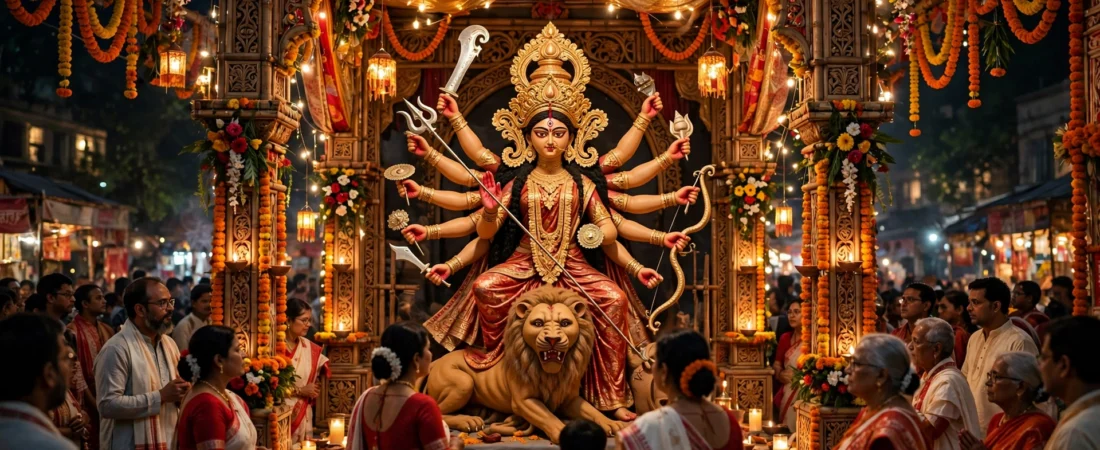
If you’ve landed here asking “how many days until Durga Puja 2027,” here’s the short version: the festival opens with Maha Shashthi on Tuesday, 5 October 2027 and closes with Bijaya Dashami on Saturday, 9 October. As of mid-October 2026, that’s roughly a year of dhak-drum anticipation — and the live timer below is counting every second of it down.
You can also open the countdown pre-set for Durga Puja 2027 and bookmark it — useful if you’re coordinating trains, leave, or a Kolkata hotel booking around the festival.
The exact 2027 dates (checked against the panchangs)
Durga Puja dates come from the Hindu lunar calendar, not the wall calendar, so they drift every year — and because lunar tithis don’t respect midnight, different almanacs occasionally disagree by a day. I checked the 2027 stretch against Drik Panchang’s October 2027 festival tables, durgapujacountdown.com’s year-specific schedule, timeanddate.com, and datetimeonline.com. They all land on the same five-day window:
- Mahalaya — Thursday, 30 September 2027. The spiritual start of the season: the end of Pitri Paksha, when devotees wake before dawn to hear the Mahishasuramardini recitation on the radio. Not one of the five main days, but the day Kolkata collectively switches into festival mode.
- Maha Panchami — Monday, 4 October. Pandals are nearly finished; in many neighbourhoods the goddess’s face is unveiled and the first evening prayers begin.
- Maha Shashthi — Tuesday, 5 October. The festival proper begins. Bodhon (the awakening), Kalparambha (the formal resolve), and Bilva Nimantran — the bilva-tree invocation — are all on the 2027 panchang for this date. Most pandal doors swing open in the evening.
- Maha Saptami — Wednesday, 6 October. The Nabapatrika bath at dawn — nine plants wrapped in a saree, bathed and installed beside the idol as the goddess in her nine forms — followed by Prana Pratishtha and the sixteen-step Shodashopachara puja. Full worship tempo starts here.
- Maha Ashtami — Thursday, 7 October. The soul of the festival: morning Pushpanjali, Kumari Puja at many pandals, and Sandhi Puja at the junction of the Ashtami and Navami tithis.
- Maha Navami — Friday, 8 October. The last full day of worship: homa (the fire offering), maha bhog, and maha aarti, with dhunuchi naach dancers swinging smouldering earthen bowls in the evening.
- Bijaya Dashami — Saturday, 9 October. The farewell: sindoor khela in the morning, then procession and bisorjon (immersion) of the idols.
One honest caveat, because it’ll show up in your searches: a couple of calendar sites list Navami on the 9th and Dashami on the 10th, and Bangladesh observes Dashami on Sunday, 10 October. That’s the standard tithi-boundary drift — the Navami–Dashami junction straddles the Friday night — and every major Indian panchang puts Vijayadashami on Saturday the 9th. Our own Dussehra 2027 countdown independently confirms the same date, since Vijayadashami is the same day.
What each day feels like on the ground
Durga Puja isn’t a festival you attend so much as one you walk through, preferably for several evenings in a row. Shashthi evening is the insider’s tip: the pandals have just opened, the idols are unveiled, and the crowds are still building — so you can actually see things instead of shuffling past them in a queue. Saptami and Ashtami are when Kolkata hits full volume. The dhak drummers set the rhythm of every street; bhog kitchens feed thousands; the maidan around College Square becomes a slow-moving river of people.
Ashtami deserves its own paragraph because it runs the show. For most Bengalis this is the most sacred day: families arrive for morning Pushpanjali dressed in their best, many pandals hold Kumari Puja honouring a young girl as the living goddess, and the Sandhi Puja — performed in the 48-minute junction between tithis — is the festival’s most charged ritual moment. Plan around it: it’s the day with the biggest crowds and the most spectacular lighting.
Navami is the final full day of worship, and it carries a bittersweet charge — the homa smoke, the evening aarti, dhunuchi naach in full flow, and adda (those long Bengali conversations over tea and snacks) stretching past midnight. Then Dashami morning: sindoor khela, married women in white sarees with red borders applying vermilion to the goddess and then to each other, before the idols are carried to the Hooghly for immersion. The parting line is “Asche bochor abar hobe” — it will happen again next year.
Durga Puja vs Navratri vs Dussehra: what’s actually different?
The three festivals share a fortnight, a lunar logic, and the theme of good defeating evil — which is why even plenty of Indians mix them up. The difference is regional tradition. In Bengal, Assam and Tripura, the five days from Shashthi to Dashami centre on Goddess Durga as the daughter returning to her natal home, with pandals, clay idols and dhak. In Gujarat and the west, the same window is Navratri: nine nights of garba and dandiya raas, closing on Vijayadashami with a completely different festive grammar. Elsewhere in India, Dussehra/Vijayadashami marks Rama’s victory over Ravana — Ramlila performances, the burning of effigies.
In 2027 the timelines line up neatly: Sharad Navratri runs from Ghatasthapana on 30 September through Vijayadashami on 9 October — the exact same closing day as Bengal’s Bijaya Dashami. If you’re tracking that one too, see our Dussehra 2027 countdown.
Planning a Kolkata trip for Puja 2027
A year out is, honestly, the ideal time to plan — Kolkata’s best-located hotels fill up for Puja, and booking now means you get choice rather than leftovers. The sweet spot for a first visit is 6–9 October (Saptami to Dashami): every pandal open, every ritual in full swing, the city at its most spectacular.
The veteran strategy for pandal-hopping is geography: one zone per evening, because Kolkata’s festival traffic doesn’t forgive criss-crossing. North Kolkata for the heritage pujas, South Kolkata for the theme spectacles. A starter list worth bookmarking: College Square, Santosh Mitra Square, Sreebhumi, Chetla Agrani, Suruchi Sangha, Ekdalia Evergreen, and Kumartuli Park (the idol-makers’ quarter, where the whole thing begins). The Kolkata Metro typically extends its hours during the festival — check its Puja timings rather than trusting cabs through the closures.
Practical notes: crowds peak on Ashtami and Navami evenings, so schedule your must-see pandals for Shashthi or Saptami if you prefer breathing room. Carry water, wear shoes you can walk miles in, and keep cash for bhog queues and street food. And if you’re coming from outside Bengal, Ashtami is the day to dress for — it’s the traditional new-clothes day of the festival.
A live countdown to Shashthi
Dates on a page are static; the wait isn’t. Drop 5 October 2027 into the free countdown timer and you’ll get a live readout of exactly how long remains until Maha Shashthi — down to the second. Swap in 9 October for Dashami, or 30 September for Mahalaya, if you’re counting from the spiritual start. And once Puja’s over, the same tool rolls straight into Diwali — Lakshmi Puja is Friday, 29 October 2027, barely three weeks later.
Frequently asked questions
What is the exact date of Durga Puja 2027?
Maha Shashthi is Tuesday, 5 October 2027, and the festival runs through Bijaya Dashami on Saturday, 9 October. Mahalaya, the spiritual start of the season, falls on Thursday, 30 September 2027.
Why do some websites say Dashami is on 10 October 2027?
Because lunar tithis rarely end at midnight, almanacs occasionally place a festival day on the adjacent Gregorian date. The Navami–Dashami junction straddles Friday night in 2027, so a few calendars push Dashami to the 10th — and Bangladesh observes it on Sunday the 10th. Every major Indian panchang has Vijayadashami on Saturday, 9 October.
When is Mahalaya 2027?
Thursday, 30 September 2027. It marks the end of Pitri Paksha (the ancestor fortnight) and the beginning of Devi Paksha — the fortnight of the Goddess. Dawn tarpan at the ghats and the Mahishasuramardini broadcast before sunrise are the day’s traditions.
Which day of Durga Puja is the most important?
Maha Ashtami (Thursday, 7 October 2027) is widely considered the most sacred day, with Pushpanjali, Kumari Puja and the Sandhi Puja at the tithi junction. Bijaya Dashami runs it close for cultural importance — sindoor khela and the immersion processions.
Is Durga Puja a public holiday?
In West Bengal, Assam, Tripura and Odisha, the main days are gazetted holidays, and Vijayadashami is a bank holiday in many states. Elsewhere in India, Dussehra (same day) covers the holiday calendar. If you’re planning travel, check your state’s official holiday list.
How long does Durga Puja last?
The public celebration runs five days, from Maha Shashthi to Bijaya Dashami (5–9 October 2027). Including Mahalaya on 30 September, the devotional season stretches over roughly eleven days.
So: Shashthi on Tuesday, 5 October, Dashami on Saturday, 9 October, and everything in between is pandals, drums, and the best five evenings Kolkata has. Set the countdown for Durga Puja 2027 and let the timer do the waiting. Shubho Sharodiya — and asche bochor abar hobe.